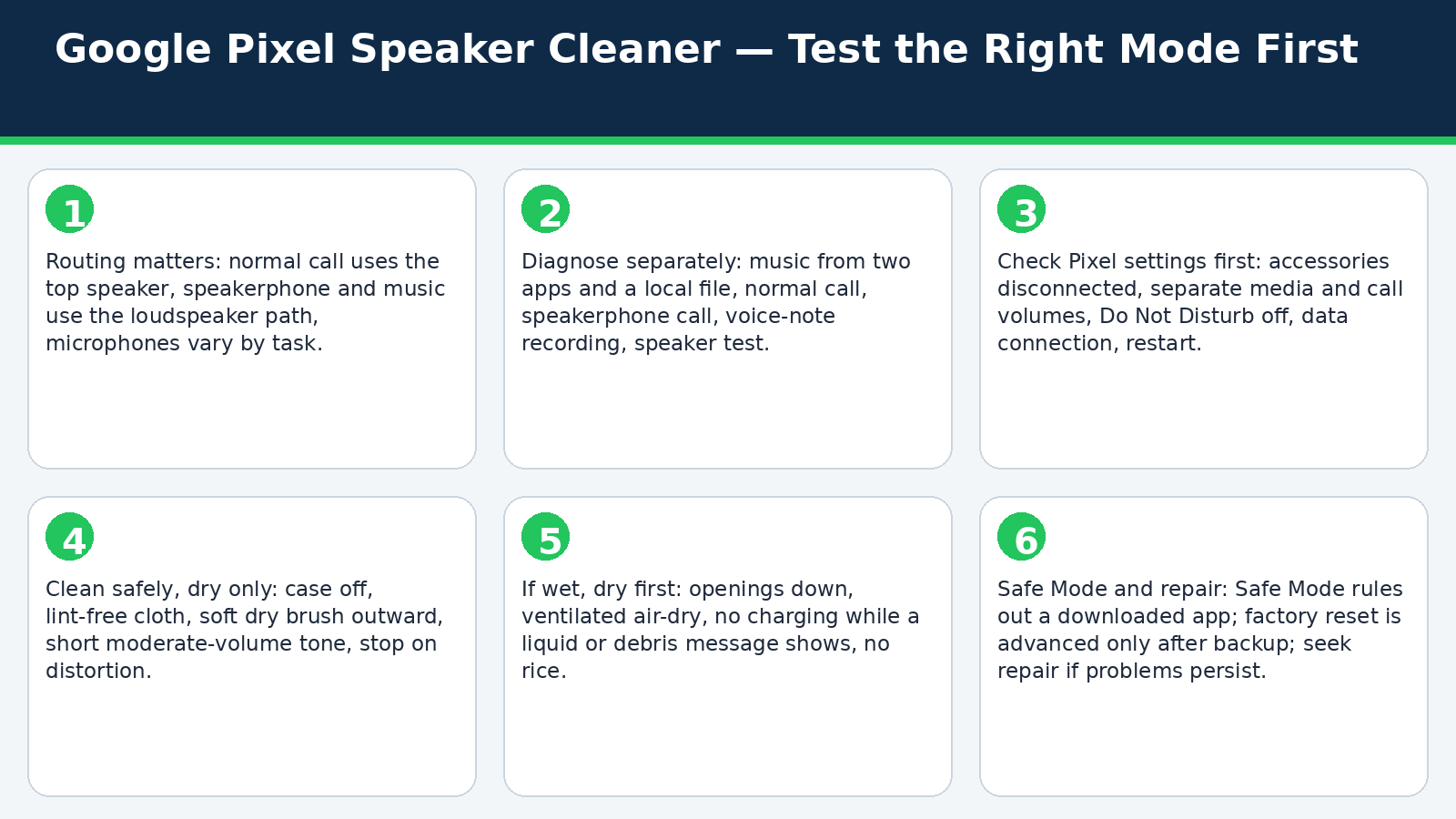
Pixel phones are the cleanest Android phones to troubleshoot, because their settings menus are close to stock Android, but they still confuse owners in one specific way: a Pixel does not use its speakers the same way for a call, for speakerphone, and for music. Once you understand that routing, most broken speaker reports turn into a settings, routing, or blockage check. This guide groups Pixel models together, from older Pixels to the newest models, and notes where a model differs.
Who this guide is for
This guide is for anyone whose Pixel sounds muffled, quiet, crackly, distorted or silent, whether after water, dust, a new app, or a software update. It covers Pixel phones only, not Google smart speakers or tablets. If a menu name below differs on your Pixel, search your Settings app for the setting name, or check Google’s Pixel support pages for your model.
It is not a repair manual. If your phone was fully submerged, shows a liquid or debris message, will not charge, or smells of burning, follow Google’s guidance and seek repair instead of repeating cleaning tones.
How Pixel sound routing works, and why it misleads tests
On Pixel phones, the top speaker handles ear-level calls, while the bottom speaker joins in for speakerphone and media playback. During music, the bottom speaker is normally louder than the top one. That means three common mistakes are easy to make: judging the bottom speaker from a normal ear call, judging the top speaker from music alone, and expecting both speakers to sound equally loud in every mode.
Test each mode separately. A normal call held to your ear tests the top speaker and the earpiece path. A speakerphone call tests the loudspeaker path. Music or video tests media playback through both speakers together. If only one mode fails, you have narrowed the problem to that path, and you should not clean or replace a speaker that was never tested.
Pixel microphones are also routed by task: different microphones are used for calls, video, and noise cancellation, so a recording test does not prove the call microphone is working, and a call test does not prove the recording microphone is working. Test both, and keep the microphone separate from the speaker in your diagnosis.
Diagnose first: test each part separately
Do these tests in a quiet room, with no Bluetooth device or USB-C audio accessory connected, and with the case removed.
Open Settings, then Sound and vibration, and raise Media volume to a comfortable level, not maximum. Ring and alarm volumes are separate controls and do not prove media sound works. Play two or three songs or videos from different apps, and include a locally saved video if possible, so a poor streaming connection does not confuse the test. Note whether sound is muffled, crackly, quiet, distorted or silent, and whether it fails in every app or only one.
Make a call and hold the phone normally to your ear, then enable Speaker and compare. Adjust call volume during the call, because call volume is separate from media volume. Record a short voice note and play it back to test the microphone. Check Settings, then Accessibility, then Audio adjustment, then Audio balance: if balance is off-centre, note its original position, centre it briefly for comparison, and restore any adjustment you need afterwards.
Then use the Speaker Test tool on this site to check for distortion or dropouts. If a test tone itself sounds distorted at a moderate volume, that points to a speaker problem rather than a simple blockage, and cleaning tones should stop.
Check the Pixel settings that route sound away
Google’s troubleshooting steps start with connection and feature checks, and this guide follows that order. First, check whether sound is playing through an accessory. If headphones, earbuds, a Bluetooth speaker, or a USB-C adapter is connected, sound plays through that accessory, not the phone speaker. Disconnect Bluetooth accessories and unplug USB-C audio accessories, then test again. On Pixel models with a 3.5 mm jack, check that no adapter or headphone is still attached.
Check Do Not Disturb and other silencing features. Do Not Disturb can silence calls and notifications even though music still plays, so a no sound report that only affects calls and alerts may be a setting, not a speaker fault. Check app-specific mute controls too: if sound fails in only one app, check that app’s mute and playback controls before changing phone-wide settings.
Check your data connection for streaming tests. Google’s guidance lists connection strength as a first check for unclear or low-volume sound, because a weak connection can make streamed music sound poor on a healthy speaker. That is why a locally saved file is part of the test above.
Restart the phone and test again. A restart clears temporary software glitches, and Google lists restart and test as a core step before advanced troubleshooting. Check for system updates as well, because audio bugs are sometimes fixed in updates, but do not treat an update as a cleaning method.
Clean a Pixel speaker safely
Dry cleaning only, and nothing inserted into any opening. Remove the case, wipe the outside of the grille with a dry, lint-free cloth, and use a soft, dry brush with light outward strokes. For the earpiece, use the same light strokes across its slot. Do not press a brush into the slot and never use a pin, needle or toothpick. For a microphone hole, wipe around the opening and brush lightly outward; do not insert anything, blow hard into it, or use liquid.
If the speaker still sounds muffled after dry cleaning, try a short browser tone at moderate volume, with the speaker facing down, using this site’s speaker cleaning tool or the Android Water Eject tool. Play one short cycle, then test with music. Repeat only once or twice more if the sound is clean and improving. Sound may help with light water or loose dust near a speaker opening. It is not a guarantee, and it does not repair a torn, corroded or electrically damaged speaker. Do not use high-pressure air at close range, and if packed dirt does not shift with brushing, stop; that is a repair-shop job.
If a Pixel gets wet
Water changes the order. Do not start by playing loud tones or plugging in a charger. Remove the case, wipe the outside dry with a lint-free cloth, and hold the phone with the speaker and port openings facing down. Power it off if you suspect liquid inside, and let it air-dry in a ventilated place. Google’s guidance specifically tells Pixel owners to check for a Liquid or debris in USB port message; do not charge while that message is shown, and follow Google’s wet-phone guidance for your model before charging or calling. Do not put the phone in rice.
Only after drying, and only if there is no liquid or debris message, test the loudspeaker at moderate volume with a short tone. If sound is still muffled after drying, or the phone was fully submerged or exposed to salt or soapy water, seek professional guidance. No specific charging-wait hour figure is given here, because guidance varies by model; follow Google’s instructions for your exact Pixel.
Use Safe Mode to test for an app problem
Pixel Safe Mode runs only pre-installed apps. The usual method is to press and hold the power button, then touch and hold Power off until a Safe Mode prompt appears, then tap Safe Mode. Menu wording varies by Android version, so use Google’s instructions if this path differs.
In Safe Mode, play music and make a test call. If the speaker works normally in Safe Mode but fails in normal mode, a downloaded app is the likely cause. Restart normally, then uninstall the most recently installed or updated audio-related apps one at a time, testing after each removal. If the speaker still fails in Safe Mode, the cause is more likely a setting, routing, blockage, water or hardware.
Troubleshooting
Only one mode fails: test that mode again separately. A normal-call failure points to the top speaker or call path; a speakerphone or music failure points to the loudspeaker path; a recording failure points to a microphone. Sound fails in one app only: check that app’s mute and playback controls, and test with a second app and a locally saved file. No sound at all: disconnect Bluetooth and USB-C accessories, check media volume separately from ring volume, check Do Not Disturb, and restart. Still muffled after water: air-dry longer, openings facing down, then try one more short tone. Do not charge while a liquid or debris message shows. Crackling or distortion: stop the tone. Distortion at moderate volume after drying may mean damage, not dirt. Works in Safe Mode only: uninstall recently added audio apps one at a time. Tone plays but nothing changes: that suggests packed debris, a setting, deeper water or damage, not a need for a higher frequency.
When to seek repair
Seek Google support or a qualified repair shop if sound stays distorted after gentle cleaning and drying; a speaker stays silent in Safe Mode and after settings checks; the phone was fully submerged or exposed to salt or soapy water; or you see corrosion, swelling, a cracked screen near a speaker, or a liquid or debris message that will not clear. Treat a factory reset as advanced troubleshooting only, after backing up your data, and only after the steps above; a reset will not fix a blocked grille, water damage or a damaged speaker.
Conclusion
For a Pixel, the safe order is: understand call, speakerphone and music routing, test each mode separately, disconnect accessories, check separate volumes and Do Not Disturb, restart, clean only the outside of the grille, try a short moderate-volume tone after drying, use Safe Mode to rule out an app, and stop on distortion or no change. That order avoids the Pixel-specific trap of judging the wrong speaker from the wrong test, and it keeps a wet or damaged phone away from louder tones and repeated app installs.
FAQ
Why does my Pixel sound fine on speakerphone but quiet on a normal call?
A normal call uses the top speaker and earpiece path, while speakerphone uses the loudspeaker path. Test both modes separately, check in-call volume during a call, and check whether a case or film covers the earpiece.
Is the bottom Pixel speaker supposed to be louder than the top one?
During music, yes, the bottom speaker is normally louder than the top one. Equal loudness is not the test for a healthy speaker. Judge each speaker in the mode that actually uses it.
How do I test a Pixel speaker properly?
Use music from two apps and a locally saved file, a normal call, a speakerphone call, and a voice-note recording, with no Bluetooth or USB-C accessory connected. Then use a speaker test tool to check for distortion or dropouts at moderate volume.
My Pixel shows a liquid or debris message. What should I do?
Do not charge the phone while that message is shown. Remove the case, wipe the outside dry, hold openings facing down, let the phone air-dry, and follow Google’s wet-phone guidance for your model before charging or calling.
Does Safe Mode help with Pixel speaker problems?
Yes. If sound works in Safe Mode but fails normally, a downloaded app is the likely cause. If sound still fails in Safe Mode, the cause is more likely a setting, routing, blockage, water or hardware problem.
Can a 50,000 Hz tone clean a Pixel speaker better?
No. A typical phone speaker cannot reliably reproduce 50,000 Hz, and a high-frequency label does not make a tone stronger. Use an audible, moderate-volume tone or sweep, and judge by a careful test afterwards.
Should I factory reset my Pixel for a speaker problem?
Only as advanced troubleshooting, after settings, routing, cleaning, drying and Safe Mode checks, and only after backing up your data. A reset will not fix a blocked grille, water damage or a damaged speaker.
Does speaker cleaner really work?
It can help in limited cases: light water or loose dust near a speaker opening. It is not a repair guarantee, it does not reliably remove embedded debris, and it does not fix a microphone or a charging port.
Related tools on this site
Related tools:
Related guides:
- Android Speaker Cleaner: A Safe Guide for Every Phone
- Speaker Cleaner Apps: Safe Use Without Installing One
- Speaker Cleaner Frequency
- Speaker and Microphone Cleaning
- iPhone Speaker Cleaner: A Safe Guide to Clearer Sound
- Does Speaker Cleaner Work?
- How to Clean Phone Speakers
- Phone Speaker Muffled
- Phone Speaker Crackling
- Phone Speaker Volume Low
- How to Test Speakers
- Clean Dust from Phone Speaker
- Clean Ear Speaker
- Phone Microphone Not Working
- Clean Charging Port Lint
Leave a Reply