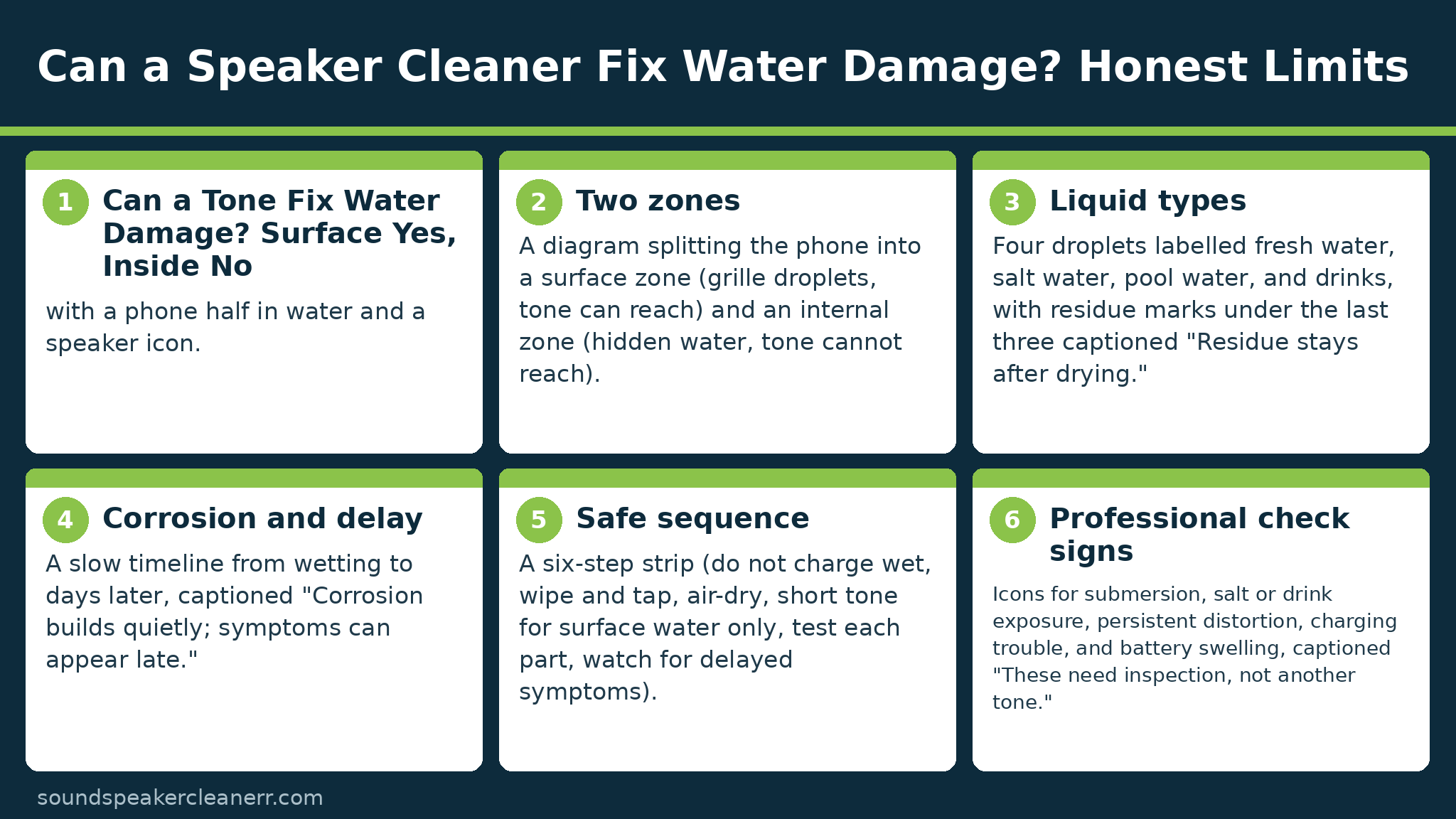
A speaker cleaner cannot fix water damage. It may help move a little surface water near the grille, but it cannot dry water inside the phone, remove salt or sugar residue, or stop corrosion. If a phone was submerged, sounds distorted after drying, or stops charging normally, it needs a professional check.
That distinction matters because the most dangerous water problems are the ones you cannot hear. A speaker that sounds fine after a splash can still have moisture inside, and moisture inside can corrode connections slowly, over days or weeks. A cleaning tone that clears the grille can make the phone sound normal while the real problem continues quietly. This guide separates surface water, which a tone may help with, from internal water damage, which it cannot fix, and lists the signs that mean drying time is not enough.
Surface water versus internal water
Think of a wet phone as having two zones. The surface zone is the outside of the phone and the shallow area just inside the speaker grille, where droplets sit on or near the mesh. This is the only zone a cleaning tone can reach, because the tone works by moving the speaker diaphragm, and that movement pushes air near the grille. A droplet sitting there can sometimes be moved toward the opening and out.
The internal zone is everything deeper: water that passed through the grille, a seam, or a port and reached the inside of the phone. A tone cannot reach this zone at all. Sound does not travel through the phone as a drying force, it does not evaporate water, and it does not push water out of sealed internal spaces. Water in the internal zone can sit on circuit boards, connectors, and the speaker's own internal parts, where it causes the two slow problems tones cannot touch: residue and corrosion.
How much water reached the internal zone depends on the exposure. A brief splash on the outside usually stays in the surface zone. A phone dropped in a pool, left in rain for a long time, or submerged under pressure is far more likely to have internal water, even if the speaker sounds only mildly muffled at first. Duration, depth, and the condition of the phone's seals all matter, and none of them can be judged from the outside with certainty.
What a tone can honestly do after water exposure
A tone has one honest job after water exposure: it may help move a small amount of surface water out of the speaker grille shortly after a splash of fresh water. If the phone sounds muffled right after a splash, the outside is wiped dry, and one or two short sessions at moderate volume with the speaker facing down clear the muffling, then surface water was likely the cause, and the tone did its job.
That is the full extent of it. A tone does not dry the phone, does not restore a water-damaged speaker, and does not make a submerged phone safe to charge. If the muffling returns after the phone dries, or if it never fully clears, the problem is no longer surface water. Continuing to run tones at that point does not help and can stress a speaker that is already struggling. Try the Water Eject tool only in that narrow surface-water case, and read Does Speaker Cleaner Work for the broader limits.
Why the type of liquid matters
Not all water is the same for a phone, and a tone treats all of them the same — which is exactly the problem.
Fresh water from a splash or brief rain exposure leaves the least residue. Once it evaporates, there may be little left behind, which is why a splash is the case where a tone is most likely to help.
Salt water leaves salt behind when it dries. Salt is corrosive to metal contacts and can keep attracting moisture even after the phone looks dry. Sound cannot remove dried salt, because salt is a solid residue, not a droplet. A phone exposed to salt water needs fresh-water rinsing guidance from its maker or a professional clean, not a tone.
Pool water contains chemicals that can leave residue and affect seals and coatings. Like salt water, it is not just water, and drying alone does not remove what it leaves behind.
Drinks — juice, soda, coffee, milk — leave sugar, acids, or fats behind as they dry. These residues are sticky, can attract dust, and can interfere with moving parts. A tone cannot dissolve or remove them, and sugary residue is a common reason a speaker sounds muffled long after the liquid itself is gone. For spill-specific guidance, see the coffee spill, juice spill, mud, milk spill and soda spill guides, and Phone Speaker Troubleshooting.
If the liquid was anything other than fresh water, do not treat a cleared grille as a cleared phone. The residue problem remains even when the sound improves.
Corrosion: the damage a tone cannot see or stop
Corrosion is the slow chemical change that happens when water, especially salty or mineral-rich water, sits on metal parts inside a phone. It can appear as green or white buildup on connectors, but it often starts invisibly, inside the phone, where no tone and no outside inspection can see it.
Corrosion matters for three reasons. First, it is progressive: it continues after the phone looks dry, because the chemical reaction does not need standing water to continue once it has started. Second, it affects connections, so its symptoms can look like unrelated faults — a speaker that crackles, a charging port that works intermittently, a button that responds slowly. Third, it is permanent in the sense that sound cannot reverse it. Once a connection is corroded, it needs cleaning or replacement by someone who can open the phone and reach the part.
You cannot test for corrosion from the outside. If a phone was submerged, exposed to salt water, or shows delayed symptoms after a wetting event, corrosion should be considered possible even if the phone currently works. That is a reason for a professional check, not for reassurance from a tone.
Delayed failure: why "it worked yesterday" is not proof
One of the most misleading outcomes after water exposure is a phone that seems fine, then fails days or weeks later. Delayed failure happens because internal water takes time to cause its effects. A connection may work while it is still wet, then fail as corrosion builds. A speaker may sound normal while residue is still soft, then muffle as the residue hardens. A battery or charging circuit may behave normally until a corroded contact finally breaks connection.
Delayed failure is also why a tone's short-term success can be misleading. If a tone clears the grille and the phone sounds fine for a day, it is tempting to conclude the phone is fixed. The honest conclusion is narrower: the grille is clear. The internal zone has not been checked, and its condition will reveal itself over time, not in the first sound test. If any delayed symptom appears — new distortion, intermittent sound, charging problems, overheating, or a swollen battery — stop using the phone normally and get it checked promptly. A swollen battery in particular is a safety issue, not a cleaning problem, and the phone should not be charged or used until it is inspected.
What to do instead of relying on a tone
For a phone that has been exposed to water, the safe sequence is:
- Power and charging safety first. If the phone is on and working, do not charge it while any part, especially the charging port, is wet. Follow your phone maker's guidance for wet devices, which takes priority over any article or video. See Water in Charging Port.
- Wipe and tap gently. Wipe the outside with a soft, dry cloth. Tap gently with the speaker facing down so loose droplets can fall out. Do not use heat, compressed air, cotton swabs pushed into openings, or rice. See Dry Phone Without Rice.
- Air-dry with patience. Leave the phone in open air with good airflow. Do not seal it in a container, and do not rush this step because the speaker sounds better.
- Try a tone only for surface water. If the phone was only splashed with fresh water, the outside is dry, and the speaker is muffled, one or two short sessions at moderate volume are reasonable. If they do not help, stop.
- Test each part separately. Check the loudspeaker, the earpiece, and the microphone, and check charging only once the phone is completely dry. Note anything that is distorted, intermittent, or missing. The Speaker Test and Mic Test tools help here.
- Watch for delayed symptoms. For at least the days following a significant wetting, pay attention to new distortion, charging trouble, or unusual heat. Any of these means a professional check, even if the phone sounded fine at first.
Signs that need a professional check
Arrange a professional inspection if any of these apply:
- The phone was submerged, not just splashed, or stayed underwater for more than a moment.
- The liquid was salt water, pool water, or a drink rather than fresh water.
- Sound stays distorted, crackling, or muffled after the phone is fully dry.
- Sound cuts in and out, or a speaker part stops working entirely.
- Charging is intermittent, slow, or fails, or the port shows discoloration or buildup.
- The phone shows new symptoms days or weeks after the wetting event.
- The battery swells, the phone overheats, or the back or screen lifts — stop charging and using the phone and get it inspected promptly.
A professional check is not an admission that the phone is ruined. Many water-exposed phones are inspected, cleaned internally, and returned working. The check is how you find out whether the damage is surface-only or internal, and it is the only method that can actually see the internal zone a tone cannot reach.
The honest bottom line
A speaker cleaner is a surface tool, and water damage is often an internal problem. That mismatch is the whole story: the tool can clear a grille, but it cannot dry a phone, remove residue, or stop corrosion. Using it for surface water after a fresh splash is reasonable. Using it as proof that a submerged or salt-water phone is fixed is not. When the exposure was serious, the liquid was not fresh water, or symptoms persist or appear late, the honest next step is drying time plus a professional check — not another tone.
FAQ
Can a speaker cleaner fix a water damaged phone?
No. A tone may move surface water near the grille, but it cannot dry water inside the phone, remove residue, or stop corrosion. Water damage needs drying time and, for serious exposure, a professional check.
My phone sounds fine after a tone. Is it fixed?
Not necessarily. A clear grille does not prove the inside is dry or undamaged. Watch for delayed symptoms such as new distortion, charging trouble, or unusual heat in the days after the wetting.
Does salt water damage differ from fresh water damage?
Yes. Salt water leaves corrosive salt residue when it dries, which sound cannot remove. A salt-water phone should be checked professionally even if it sounds fine at first.
Can a tone remove sugar or drink residue from a speaker?
No. Sugar, acids, and fats dry into sticky residue that sound cannot dissolve or dislodge. Residue needs a professional clean, not more tones.
How long should I wait before charging a wet phone?
Until the phone, including the charging port, is completely dry, following your phone maker's guidance. No specific hour figure is given here because guidance varies by maker and model — check the maker's own support page for your phone.
What is delayed water damage?
Damage that appears days or weeks after the wetting, as corrosion builds or residue hardens. A phone that works at first can develop distortion, charging problems, or other faults later.
Should I keep running tones if the speaker stays muffled after drying?
No. Persistent muffling after full drying points to residue, corrosion, or damage, not surface water. Stop running tones and arrange a professional check.
Is a swollen battery after water exposure a cleaning problem?
No, it is a safety issue. Do not charge or use the phone; get it inspected promptly.
Leave a Reply