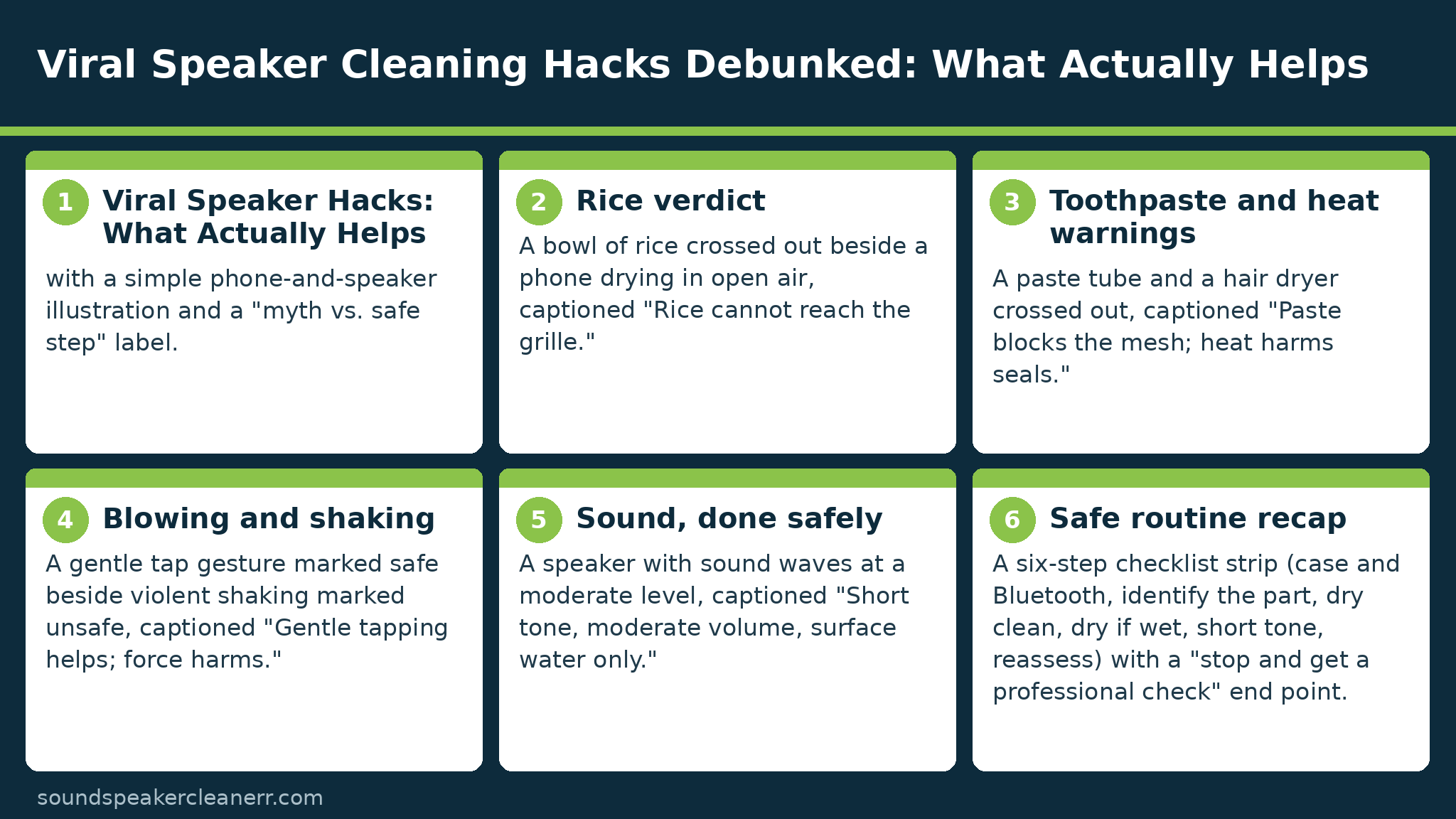
Most viral speaker cleaning hacks do not work, and a few can damage your phone. Rice cannot pull water from a grille, toothpaste can block the mesh, and hot air can harm seals. Start instead with a gentle dry clean and, for surface water, a short tone at moderate volume.
Short videos make every hack look instant. A phone goes into a bowl, a paste goes on a grille, a dryer blows for ten seconds, and the sound comes back loud and clear. What the video rarely shows is the phone that got worse, the mesh that stayed blocked, or the problem that was never dirt at all. This guide judges each popular hack on its own, explains why it fails or helps, and gives you the safe alternative for the same situation.
Why viral hacks look convincing
A hack video has three advantages over real advice. First, it shows one phone, one time, with no follow-up. If the sound improves for any reason — the phone dried on its own, a setting changed, a case came off — the hack gets the credit. Second, it skips the phones where the hack did nothing, because a failed demo makes a boring video. Third, it treats every muffled speaker as the same problem, when muffled sound has several different causes: surface water, loose dust, packed lint, a settings change, a Bluetooth connection, or physical damage.
That is why the honest test for any hack is narrow. Does it address the actual cause? Does it reach the part it claims to clean? And can it cause new damage while it tries? A hack that fails any of those three questions is not worth trying, even if it worked once on camera.
Hack 1: Put the phone in rice
Verdict: Does not help the speaker, and it can add a new problem.
The rice claim is that dry rice absorbs moisture from a wet phone. Rice does absorb some moisture from the air around it, but a speaker grille is a tiny opening, and the water that matters is trapped in or behind that mesh, not sitting in the bowl. Rice grains cannot reach into the grille, and they cannot pull water out of a mesh by contact through air. Independent testing of viral fixes has judged the rice claim as fake, and manufacturer guidance for wet phones points away from rice toward wiping the outside, tapping gently with the opening facing down, and leaving the phone in open air to dry.
Rice also brings its own risks. Fine rice dust and starch can settle into openings, and small grains or fragments can lodge near a grille or charging port. A phone left in rice is also a phone that is not drying in open airflow, which is the drying method manufacturers actually recommend. If the phone was only splashed, the safer path is to wipe the outside with a soft, dry cloth, keep the speaker facing down so loose droplets can fall out, and let the phone air-dry before testing it again. For a phone that was submerged, rice is not a substitute for drying time or a professional check. See also Phone Fell in Water and Dry Phone Without Rice.
Safe alternative: Open-air drying, a soft dry cloth, and a short tone at moderate volume only after the outside is dry — and only for surface water near the grille.
Hack 2: Rub toothpaste on the speaker
Verdict: Harmful. Do not do this.
Toothpaste shows up in viral videos as a polish for screens and a cleaner for grilles, because it contains mild abrasives and looks like a cleaning paste. On a speaker, those same properties are the problem. A paste does not flow out of a fine mesh the way water does. It dries in the holes, adds a new layer of blockage on top of whatever dust was already there, and its abrasive particles can scratch surrounding surfaces. Some toothpastes also contain flavorings, whitening agents, or other ingredients that were never meant for electronics and can leave residue that attracts more dust later.
There is no version of this hack that is safe for a speaker grille: not a small dab, not a soft brush, and not a rinse afterward, because rinsing a phone speaker to remove paste puts more liquid into the very part you were trying to clean. If toothpaste or any paste has already been applied, wipe only the outside gently with a dry, soft cloth, do not push anything into the grille to scrape it out, and if sound stays muffled, treat it as a blockage that needs a gentle dry clean or a professional look — not more paste.
Safe alternative: A dry, soft-bristled brush used lightly across the grille surface, or a soft dry cloth. Never a paste, liquid cleaner, or sharp object.
Hack 3: Blow-dry the speaker with a hair dryer
Verdict: Risky. Heat and forced air can make things worse.
A hair dryer seems logical: heat dries water, and airflow pushes it out. On a phone, both parts of that logic backfire. Heat can soften adhesives that seal the phone, stress the battery, and warp thin mesh or plastic parts. Forced hot air can also drive water and dust deeper into the phone instead of out of it, especially if the air is aimed straight into a small opening. Manufacturer guidance for wet phones consistently warns against external heat sources, and that warning exists because the damage from heat is often invisible until a seal fails or a part stops working later.
Warm air from a distance is sometimes suggested online as a gentler version, but it is still unnecessary. Open air at room temperature dries a phone without adding heat risk, and it costs nothing. If you are tempted to use a dryer because the phone still sounds muffled after drying, the muffled sound is more likely to be residue, packed dust, or damage — none of which heat fixes.
Safe alternative: Room-temperature air drying with good airflow, speaker facing down, and no charging until the phone is completely dry. Follow your phone maker's guidance for wet devices, which takes priority over any video.
Hack 4: Blow hard into the speaker grille
Verdict: Mostly useless, and it can push debris deeper.
Blowing into a grille feels like it should clear it, the way blowing clears dust off a surface. The problem is scale and direction. A speaker mesh has very small holes, and the debris blocking it is often lint or dust that is wedged in, not sitting loosely on top. A puff of breath is warm, moist air, so it adds a little moisture while failing to dislodge wedged debris. Hard blowing can also push a loose particle further into the mesh rather than out of it, turning a surface blockage into a deeper one.
Breath is not compressed air, and compressed air is not recommended for phone speakers either — a strong, narrow jet can damage a delicate diaphragm or mesh. The gentle version of this idea, brushing the surface lightly with a dry soft brush, works better because it lifts debris off the surface instead of forcing it inward.
Safe alternative: Light brushing across the grille with a dry, soft brush, then a sound test. If the blockage is packed in, stop and get a professional clean rather than forcing it.
Hack 5: Shake the phone violently to throw the water out
Verdict: Gentle tapping can help; violent shaking can harm.
This hack has a kernel of truth, which is why it survives. Tapping a phone gently with the speaker facing down can let loose droplets fall out of the grille, and that is a step manufacturers themselves suggest as part of drying a wet phone. The viral version goes further: shake hard, spin the phone, or slap it against a hand. Violent shaking risks a dropped phone, a loose internal part being knocked further out of place, and water being driven from the grille area into other parts of the phone.
The safe version is boring on purpose. Hold the phone firmly, speaker facing down, and tap it gently against your palm a few times. Wipe away any droplets that appear. Then stop, let the phone air-dry, and test the sound. If shaking becomes your main method, you are probably dealing with water that is not near the grille anymore, and no amount of shaking will reach it.
Safe alternative: Gentle downward tapping, wiping, and air drying. Never violent shaking, and never charge a wet phone.
Hack 6: Play a "magic" cleaning sound at maximum volume
Verdict: Partly true, but the viral version overpromises.
Sound-based cleaning is the one viral idea with a real mechanism. A speaker makes sound by moving its diaphragm, and that movement can push air near the grille, which can sometimes move a droplet of water or a loose particle toward the opening. That is a narrow, modest effect, and honest guides say so. The viral version claims much more: that any sound, at maximum volume, will clean any speaker, remove all water and dust, and fix distortion or crackling.
Maximum volume is where this hack turns risky. A damaged or waterlogged speaker played at full volume can distort, and repeated long sessions at high volume stress the speaker without improving the result. Moderate volume is the safer choice, and short sessions are enough to test whether surface water or loose dust was the problem. If one or two short sessions at moderate volume do not help, more volume and more sessions will not fix a deeper cause. Sound also cannot clean a microphone or a charging port, because those parts do not move like a speaker, and it cannot repair a torn diaphragm or corrosion. Try the browser-based Water Eject tool or Dust Cleaner tool for surface water or loose dust, and read Does Speaker Cleaner Work for the full limits.
Safe alternative: A short tone at moderate volume, speaker facing down, with the phone's outside already dry — then a sound test, then drying time if the problem remains.
The safe routine that replaces all six hacks
When a speaker sounds muffled, work in this order instead of reaching for a viral fix:
- Check the obvious first. Remove the case, turn off Bluetooth so audio is not going to another device, and check media volume. A surprising number of "broken" speakers are a case covering the grille or audio routed elsewhere.
- Identify which part is affected. Test the loudspeaker with music, the earpiece with a call, and the microphone with a voice recording. Each part has a different fix, and a speaker tone only targets the speaker parts.
- Dry clean gently. Brush the grille lightly with a dry, soft brush or wipe with a dry, soft cloth. Do not insert anything into the grille.
- If the phone is wet, dry it first. Wipe the outside, tap gently with the speaker facing down, and air-dry in open air. Do not charge until completely dry, and follow your phone maker's guidance.
- Try a short tone at moderate volume. Use it only for surface water or loose dust near the grille. One or two short sessions, then a sound test.
- Stop and reassess if nothing changes. Persistent muffling, crackling at every volume, distortion after drying, or no sound at all are signs of packed debris, residue, or damage. Those need a professional check, not a stronger hack. See Phone Speaker Troubleshooting and Clean Phone Safely.
How to spot the next viral hack before you try it
Ask four questions about any speaker hack you see online. First, does it reach the part it claims to clean, or does it just sit on the outside? Second, does it add something to the phone — paste, heat, moisture, starch — that will be harder to remove than the original problem? Third, does it promise to fix every cause, including damage, with one trick? Fourth, does it contradict the phone maker's own guidance for wet or damaged devices? If any answer is worrying, skip the hack. The safe routine above is less dramatic than a viral video, but it is the routine that leaves your phone in the same condition it started in — or better.
FAQ
Does putting a phone in rice clean the speaker?
No. Rice cannot reach water trapped in or behind a speaker grille, and rice dust can add a new blockage. Wipe the outside, tap gently with the speaker facing down, and air-dry in open air instead.
Can toothpaste clean a phone speaker grille?
No, and it can make the problem worse. Toothpaste dries in the fine mesh, adds blockage, and can scratch nearby surfaces. Use only a dry, soft brush or cloth on the grille.
Is it safe to use a hair dryer on a wet phone speaker?
No. Heat can soften seals and stress internal parts, and forced air can push water deeper. Room-temperature air drying is the safer method, and your phone maker's guidance takes priority.
Does blowing hard into the speaker help?
Usually not. Breath is moist air, and hard blowing can push debris deeper into the mesh. Light brushing across the grille surface is a better way to lift surface dust.
Can shaking the phone remove water from the speaker?
Gentle tapping with the speaker facing down can let loose droplets fall out, but violent shaking risks dropping the phone or driving water deeper. Tap gently, wipe, and air-dry.
Does a speaker cleaning sound work at maximum volume?
A tone can sometimes move surface water or loose dust near the grille, but maximum volume does not improve that effect and can stress a damaged speaker. Use moderate volume and short sessions, then test the sound.
What should I do if no hack fixes the muffled sound?
Check Bluetooth, volume, and the case first, then test the loudspeaker, earpiece, and microphone separately. If muffling, crackling, or distortion persists after gentle cleaning and drying, get a professional check rather than trying a stronger hack.
Can a speaker cleaning tone clean the microphone or charging port?
No. A tone moves a speaker diaphragm, which is not how a microphone or charging port works. Those parts need their own approach, and a wet charging port must air-dry completely before charging.
Leave a Reply