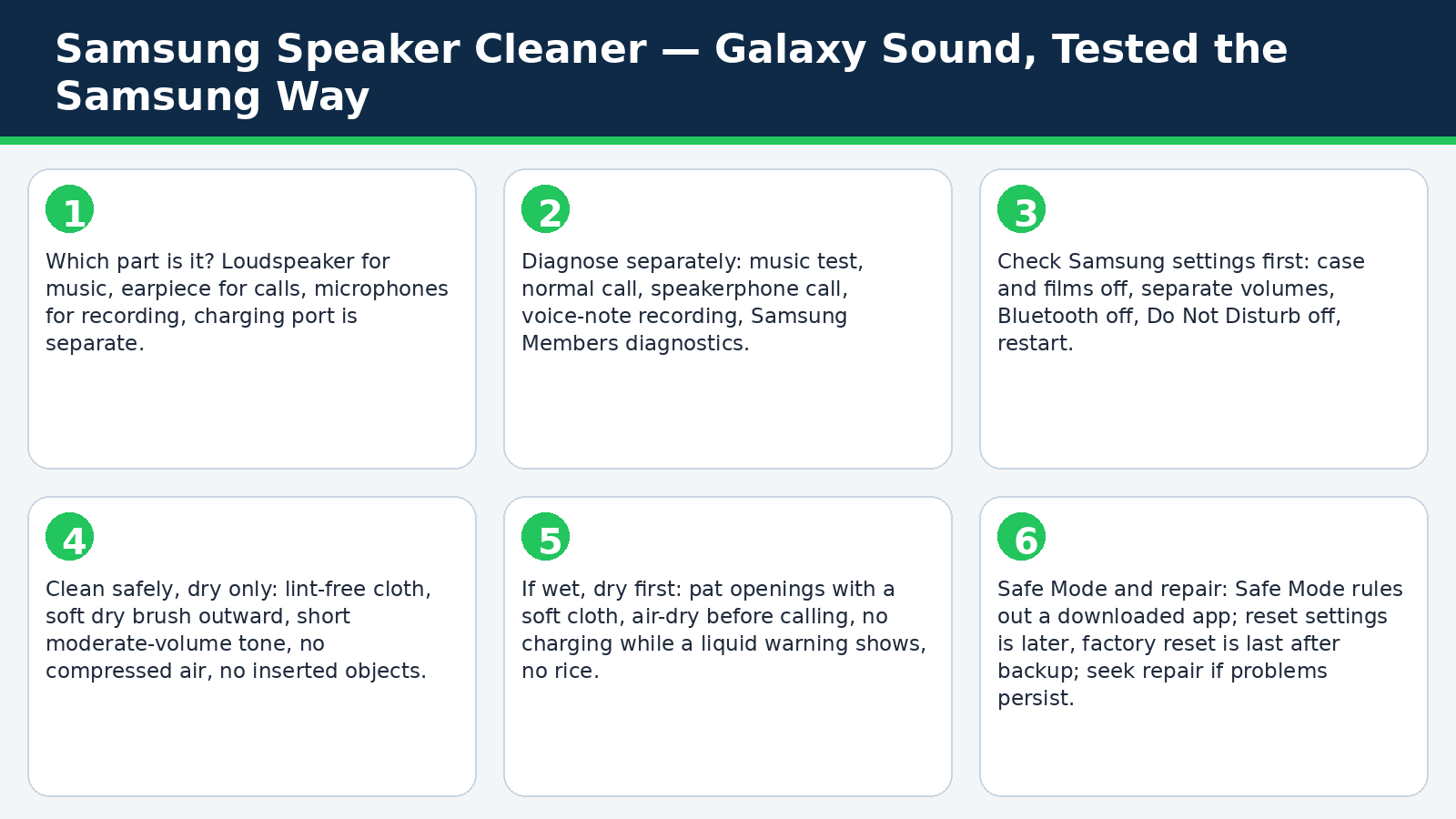
Samsung Galaxy phones share the same safe speaker approach as other Android phones, but they add two Samsung-specific tools that are worth using before you install anything: the diagnostics in the Samsung Members app, and Samsung’s own step order for calls, Safe Mode and wet phones. This guide groups Galaxy S, Galaxy A and Galaxy M models together, because their speakers fail for the same reasons even though their exact layouts and One UI menus differ.
Who this guide is for
This guide is for anyone whose Galaxy phone sounds muffled, quiet, crackly or silent, whether after water, dust, a new app, or a software update. It does not replace Samsung’s instructions for your exact model. If a menu name below differs on your phone, search your Settings app for the setting name, or check Samsung’s support pages for your model.
It is not a repair manual. If your phone was fully submerged, shows a liquid warning, will not charge, or smells of burning, follow Samsung’s guidance and seek repair instead of repeating cleaning tones.
The Galaxy speakers and microphones, in plain terms
A Galaxy phone normally has a loudspeaker, usually at the bottom edge, and a smaller earpiece at the top for normal calls. Many Galaxy models use both together for stereo media sound. It also has more than one microphone: one near the bottom for calls, and others used for noise cancellation and video. Those parts fail differently, and testing them separately is the fastest way to avoid a wrong fix.
Music that sounds muffled points to the loudspeaker. Callers who sound quiet while speakerphone sounds fine point to the earpiece. Callers who cannot hear you while you hear them fine point to a microphone. A cable that will not click in, or charging that only works at an angle, points to the charging port, which sound does not clean. Keep those four parts separate before you clean anything.
Diagnose first: test each part separately
Do these tests in a quiet room, with no Bluetooth device connected and the case removed, so a case or film cannot hide the result.
Play music or a video at a moderate volume and note whether it is muffled, crackly, quiet or silent. Then use the Speaker Test tool on this site to check for distortion or dropouts. Make a normal call without speakerphone and listen through the earpiece, then switch the same call to speakerphone and listen through the loudspeaker. Record a short voice note and play it back to test the microphone. If only one test fails, you have narrowed the problem to that part.
Samsung Members adds a second, useful check. Open Samsung Members, go to Support, then Phone diagnostics, and run the speaker and microphone tests offered there. A diagnostics pass does not prove the speaker is perfect, and a diagnostics fail does not by itself prove hardware damage, but a clear difference between the loudspeaker test, the earpiece test and the microphone test helps you describe the problem accurately, whether you fix it yourself or take it to a service centre.
Check the Samsung settings that mimic a broken speaker
Samsung’s support steps start with the simplest causes, and this guide follows that order. First, remove any case, screen protector or film that covers a speaker or microphone opening, and test again. A poorly placed protector is one of the most common causes of distorted call sound, and it costs nothing to rule out.
Next, check volumes separately. In-call volume can only be adjusted during a call, using the side volume keys, while media volume is adjusted during music or video. Open Settings, then Sound and vibration, then Volume, and check that media volume is up. Turn Bluetooth off temporarily, because sound may be routing to earbuds, a car system or a Bluetooth speaker instead of the phone. Check Do Not Disturb as well: it can silence calls and notifications even though music still plays.
Restart the phone and test again. A restart clears temporary software glitches that affect audio, and Samsung lists it before deeper steps for a reason. If sound fails in only one app, check that app’s permissions and mute controls before changing phone-wide settings, and test with a second app and a locally saved file so a streaming problem does not confuse the result.
Clean a Galaxy speaker safely
Dry cleaning only, and nothing inserted into any opening. Wipe the outside of the grille with a dry, lint-free cloth, then use a soft, dry brush with light outward strokes. For the earpiece, use the same light strokes across its slot. Do not press a brush into the slot and never use a pin, needle or toothpick. For a microphone hole, wipe around the opening and brush lightly outward; do not insert anything, blow hard into it, or use liquid, because a microphone membrane is delicate.
If the speaker still sounds muffled after dry cleaning, try a short browser tone at moderate volume, with the speaker facing down, using this site’s speaker cleaning tool or the Android Water Eject tool. Play one short cycle, then test with music. Repeat only once or twice more if the sound is clean and improving. Sound may help with light water or loose dust near a speaker opening. It is not a guarantee, and it does not repair a torn, corroded or electrically damaged speaker.
Do not use canned compressed air for drying or cleaning, even though some community posts suggest it. Samsung’s own guidance warns against cans of compressed air, and high-pressure air at close range can push debris deeper or damage a mesh. If packed dirt does not shift with brushing, stop; that is a repair-shop job.
If a Galaxy phone got wet
Water changes the order. Do not start by playing loud tones or plugging in a charger. Remove the case, wipe the outside dry, and hold the phone with the speaker and port openings facing down. Samsung’s guidance for a wet phone is to pat the earpiece, primary microphone, external speaker and USB port with a clean, soft cloth, and to let the phone air-dry before calling. If the phone got wet with salt water, Samsung’s guidance is to wash with fresh water and then dry thoroughly, because salt can block the microphone, earpiece or speaker; follow Samsung’s full wet-phone instructions for your model rather than improvising.
Do not charge while a liquid warning is shown, and do not put the phone in rice. Only after drying, and only if there is no liquid warning, test the loudspeaker at moderate volume with a short tone. If sound is still muffled after drying, or the phone was fully submerged or exposed to salt or soapy water, seek professional guidance. No specific charging-wait hour figure is given here, because guidance varies by model; follow Samsung’s instructions for your exact phone.
Use Safe Mode to test for an app problem
Samsung’s Safe Mode steps are: swipe down to open Quick Settings, tap the power icon, touch and hold Power off until the Safe Mode prompt appears, then tap Safe Mode. In Safe Mode, only pre-installed apps run. Play music and make a test call. If the speaker works normally in Safe Mode but fails in normal mode, a downloaded app is the likely cause. Restart normally, then uninstall the most recently installed or updated audio-related apps one at a time, testing after each removal. If the speaker still fails in Safe Mode, the cause is more likely a setting, blockage, water or hardware.
If Safe Mode does not identify an app, Samsung’s later steps include resetting all settings, which resets network, accessibility and other settings while keeping your data, and, as a last resort, a factory reset after backing up your data. Do not start with a factory reset. A reset will not fix a blocked grille, water damage or a damaged speaker.
Troubleshooting
Still muffled after water: air-dry longer, speaker facing down, then try one more short tone. Do not charge while a liquid warning shows. Crackling or rattling: stop the tone. Crackling at moderate volume can mean debris, distortion or damage. Do not raise the volume to push through it. Callers sound quiet, speakerphone sounds fine: check the earpiece, in-call volume during a call, and any case or film covering the earpiece. Callers cannot hear you: check microphone permissions, a case covering a mic hole, and Bluetooth routing, then test with Voice Recorder. Sound low but clear: check media volume, Sound and vibration settings, and whether a case blocks the grille. Works in Safe Mode only: uninstall recently added audio apps one at a time. Tone plays but nothing changes: that suggests packed debris, a setting, deeper water or damage, not a need for a higher frequency.
When to seek repair
Seek Samsung service or a qualified repair shop if sound stays distorted after gentle cleaning and drying; a speaker stays silent in Safe Mode and after resetting settings; the phone was fully submerged or exposed to salt or soapy water; or you see corrosion, swelling, a cracked screen near a speaker, or a liquid warning that will not clear. Bring a clear description: when it started, whether water or dust was involved, what diagnostics showed, and what you already tried.
Conclusion
For a Galaxy phone, the safe order is: remove the case and films, test loudspeaker, earpiece and microphone separately, run Samsung Members diagnostics, check separate volumes, Bluetooth and Do Not Disturb, restart, clean only the outside of the grille, try a short moderate-volume tone after drying, use Safe Mode to rule out an app, and stop on distortion or no change. That order uses Samsung’s own tools first, and it avoids the two most common mistakes: cleaning the wrong part, and playing louder tones at a wet or damaged phone.
FAQ
Does Samsung have a built-in speaker cleaner tone?
No built-in cleaning tone is claimed here. Samsung’s own tools are diagnostics in Samsung Members and its support troubleshooting steps. A browser tool on this site gives the short tone test without installing an app.
How do I run a Samsung speaker test?
Open Samsung Members, go to Support, then Phone diagnostics, and run the speaker and microphone tests offered there. Also test with music, a normal call, a speakerphone call, and a voice-note recording, because each test covers a different part.
Why do callers sound quiet but music sounds fine?
Music uses the loudspeaker, while a normal call uses the earpiece. Check the earpiece for a covering case or film, adjust in-call volume during a call, turn Bluetooth off, and test the earpiece separately from the loudspeaker.
Should I use compressed air on a Galaxy speaker?
No. Samsung’s guidance warns against cans of compressed air for drying and cleaning. Use a dry, lint-free cloth and a soft, dry brush with light outward strokes, and stop if packed dirt does not shift.
My Galaxy phone got wet. Can I charge it right away?
No, not while a liquid warning is shown. Pat the openings with a clean, soft cloth, let the phone air-dry, and follow Samsung’s wet-phone guidance for your model before charging or calling.
What does Safe Mode prove on a Samsung phone?
If sound works in Safe Mode but fails normally, a downloaded app is the likely cause. If sound still fails in Safe Mode, the cause is more likely a setting, blockage, water or hardware, and deeper settings or repair steps are needed.
Can a 50,000 Hz tone clean a Galaxy speaker better?
No. A typical phone speaker cannot reliably reproduce 50,000 Hz, and a high-frequency label does not make a tone stronger. Use an audible, moderate-volume tone or sweep, and judge by a careful test afterwards.
Does speaker cleaner really work?
It can help in limited cases: light water or loose dust near a speaker opening. It is not a repair guarantee, it does not reliably remove embedded debris, and it does not fix a microphone or a charging port.
Related tools on this site
Related tools:
Related guides:
- Android Speaker Cleaner: A Safe Guide for Every Phone
- Speaker Cleaner Apps: Safe Use Without Installing One
- Speaker Cleaner Frequency
- Speaker and Microphone Cleaning
- iPhone Speaker Cleaner: A Safe Guide to Clearer Sound
- Does Speaker Cleaner Work?
- How to Clean Phone Speakers
- Phone Speaker Muffled
- Phone Speaker Crackling
- Phone Speaker Volume Low
- How to Test Speakers
- Clean Dust from Phone Speaker
- Clean Ear Speaker
- Phone Microphone Not Working
- Clean Charging Port Lint
Leave a Reply