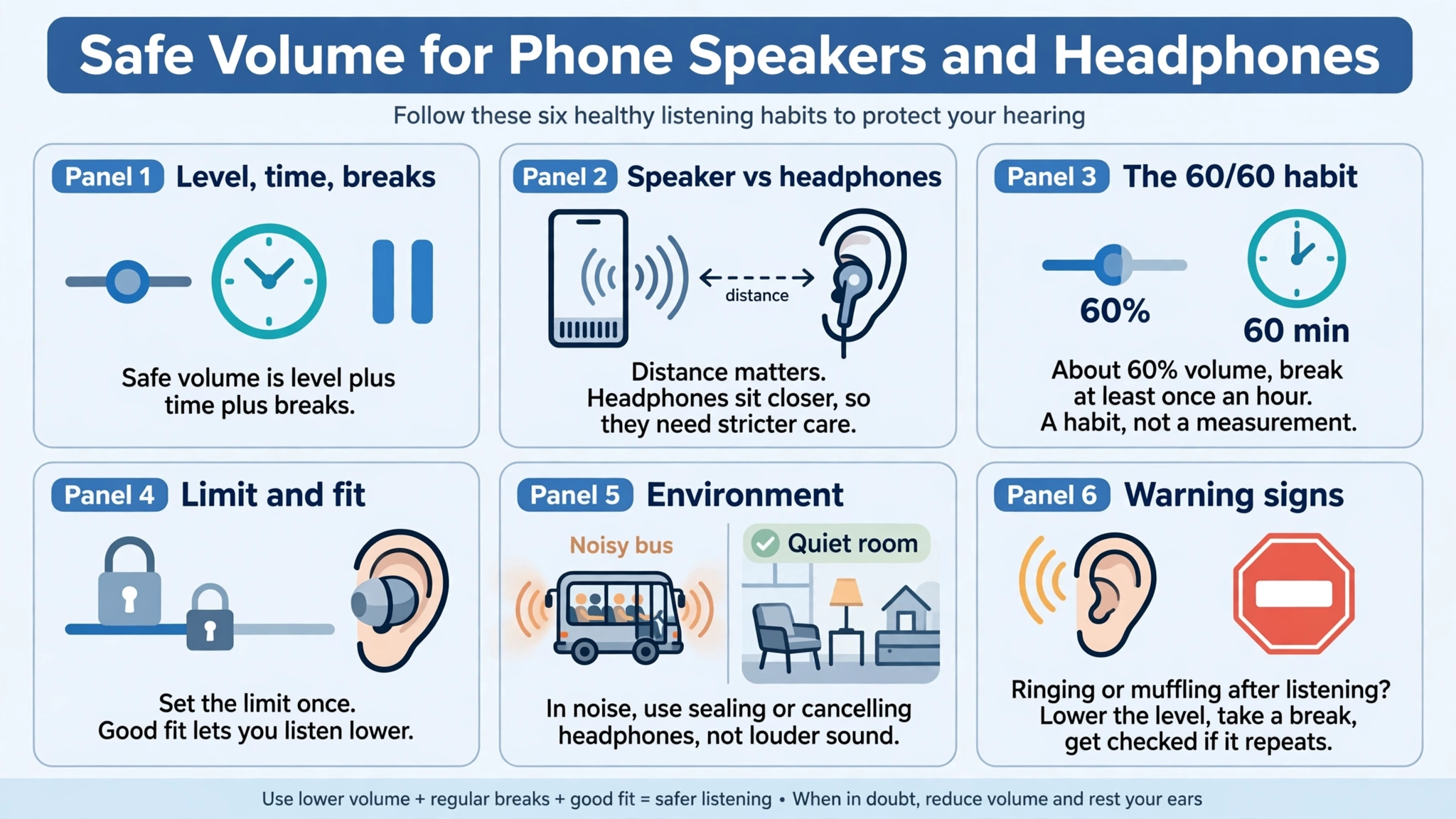
Safe volume is not a single number on a slider. It is a combination of how loud the sound is, how long you listen, how close the sound source is to your ears, and how often you give your ears a quiet break.
That combination matters because phone speakers and headphones behave differently. A phone speaker sits at arm's length and spreads sound into a room. Headphones and earbuds sit in or on your ears and deliver sound directly to them. The same volume percentage can therefore mean very different exposure in each case, and a habit that is safe for a speaker in a quiet room may not be safe for earbuds on a noisy bus.
The direct answer: level, time, and breaks together
Keep everyday listening at a moderate level, well below maximum, take a break at least once an hour, and use your phone's built-in volume limit and exposure tracking where available. A widely cited practical habit is the 60/60 rule: no more than about 60% of maximum volume, and no more than about 60 minutes of continuous listening before a break.
Treat that rule as a habit, not as a precise measurement. As hearing guidance notes, 60% on one phone with one pair of headphones is not the same decibel level as 60% on another phone with different headphones. The rule is useful because it is easy to remember and conservative for most everyday listening, but it does not replace a volume limit, exposure tracking, or attention to warning signs. If sound feels loud, if you need to raise your voice to be heard over it, or if your ears ring afterward, the level was too high for that session, whatever the slider showed.
Why headphones need stricter care than phone speakers
Distance is the main difference. Sound weakens as it travels away from its source, so a phone speaker at arm's length delivers less energy to your ears than earbuds sealed in your ear canal at the same nominal volume. Earbuds also block less outside noise unless they fit well, which tempts you to raise the volume to overcome traffic, a train, or a busy room.
Over-ear headphones sit farther from the eardrum than earbuds and often seal better, which can help you listen at a lower level with the same clarity. Noise-cancelling headphones help in the same indirect way: by reducing outside noise, they let you hear clearly without raising the volume to compete with the environment. Noise-cancelling does not make loud listening safe; it makes quiet listening practical.
Phone speakers have a different risk. Because the sound is shared with the room, it is easy to raise the volume for a group, a video, or a call on speakerphone, and then keep it high out of habit. A speaker at maximum volume can also distort, which is a sign the speaker is being pushed beyond clean output, not a sign that louder will sound better. If a phone speaker rattles, crackles, or distorts at high volume, turn it down. Distortion is a warning for both the speaker and your ears.
Use the volume limit and exposure tools already on your phone
Most modern phones offer a volume limit, a safe-listening warning, or an exposure record in the sound or health area, though labels vary by operating system version and manufacturer. Use the Settings search box to find volume limit, headphone safety, or hearing settings on your phone, and turn on the limit before you need it, not after a loud session.
A volume limit caps the maximum output, which removes the temptation to keep raising the volume as your ears adapt. Loudness adaptation is a real trap: after a few minutes at a high level, that level starts to feel normal, and you raise it again to get the same sense of impact. A limit breaks that cycle. Set the limit at a comfortable moderate level, and leave it there for everyday listening. Raise it only deliberately for a specific reason, and return it afterward.
Exposure tracking, where available, records how long you have listened at higher levels and can warn you when a weekly allowance is approached. Treat a warning as useful information, not as an annoyance to dismiss. If your phone warns you often, your everyday level is higher than you think, and a lower limit, better-fitting headphones, or shorter sessions are better responses than turning warnings off.
For children, keep limits stricter and supervision closer. Public-health guidance cited in Section A uses a lower weekly allowance for children than for adults, and children may not report discomfort or ringing reliably. A volume limit, well-fitted headphones, and regular breaks matter more for young listeners than any single volume number.
Fit, environment, and breaks matter as much as the slider
Fit is a safety tool, not just a comfort choice. Well-fitted earbuds seal the ear canal and block some outside noise, so you do not need to raise the volume to hear clearly. Poorly fitting earbuds leak sound and let noise in, which pushes the volume up. Try different tip sizes if your earbuds offer them, and check the fit before raising the volume. For over-ear headphones, a good seal around the ear serves the same purpose.
Environment matters just as much. In a quiet room, a moderate level is usually clear. On public transport, in traffic, or in a busy cafeteria, the same level may be drowned out. Rather than raising the volume to compete, use noise-cancelling or well-sealing headphones, move away from the noise source where you can, or accept a shorter session at a moderate level. In very noisy places, earplugs are a better choice than louder headphones, because they reduce the total sound reaching your ears.
Breaks are the third part of the routine. Take a short quiet break at least once an hour, and a longer break after a loud event such as a concert or a long gaming session. Public-health guidance suggests resting ears in a quiet space for 10 minutes after every hour in noisy environments. A break does not undo damage, but it reduces total exposure and gives you a chance to notice ringing or muffling that you might otherwise ignore while sound is still playing.
A safe daily routine for speakers and headphones
A simple routine covers both speakers and headphones without needing constant calculations. Start the day with a moderate volume limit already on. For headphones and earbuds, stay around or below 60% of maximum for everyday listening, and take a break at least once an hour. For phone speakers, keep the volume comfortable for the room, not loud enough to be heard clearly from another room, and turn it down when distortion appears.
When you switch from speaker to headphones, turn the volume down first, then raise it gradually to a comfortable level. Headphones deliver sound much closer to your ears, so a speaker level that felt moderate in a room can feel loud through earbuds. The same caution applies in reverse when you switch from headphones to a car system or a Bluetooth speaker: check the level before playing, rather than assuming it will be the same.
For calls, use the earpiece at a comfortable level rather than speakerphone at high volume in a noisy place, and use headphones only when you can keep the level moderate. For videos and games, prefer the phone speaker or a room speaker at a moderate level over earbuds at a high level when you have the choice, because distance reduces exposure.
Keep a simple personal check: if you cannot hear someone speaking normally nearby without raising your voice, if you need to shout to be heard over your own headphones, or if your ears feel full, muffled, or ringing after listening, the session was too loud or too long. Lower the limit, shorten the next session, and take a longer break.
Warning signs to act on, not push through
Temporary ringing or muffled hearing after loud exposure, even if it improves by the next day, is a sign of overexposure, not a normal part of listening. Repeating that cycle increases the risk of lasting change over time. Other warning signs include needing to turn the volume higher than you used to for the same clarity, difficulty understanding speech in noisy places, and a feeling of pressure or fullness that does not clear quickly.
If you notice these signs repeatedly, lower your everyday volume, shorten sessions, and consider a hearing check. A hearing professional can measure what a volume slider cannot, and early advice is more useful than waiting until a problem becomes obvious in daily conversation. Do not use a speaker test, a tone, or a hearing-age tool as a diagnosis; those tools can show a pattern, but they cannot replace a professional assessment.
Also act on speaker warning signs. Persistent distortion at moderate volume, rattling, one-sided sound, or sound that stays quiet after drying and settings checks points to a speaker problem, not to a need for more volume. Do not keep raising the volume to compensate for a damaged or blocked speaker, because that can make distortion worse and can expose your ears to louder sound without improving clarity.
Phone speakers, headphones, and hearing: what to remember
Safe listening is a routine, not a single setting. Level, time, distance, fit, environment, and breaks work together. A moderate level with regular breaks and a volume limit is safer than a high level with no breaks, even if the high level feels fine in the moment. Headphones need stricter care than phone speakers because they sit closer to your ears. Noise-cancelling and good fit help by letting you listen lower, not by making loud listening safe.
Set the limit once, keep it on, take breaks, and listen to warning signs. Those four habits protect both your hearing and your phone speaker, and they cost nothing to keep.
FAQ
1. What volume is safe for headphones?
A practical habit is to stay around or below 60% of maximum volume for everyday listening, with a break at least once an hour. That percentage is not a calibrated decibel level and varies by phone and headphones, so use a volume limit and exposure tracking where available, and lower the level if sound feels loud or your ears ring afterward.
2. Is phone speaker volume safer than headphone volume?
Generally, yes, because a phone speaker sits farther from your ears and spreads sound into a room, while earbuds deliver sound directly into the ear canal. A speaker can still be too loud, especially at maximum volume or in a small room, and distortion at high volume is a sign to turn it down.
3. Does noise-cancelling make loud listening safe?
No. Noise-cancelling reduces outside noise, which lets you hear clearly at a lower volume. That indirect benefit is real, but it does not make a high volume safe. Keep the level moderate even with noise-cancelling on.
4. How do I set a volume limit on my phone?
Look in the sound or health area of Settings for a volume limit, headphone safety, or hearing setting, and use the Settings search box if the label differs on your phone. Set the limit at a comfortable moderate level for everyday listening, and leave it on rather than raising it for every session.
5. What should I do if my ears ring after listening?
Take a quiet break, lower your everyday volume, and shorten the next session. Repeated ringing or muffled hearing after listening is a warning sign of overexposure, not something to push through. If it happens repeatedly, consider a hearing check with a professional.
6. Should children use the same volume limit as adults?
No. Keep limits stricter for children, use well-fitted headphones, supervise listening, and include regular breaks. Public-health guidance cited in this article uses a lower weekly sound allowance for children than for adults, and children may not report discomfort reliably.
7. My phone speaker distorts at high volume. Should I turn it up more to hear clearly?
No. Turn it down. Distortion means the speaker is being pushed beyond clean output, and louder sound will not improve clarity. Check for a blocked grille or a settings problem at a moderate volume, and seek repair if distortion persists at moderate volume.
Leave a Reply