A Poco X speaker fault usually lives in one of two places: the bottom grille beside the USB-C port, or the top earpiece. Check both openings, check HyperOS media volume, per-app volume, and Volume booster where your model shows it, and clean dry only. Sound alone does not always clear water or dust, and it never repairs damage.
What makes a POCO X different from other POCO phones
POCO X is POCO's mid-range performance line: stronger performance than POCO's entry lines, at a mid-range position below its flagship line. That position shapes how X owners notice speaker faults. An X phone is used for long gaming and video sessions, so a fault that appears only in one game, only at high volume, or only on one side is noticed quickly — and each of those patterns has a different cause. A game-only fault is usually routing or an in-game setting. A high-volume-only fault is often a sound-enhancement setting. A one-sided fault is usually a blocked grille or a balance setting.
The X-specific geography matters too. Third-party X guides document the bottom-firing speaker beside the USB-C port as the opening most easily clogged with pocket lint or dust, and the top earpiece as the second opening to check. A case that covers either opening produces a fault that looks like hardware failure until the case is removed. If your POCO is not an X model, use the whole-POCO guide in this batch instead; its brand-wide routine fits entry and flagship POCO phones better, and it does not assume the X grille layout or the newer-X settings below.
Check the two X openings first
Remove the case. Look at the thin grille beside the USB-C port on the bottom edge, using another phone's flashlight or a bright light to see whether debris is packed inside. Look at the top earpiece as well. A bottom-only check misses half the X pattern: music and speakerphone use the bottom speaker, calls use the earpiece, and a stereo pair — where your model has one — uses both, so a fault in one opening produces a different symptom from a fault in the other.
Test with the case off. Play music at a moderate volume in two different apps, make a normal call without speakerphone for the earpiece, then switch the same call to speakerphone for the loudspeaker, and record a short voice note and play it back for the microphone. If only one test fails, you have narrowed the fault to that part. A loudspeaker tone does not clean a microphone or a charging port, and a blocked earpiece does not explain muffled music. Use this site's Speaker Test tool at a moderate volume to confirm which opening is affected, and note whether the fault follows the same opening across apps.
Check HyperOS volume, booster, and routing on an X
Open a video or game, start playback, and press a volume button. Confirm media volume itself is up, and tap the gear or expand icon beside the slider if your HyperOS build shows one, to check whether that app's volume was turned down independently of the system. On some newer X models, third-party X guides document a Volume booster control in Settings, then Sound and vibration. If your model shows it, test with it both on and off: a booster can make quiet audio louder, but it can also make distorted audio sound worse, so it is a diagnostic control, not a repair. If your model does not show Volume booster, do not install anything to add it; test at a moderate volume without it.
Check Do Not Disturb in Settings, then Sound and vibration, including any scheduled rule, and turn Bluetooth off temporarily so sound cannot be routed to earbuds, a car system, or a Bluetooth speaker you are not using. Check sound enhancements and any equalizer, and test with enhancements disabled if sound is distorted. Restart the phone once; on X models, a force restart by holding the power button until the POCO or HyperOS logo appears is the documented fallback if the normal restart path does not respond. Check for a HyperOS update in Settings, then About phone, then System updates, because some audio issues are fixed in newer software versions — but do not treat an update as a grille cleaning, and do not update while a wet phone is still drying.
Clean both X grilles safely, dry only
Wipe the outside of both grilles with a dry, lint-free cloth. Use a soft, dry toothbrush or clean, dry paintbrush with light outward strokes across the bottom grille beside the USB-C port, and the same light outward strokes across the top earpiece. Inspect both openings again with a bright light. Short bursts of compressed air from a few inches away, can held upright, are described in third-party X guides as an option; if you use this method, keep bursts short and the can upright, and stop if debris does not shift. Never poke a pin, paperclip, needle, or toothpick into any opening, and never use liquid cleaners or blow hard into an opening, because forced air can push debris or moisture deeper.
If your X has Clear Speaker, it is usually in Settings, then Additional settings, then Clear Speaker, where present, and plays for about 30 seconds. Third-party guides report Xiaomi's guidance as repeating it a few times with the speaker pointing down. If you cannot find it, use this site's browser cleaning tool instead, at a moderate volume, speaker facing down, for one short cycle, then test both openings with music and a call. Repeat only a few times if sound is clean and improving. Sound may help with light water or loose dust near a speaker opening. It does not always eject water or dust, it does not repair damage, and it does not clean a microphone or a charging port. Stop on distortion, rattling, or no change after a few cycles.
Game audio on an X: the series-specific trap
X phones are gaming phones in practice, even when they are not marketed that way in a given year, so game audio deserves its own check. If sound fails only in one game, check that game's own volume and mute controls, and check whether a headset or controller audio route is still active after a gaming session, before changing phone-wide settings. If sound fails in every app, return to the X routine: two openings, media and per-app volume, Volume booster test where shown, Do Not Disturb, Bluetooth, restart, grille, tone.
Safe Mode is the decisive test for an app problem. In Safe Mode only pre-installed apps run. If the speaker works normally in Safe Mode but fails in normal mode, a downloaded app is the likely cause; restart normally and uninstall recently installed or updated audio-related apps one at a time, testing after each removal. If the speaker still fails in Safe Mode, the cause is more likely a setting, blockage, water, or hardware. Menu wording for Safe Mode varies by HyperOS version, so use Xiaomi's instructions for your model if the usual power-menu path differs.
If your POCO X gets wet
Do not start with a cleaning tone, and do not plug in a charger while the port may be wet — especially on an X, where the bottom grille sits beside the USB-C port, so water in the grille and water in the port often arrive together. Remove the case, wipe the outside dry with a lint-free cloth, and hold the phone with the speaker and port openings facing down. Power it off if you suspect liquid inside, and let it air-dry in a ventilated place away from heat. Do not use a hair dryer, do not put the phone in rice, and do not charge it until you are confident the port is dry and no liquid warning is shown. Follow the manufacturer's guidance for your exact model; no charging-wait hour figure is given here, because guidance varies by model.
Only after drying, and only with no liquid warning, test both openings at moderate volume with Clear Speaker where present, or one short browser tone. If sound is still muffled after drying, or the phone was fully submerged or exposed to salt water or soapy water, seek professional guidance rather than repeating tones. Water deep inside a phone is not the same as water in the grille.
When to seek repair
Seek Xiaomi or POCO service, or a qualified repair shop, if sound stays distorted after gentle dry cleaning of both grilles and full drying; a speaker stays silent in Safe Mode and after routing and booster checks; distortion appears at moderate volume in every app and in the speaker test; the phone was fully submerged or exposed to salt or soapy water; you see corrosion, swelling, or a cracked area near a speaker; or a liquid warning will not clear. A factory reset is a last step, only after backing up your data, and it will not fix a blocked grille, water damage, or a damaged speaker. Bring your two-opening test results — bottom grille, top earpiece, and whether Safe Mode changed anything — because that information shortens the repair diagnosis.
Conclusion
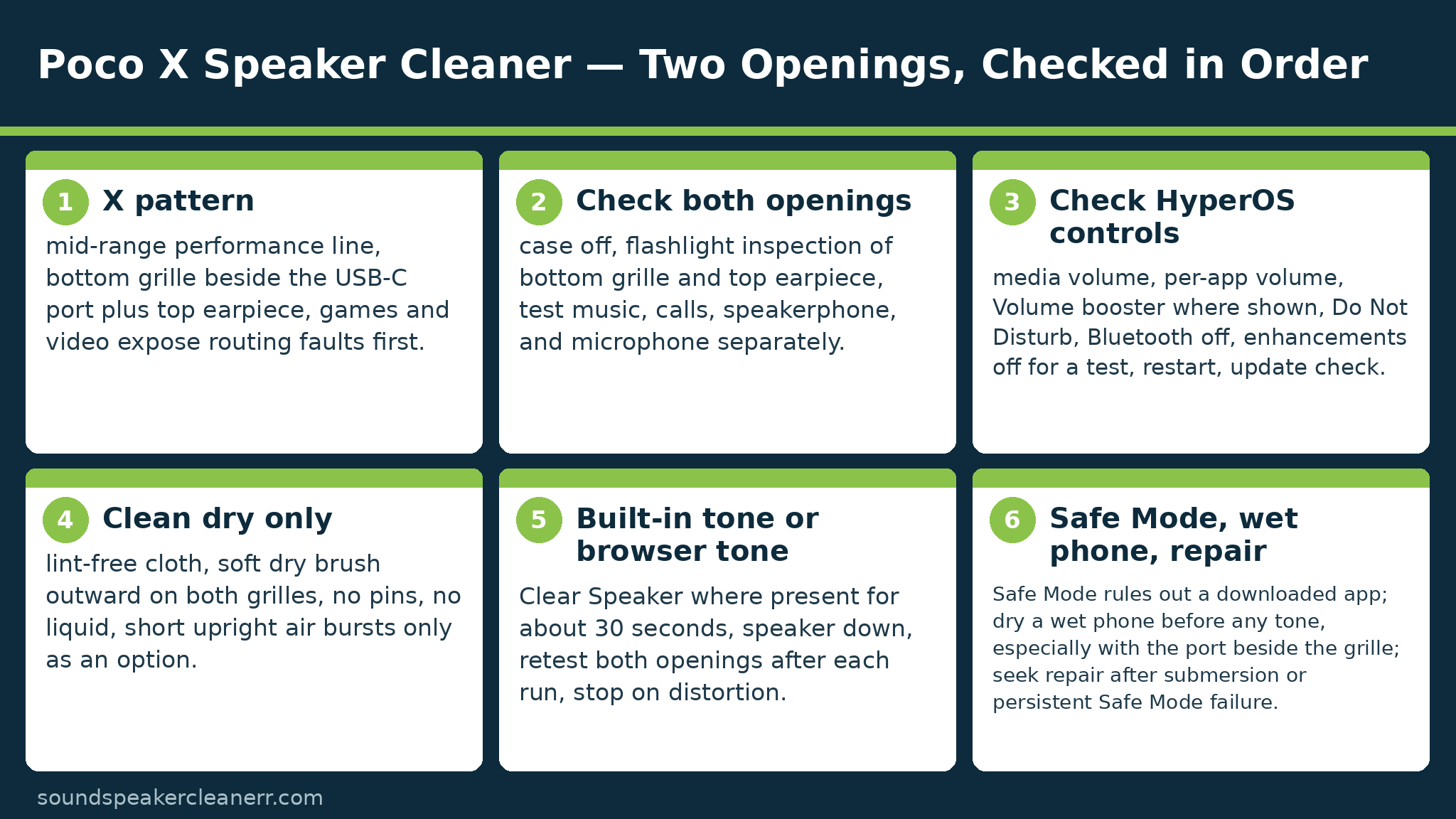
For a POCO X, the safe order is: check the bottom grille beside the USB-C port and the top earpiece, case off; test music, calls, speakerphone, and microphone separately; check media and per-app volume, Volume booster where shown, Do Not Disturb, Bluetooth, and sound enhancements; restart and check for a HyperOS update; brush both grilles dry and outward only; use Clear Speaker where present or one short browser tone where it is not; use Safe Mode to rule out an app; dry a wet phone fully before any tone; and stop on distortion or no change. That routine fits the X series' actual pattern — a mid-range performance phone, two openings to check, and gaming and media routing that fails first — without promising that sound alone can repair damage.
FAQ
Where is the speaker cleaner on a Poco X?
On models that include it, it is usually in Settings, then Additional settings, then Clear Speaker. It is not on every X model. If you cannot find it, use a browser cleaning tool instead.
Where is the main speaker on a Poco X?
Third-party X guides document a bottom-firing speaker beside the USB-C port, plus a top earpiece. Check both openings, case off, because a case can cover either one.
What is Volume booster on a Poco X?
On some newer X models, third-party guides document a Volume booster control in Settings, then Sound and vibration. Test with it on and off if your model shows it; if your model does not show it, do not install anything to add it.
Why does my Poco X have no sound in games but sound in calls?
Games and calls use different audio routes and volumes. Check the game's own volume and mute, per-app volume, Bluetooth routing, and Do Not Disturb before assuming the speaker is broken.
Can sound clean a Poco X microphone or charging port?
No. A loudspeaker tone is played through the loudspeaker. For a microphone, wipe around the opening and brush lightly outward without inserting anything; for a charging port, do not charge while it may be wet and follow charging-port guidance.
My Poco X got wet. Should I use Clear Speaker right away?
No. Remove the case, wipe the outside dry, hold openings facing down, and let the phone air-dry. Do not charge while a liquid warning is shown. Only after drying, test both openings with Clear Speaker or one short browser tone.
Will a very high frequency tone clean my Poco X speaker better?
No. A typical phone speaker cannot reliably reproduce 30,000, 50,000, or 100,000 Hz, and a high-frequency label does not make a tone stronger. Use an audible, moderate-volume tone and judge by a careful test afterwards.
When is a Poco X speaker beyond home cleaning?
When sound stays distorted after dry cleaning of both grilles and drying, stays silent in Safe Mode after routing checks, or follows full submersion or salt or soapy water exposure. Seek qualified repair in those cases.
Leave a Reply