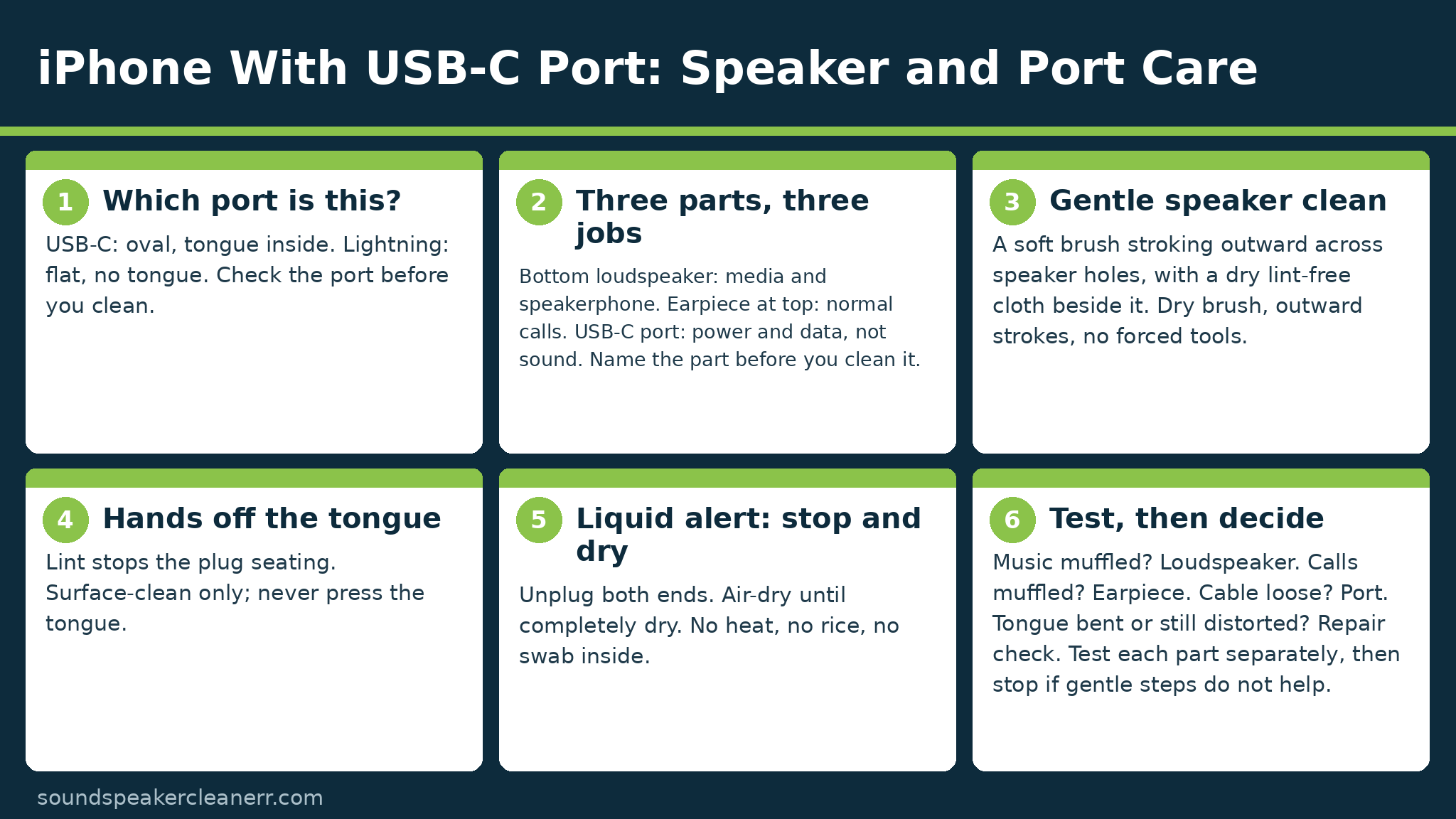
A USB-C iPhone needs gentle, separate care for three parts: the bottom loudspeaker, the earpiece at the top, and the oval USB-C port with its central tongue. Brush speaker grilles lightly with a dry soft brush, keep tools and liquids away from that tongue, and never charge a wet USB-C connector until completely dry.
That short answer matters because the tongue is the one feature Lightning owners never had to think about. It sits in the middle of the opening, carries the contacts, and is easy to press, bend, or scratch if you push a tool into the port to chase lint. A bent tongue can make every cable feel loose, even when the speaker sounds perfect. Keeping speaker cleaning and port cleaning separate — different tools, different pressure, different checks — protects both.
How to tell you have a USB-C iPhone
The fastest check is the charging port itself. A USB-C opening is a wider oval with a small central tongue inside. A Lightning opening is a flat, narrow slot with no central tongue. If you are unsure, check the model in the usual About route on your iOS version, then check Apple's specifications for that model, rather than guessing from the phone's size or color.
As a general lineup guide, the iPhone 15 lineup, announced in September 2023, was the first iPhone lineup to use USB-C instead of Lightning, and iPhone 14 and earlier models use Lightning. That lineup boundary is useful, but it is not a substitute for checking your own phone: a household may hold both kinds, cables may be mixed up, and a USB-C cable from another device may fit a USB-C iPhone while a Lightning cable never will. If a cable does not fit without force, stop. Forcing a Lightning plug into a USB-C opening, or the reverse, damages the port and the cable.
USB-C iPhones also share cables with many other devices, which is convenient and also a cleaning risk. A cable that lives in a bag, a car, or a jacket pocket collects lint and grit on its plug, and every plug-in carries some of that into the phone's port. Keep the cable plug clean and dry, and do not use a cable whose plug looks bent, frayed, or dirty to test whether the port is at fault.
The three parts: loudspeaker, earpiece, and USB-C port
Before you clean anything, name the part you are treating. The loudspeaker sits at the bottom edge, beside the USB-C port, and plays media, ringtones, and speakerphone calls. The earpiece is the small speaker at the top, above the screen, and plays normal calls. The microphone captures your voice and is a separate opening again. The USB-C port carries power, data, and wired accessories; it is not a speaker, and cleaning it will not fix a muffled loudspeaker, just as cleaning the speaker will not fix a loose cable.
Test each part separately with the same short, familiar voice message, at a comfortable volume, with Bluetooth and wired headphones disconnected. If music sounds muffled but calls sound fine, the bottom loudspeaker is the suspect. If calls sound muffled but music sounds fine, the earpiece is the suspect. If the cable wobbles or charging starts and stops, the USB-C port is the suspect, even if sound is perfect. If your own voice sounds distant to the other caller while you hear them clearly, the microphone is the suspect. This two-minute split saves you from cleaning the wrong part repeatedly.
A case or screen protector can also imitate a fault. A case edge that covers part of the bottom speaker holes, or a protector edge that sits over the earpiece slit, will muffle sound no matter how clean the phone is. Remove the case before you judge the sound, and check the protector's cutouts before you blame the speaker.
Cleaning the bottom speaker safely
Work on a clean table in good light, with the phone powered off and all cables unplugged. Remove the case. Look at the bottom edge: you will see the USB-C opening in the middle and small speaker holes to one side. Brush those holes lightly with a clean, dry, soft-bristled brush, stroking outward so loosened dust falls away from the phone rather than toward the port. Wipe the surrounding frame with a dry lint-free cloth. That is the whole routine for most dust.
Do not use compressed air. Apple advises against it for iPhone cleaning, and a strong blast can drive dust deeper into the grille or into the port beside it. Do not drip water, soap, or cleaning liquid onto the speaker holes, and do not press a damp cloth into the openings. A slightly damp lint-free cloth is for the outside surfaces only, kept away from openings, exactly as Apple's cleaning guidance describes. Do not use a needle, pin, SIM-eject tool, or metal pick to clear a speaker hole. The mesh behind the holes is thin, and a puncture turns a cleaning job into a repair.
If brushing once does not help, brush once more and retest with the same voice message. Do not escalate to harder tools or louder sound. A speaker that stays muffled after two gentle cleanings may be blocked deeper inside, may have residue from a liquid, or may be damaged. At that point the safe move is a professional check, not a sharper tool.
Cleaning around the USB-C port without touching the tongue
The USB-C port's most common problem is lint and dust collecting around the central tongue and along the walls of the oval opening. Each plug-in compresses that debris, and eventually the plug cannot seat fully, so charging feels loose, stops and starts, or needs the cable held at an angle. That is a port problem, and it is easy to mistake for a failing cable or a failing battery.
The safe home step is inspection and surface cleaning only, with the tongue treated as out of bounds. In good light, look into the opening without pushing anything inside. Brush lightly across the outside of the opening with a dry soft brush, and wipe the phone's bottom edge with a dry lint-free cloth. If you can see loose dust at the very mouth of the opening, a light brush stroke may lift it. Do not push a toothpick, cotton swab, paper towel, or any tool into the port, and do not press sideways against the tongue. Secondary guides that suggest scraping along the bottom of the port assume a steadier hand than most readers have, and a slip against the tongue can bend contacts that no amount of brushing will straighten.
Test with a cable you know works, pushed straight in without force. A clean connection should feel snug, not wobbly. If the cable still feels loose after surface cleaning, if the tongue looks bent or off-center, or if you see discolored contacts, stop. Port work beyond the surface is a repair-shop job, where the phone can be inspected without power running through a damaged connector. Trying a different cable first is still worthwhile: a worn cable can imitate a dirty port, and replacing the cable is cheaper than any repair.
Keep the port dry in daily use as well. Do not charge the phone with a wet cable, do not leave the phone charging in a steamy bathroom, and do not put a damp phone straight into a pocket where lint sticks to a wet opening. Because USB-C cables are shared with other devices, check the plug before each use: a dirty plug dirties every port it enters.
What to do when liquid is detected
If you connect a USB-C cable or accessory and see a liquid-detection alert, unplug the cable from the phone and unplug the other end from the charger or accessory. Do not keep trying the cable to see whether the warning clears, and do not use an emergency override to force charging through a wet connector unless you genuinely have no other way to charge in an emergency. Apple warns that charging while the connector is wet can corrode the pins and cause permanent damage or connectivity problems, so an override trades a short-term charge for a long-term port problem.
Dry the phone by tapping it gently against your hand with the USB-C connector facing down, then leaving it in a dry place with good airflow. Do not use a hairdryer or other external heat, do not use compressed air, do not insert a cotton swab or paper towel into the connector, and do not put the phone in a bag of rice, which can leave small particles inside the phone. If your phone supports wireless charging and the back of the phone is dry, a wireless charger can be a temporary alternative while the port dries, following Apple's guidance for your model.
Wait until the iPhone and the cable are completely dry before plugging in again. This draft deliberately gives no hour figure, because secondary sources disagree and the maker's rule is the safe one: completely dry, not dry enough for one try. The alert wording can vary with the cable and accessory — for example, one wording covers a USB-C to USB-A cable — but the action is the same in every case: unplug, dry, wait, retest. If the alert returns after the phone and cable are fully dry, or if it appears with a cable you know is dry, the cable, the accessory, or the port itself may be damaged, and that is a support or repair question rather than a drying question.
Note the speaker distinction here too. A liquid alert does not mean the speaker is wet, and a clear speaker does not mean the port is dry. Dry and test each part separately, and do not judge the port by the speaker's sound.
Can a cleaning tone help a USB-C iPhone?
A cleaning tone is a sound played through the speaker, and it may help move loose moisture or dust sitting near the grille. It is not a repair, it does not dry the USB-C port, it does not straighten a bent tongue, it does not remove corrosion, and it does not fix a blocked earpiece when you play it through the loudspeaker. Use it only after the outside of the phone is dry, only at a moderate volume, and only for one short cycle with the phone on a table.
If one short cycle does not improve the sound, stop. Repeating the tone louder or longer will not reach lint packed around the tongue or residue behind the mesh, and sustained high volume is harder on a speaker that may already be struggling. Instead, return to gentle brushing, retest with a familiar voice message, and consider a professional check if the sound stays muffled, crackles, or cuts out. The site's own water-eject and dust-cleaner tools follow this same moderate-volume, short-cycle idea, and they are a safer first try than any improvised loud test.
Also check the simple software causes before you blame the hardware. A connected Bluetooth speaker or pair of headphones, a Focus mode, the Action button or Ring/Silent control where your model has one, or a low media volume can all imitate a broken loudspeaker. Disconnect Bluetooth, check the volume and silent settings on your iOS version, and retest. If sound returns, the speaker was never dirty.
When to stop and seek repair
Stop home cleaning and seek a professional check if any of these apply: sound is distorted at every volume, one speaker produces no sound in every app, sound changes when you press gently near the speaker or port, you can see a dent, crack, bent tongue, or discolored contact, the phone has been submerged or exposed to salt water or a sugary drink, the phone overheats, restarts, or shows screen problems alongside muffled sound, or a liquid-detection alert keeps returning after full drying. Back up the phone before service if you can do so safely, and tell the repairer about any liquid exposure, because corrosion can spread and a delay can make repair harder.
A USB-C iPhone that is otherwise healthy is worth this care. Gentle brushing, a tongue left untouched, a clean cable plug, and patience after liquid exposure will keep most USB-C speakers sounding clear without ever needing a sharp tool. The moment gentle steps stop helping, the kindest thing for the phone is a trained inspection, not a harder push.
FAQ
How do I know my iPhone has a USB-C port?
Look at the charging opening: USB-C is a wider oval with a small central tongue inside, while Lightning is a flat, narrow slot with no central tongue. If you are still unsure, check the model in the About route on your iOS version and check Apple's specifications for that model.
What is the central tongue, and why must I avoid it?
The tongue is the small flat piece in the middle of the USB-C opening that carries the contacts. Pressing, bending, or scratching it can make every cable feel loose, even when the rest of the port is clean. Brush only across the outside of the opening, and leave any work inside the port to a repair professional.
Why does my USB-C cable feel loose?
Dust and lint collecting around the tongue and walls of the opening can stop the plug seating fully. Try a cable you know works, pushed straight in without force. If it still feels loose after surface cleaning, or if the tongue looks bent, have the port inspected rather than forcing the cable.
What does a liquid-detection alert mean on a USB-C iPhone?
It means liquid has been detected in the USB-C connector, or on the cable or accessory, and charging and accessory connection are unavailable until everything is dry. Unplug both ends, dry the phone with the connector facing down in airflow, and do not plug in again until the iPhone and cable are completely dry.
Can I use compressed air on my USB-C iPhone speaker?
No. Apple's iPhone cleaning guidance advises against compressed air. Use a clean, dry, soft-bristled brush and a lint-free cloth instead, and keep moisture out of the openings.
Will a cleaning tone dry out my USB-C port?
No. A cleaning tone plays through the speaker and may help move loose moisture or dust near the speaker grille, but it cannot dry the charging port, straighten a bent tongue, remove corrosion, or repair damage. Dry the port by airflow and time, and test the port separately from the speaker.
My calls are muffled but music sounds fine. Is that the USB-C port?
No. That pattern points to the earpiece at the top, which plays normal calls, rather than the bottom loudspeaker or the USB-C port. Clean the earpiece grille gently, check the case and screen protector cutouts, and test again before touching the port.
When should I stop cleaning and get a repair?
Stop if sound is distorted at every volume, one speaker is silent in every app, you see a dent, crack, bent tongue, or discolored contact, the phone was submerged or exposed to salt water, or a liquid alert keeps returning after full drying. Back up the phone if you safely can, and tell the repairer about any liquid exposure.
Leave a Reply