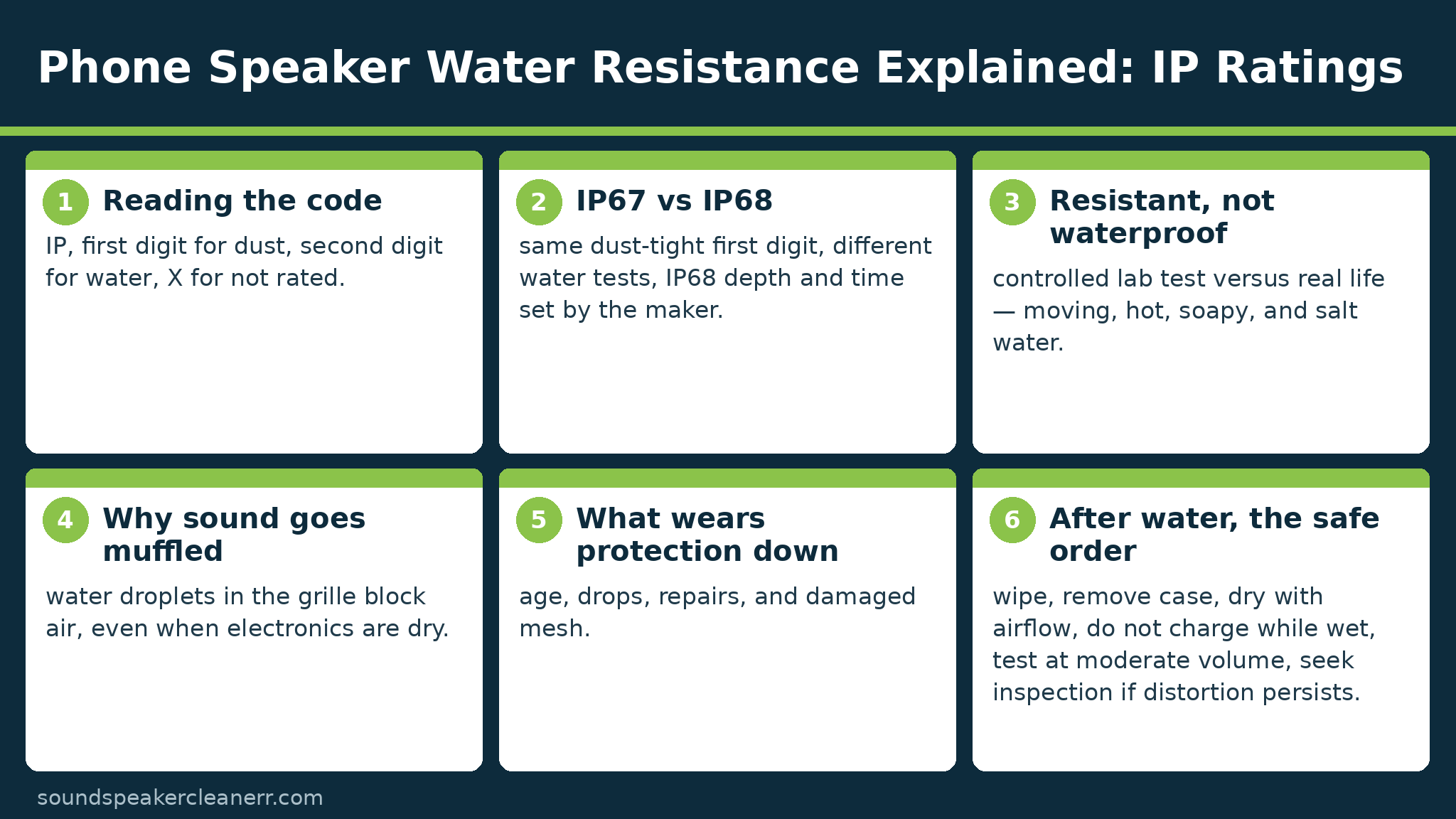
An IP rating tells you how well a phone's enclosure resisted dust and water in laboratory tests when it was new. It does not mean the phone is waterproof, it does not guarantee the speaker will sound normal after getting wet, and it does not last forever.
That distinction is the most important idea in this guide. Water resistance is a tested level of protection under controlled conditions, not a promise that any water exposure is safe. Once you understand what the two digits mean, why IP68 phones can still differ from each other, and what makes protection wear down, you can make much better decisions after a splash, a drop in water, or a day in the rain.
What "IP" means, and how to read the two digits
IP stands for Ingress Protection, and the rating system comes from the international standard IEC 60529. "Ingress" simply means something getting in — in this case, dust or water getting into the phone's enclosure. The rating is usually written as "IP" followed by two characters, for example IP67 or IP68.
The first digit describes protection against solids, mainly dust. A 6 means dust-tight under the test: no dust ingress in the test conditions. Lower numbers mean less protection, with 5 meaning dust-protected (some dust may enter but not enough to interfere with operation) and lower numbers meaning progressively less.
The second digit describes protection against water. It runs from 0 (no protection) upward through splashing and spraying levels to immersion levels: 7 generally means protection against temporary immersion under defined test conditions, and 8 means protection against immersion under conditions specified by the manufacturer, deeper or longer than the level-7 test. A 9, rarely seen on phones, covers high-pressure, high-temperature water jets.
An X in place of a digit means that part was not tested or not rated, not that the phone has no protection at all. IPX8, for example, means the phone was tested for immersion but its dust protection was not certified under that rating. It does not prove the phone has no dust protection; it only means no dust rating was given. Always read the X literally: "not rated for this part," not "zero protection" and not "full protection."
IP67 and IP68 in plain language
IP67 and IP68 are the ratings most readers will meet, and they share the same first digit: both are dust-tight. The difference is in the water test.
In general terms, IP67 covers immersion in up to one metre of fresh water for 30 minutes under controlled test conditions. IP68 covers immersion deeper than one metre, for a duration set by the manufacturer. That last point is essential: IP68 is not one single depth. Two IP68 phones can have different tested depths and times because each manufacturer specifies its own test conditions within the standard. One maker may test at a shallower depth than another, and both may still legitimately carry the IP68 label.
That is why a shopping listing that says only "IP68 waterproof" is not enough information. The rating alone does not tell you the tested depth, the tested time, or the water type. To know what your specific model was tested for, you need the manufacturer's own product page or care guide for that exact model. This article deliberately does not attach a depth or time to any named model, because those figures vary and must come from the maker.
It is also worth noting what the tests do not cover. Laboratory immersion tests typically use fresh, still water at room temperature, with a new phone in good condition. They do not test moving water, hot water, soapy water, chlorinated pool water, or salt water in the same way, and they do not test a phone that has been dropped, repaired, or used for years. Real life is messier than the test, and the rating does not travel with the phone into every real-life condition.
Water resistance is not waterproof
No mainstream phone is waterproof in the everyday sense of that word, even if marketing or a retailer uses the word loosely. Water resistance means the phone resisted water under specific test conditions. Waterproof would mean water cannot get in under any normal condition, and no phone maker promises that.
There are three practical reasons for the gap. First, the tests are controlled and limited, as described above. Second, protection depends on seals, adhesives, and the mesh and grille system, all of which can wear, loosen, or be damaged. Third, water can still enter through openings — including the speaker and microphone openings and the charging port — even on a resistant phone, and water sitting in those openings can muffle sound until it clears, even if no water reached the electronics inside.
That exclusion is itself a signal: the makers do not treat a water-resistance rating as a guarantee that water exposure is harmless. Do not rely on a rating as permission to swim with a phone, use it under a shower, or test it in water on purpose. A rating is protection against accidents, not an invitation to seek out water.
Why a water-resistant phone can still sound muffled
This is the question that brings many readers to a speaker-cleaner site, and the answer has two parts.
The first part is water in the sound path. Even if no water reaches the electronics, water droplets can sit in the speaker grille and mesh. Those droplets block air movement, so sound turns muffled or quiet until the water evaporates or is moved out. This is a temporary, surface-level problem, and it is the kind of problem a short, moderate-volume tone session is designed to help with: the diaphragm's movement pushes air, and the air may push droplets out of the grille. Sound cannot, however, dry the inside of the phone.
The second part is water beyond the sound path. If water has entered the phone, or if residue from salt, chlorine, or soap remains after the water dries, the problem is deeper than a blocked grille. Sound may stay distorted, crackly, or uneven, or other problems may appear — for example, charging warnings, a microphone that sounds faint, or a screen problem. Those signs point to inspection, not to more tones. Repeated loud tones will not remove internal water or residue, and they add stress to a speaker that may already be affected.
The speaker, earpiece, microphone, and charging port each have their own openings and their own water behaviour. Water in the loudspeaker grille affects media and speakerphone sound. Water in the earpiece affects calls held to your ear. Water in the microphone affects how you sound to others. Water in the charging port is a charging-safety matter, not a sound matter. Check each part separately instead of assuming one fix covers all four.
What wears protection down
An IP rating describes a phone when it leaves the factory, in test condition. Everyday life changes that condition.
Age and use. Seals and adhesives age. Heat, cold, humidity, and normal flexing over months and years can reduce their effectiveness. A three-year-old phone does not necessarily have the same protection as it had on day one, even if it has never been dropped.
Drops and knocks. A drop can crack a shell, loosen a seal, or shift a speaker module slightly. The phone may look fine and work fine, but its water protection may be weaker. The same applies to a bent frame or a screen that no longer sits flush.
Repairs and opening. Opening a phone breaks its factory seals. A careful repair with new seals can restore much of the protection, but it is not automatically the same as the factory condition, and a repair that reuses old seals or leaves a gap will be weaker. If a phone has been opened, treat its rating as uncertain.
Damaged mesh or grille. As the companion mesh article explains, the mesh is one part of the dust and water protection system. A torn or pushed-in mesh gives water and dust an easier path, even if the rest of the phone is intact.
Residue and chemicals. Salt water, chlorinated water, soap, sunscreen, and cleaning chemicals can affect seals and leave residue in openings. Rinsing a phone under a tap after salt-water exposure is sometimes suggested in general care advice, but only if the maker advises it for that model, and it never turns a resistant phone into a waterproof one. When in doubt, follow the maker's care guide for your exact model rather than general advice.
None of this means a water-resistant phone is fragile. It means the rating is a starting point that declines with real-world wear, and that a phone's current protection is always a little uncertain. Caution costs nothing; an avoidable swim costs a phone.
What to do after your phone gets wet
The steps below are general and safe. For model-specific steps, always follow the phone maker's guidance, which takes priority over any general guide.
First, take the phone out of the water and wipe the outside with a soft, dry, lint-free cloth. Do not shake it violently, do not blow into the openings, and do not use compressed air into the openings, because those actions can push water deeper.
Second, if the phone has a case, remove it so water is not trapped against the openings. Hold the phone with the openings facing downward for a short time so gravity can help droplets leave the grille, and tap it very gently — not forcefully — if the maker advises that step.
Third, leave the phone in a dry place with airflow until it is fully dry. Do not use an external heat source such as a hair dryer on high heat, do not put it in rice (grains and starch can enter openings and form residue), and do not insert anything into the openings to dry them. Do not charge the phone, and do not plug anything into a wet charging port, until the phone is fully dry and the maker says it is safe. This guide gives no specific hour figure for any maker, because that figure must come from the maker's own support page for your model.
Fourth, once the phone is dry, test the sound at moderate volume: media through the loudspeaker, a call through the earpiece, and a voice recording to check the microphone. A short tone session may help if surface water in the grille is the remaining problem. If sound is clear, the episode is likely over. If sound stays distorted, crackly, or silent, or if any other fault appears, stop and seek professional inspection. Do not keep repeating loud tones in the hope that persistence will fix internal water or damage.
Finally, "sounds fine now" is not the same as "protection restored." A phone that dries out may still have weaker seals than before, so be more cautious with it near water in the future.
Common misunderstandings, corrected
"IP68 means I can swim with it." No. Neither IP67 nor IP68 by itself approves swimming or diving. Moving water, pressure changes, chlorine, and salt all go beyond the standard immersion test.
"A higher number is always better in every way." A higher water digit means a stronger water test, but it does not change the dust digit, and it does not tell you the manufacturer's specific depth and time for IP68. Compare full specifications, not just the headline rating.
"My phone has no rating, so it has no protection." An unrated phone may still have some seals and a mesh, but you have no tested assurance. Treat it as unprotected near water, which is the safer assumption.
"IPX8 means no dust protection." No. The X means dust was not rated, not that dust protection is zero. Check the maker's full specification for dust information.
"The rating lasts for the life of the phone." No. Seals wear, drops happen, repairs open the phone, and mesh can be damaged. Protection declines over time, and a rating is not a lifetime guarantee.
"If the speaker sounds muffled, water must have damaged the phone." Not necessarily. Water in the grille alone can muffle sound temporarily, and the phone may be otherwise fine once it dries. Persistent distortion or other faults are the signs that point to deeper trouble.
The short version to remember
Read an IP rating as two digits: dust first, water second, with X meaning "not rated for that part." IP67 and IP68 are both dust-tight; their water tests differ, and IP68 depths and times are set by each manufacturer, so two IP68 phones are not automatically identical. Water resistance is tested protection under controlled conditions, not waterproofing, and it wears down with age, drops, repairs, and damaged mesh. After water exposure, dry the phone gently with airflow, do not charge while wet, follow the maker's guidance, and treat persistent distortion or other faults as a reason for inspection, not for louder tones. If you remember "resistant, not waterproof, and not forever," you have the whole rating system in one line.
FAQ
What does an IP rating mean?
It is an Ingress Protection rating under IEC 60529. The first digit covers dust and solids, the second covers water, and an X means that part was not tested. It describes test performance when the phone was new, not a guarantee for all real-life water exposure.
What is the difference between IP67 and IP68?
Both are dust-tight. IP67 generally covers immersion in up to one metre of fresh water for 30 minutes under test conditions. IP68 covers immersion deeper than one metre for a duration specified by the manufacturer, so the exact depth and time vary by model and must be checked on the maker's page.
Does IP68 mean a phone is waterproof?
No. Water-resistant and waterproof are not the same. IP68 means the phone passed a manufacturer-specified immersion test; it does not approve swimming, diving, hot water, soapy water, or salt water, and liquid damage is commonly excluded from warranties.
What does IPX8 mean?
The X means dust protection was not rated or certified under that rating. The 8 means immersion was tested under manufacturer-specified conditions. It does not mean the phone has no dust protection, only that no dust rating was given.
Why does my water-resistant phone sound muffled after getting wet?
Water droplets sitting in the speaker grille and mesh block air movement, so sound turns muffled even if no water reached the electronics. The sound often clears as the phone dries. If it stays distorted after drying, the problem may be residue or internal water, and inspection is the right step.
Can I charge my phone while it is still wet?
No. Do not charge a wet phone or plug anything into a wet charging port. Wait until the phone is fully dry and follow the phone maker's guidance for your exact model. This guide gives no specific hour figure, because that figure must come from the maker.
Does an IP rating last for the whole life of the phone?
No. Seals and adhesives age, drops can loosen them, repairs break factory seals, and damaged mesh weakens the system. Treat an older, dropped, or repaired phone as having less protection than its original rating suggests.
Can a cleaning tone restore water resistance?
No. A tone can sometimes move surface water out of the grille, but it cannot restore seals, repair a torn mesh, remove internal water, or renew a worn rating. It is a surface-sound help, not a protection repair.
Leave a Reply