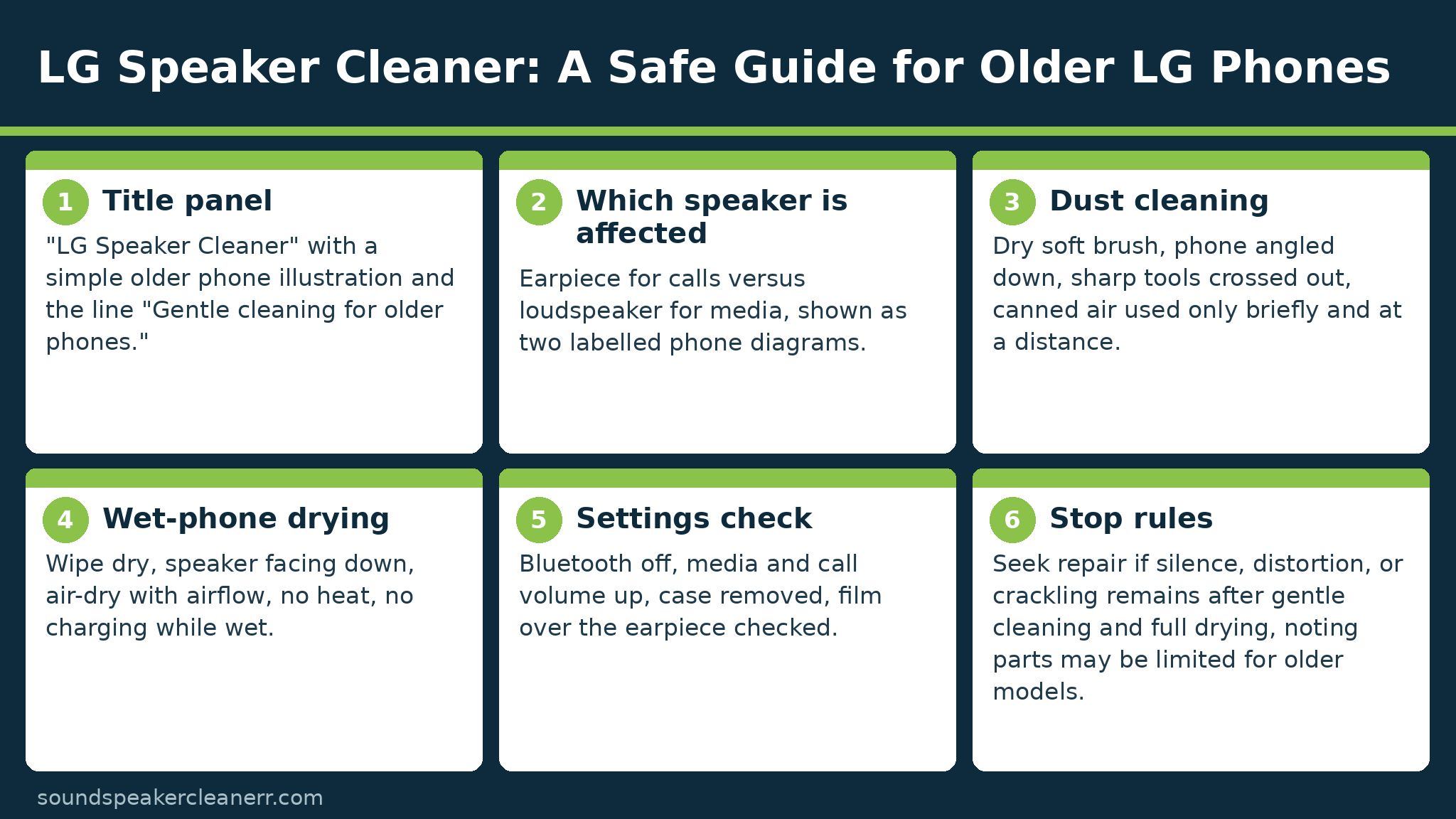
An older LG phone usually sounds muffled because dust, lint, or water is blocking the small speaker grille, not because the speaker has suddenly failed. Start by removing the case and checking whether calls, media, or both are affected, then clean the grille gently with a dry soft brush. If the phone got wet, dry the outside, keep the speaker facing down, and let it air-dry fully before charging. If sound stays distorted, silent, or crackling after careful cleaning and drying, stop and seek repair rather than pushing tools into the grille, because an older phone is less forgiving of a torn mesh or a forced opening than a new one.
Why older LG phones need a gentler approach
LG is a legacy phone brand for readers of this guide: the LG phones still in use today are older models, and that age changes the cleaning calculus in three practical ways. First, parts and official support are harder to come by than they were when the phone was new, so a repair that damages the grille or the body can be harder to undo. Second, years of pocket lint, case debris, and dried residue build up more thickly than a few months of dust, which makes aggressive scraping more tempting and more risky at the same time. Third, batteries, seals, and adhesives age, so opening an older phone at home, or pressing hard on its openings, carries risks that go beyond the speaker itself.
None of that means an older LG phone cannot be cleaned safely. It means the safe method is the gentle one: dry brushing, a dry cloth, a case check, and settings checks, in that order, with professional help as the next step when those fail. Do not open the phone, do not remove a glued back panel, and do not use a pin, needle, or paper clip to clear a hole. Asurion's muffled-speaker guide warns that a pointy object can permanently damage the speaker, and on an older phone that damage is less likely to be cheaply repaired.
This is a parent guide for LG phones as a group. It does not claim a feature, rating, or menu layout for any single model, because LG phones span many years, designs, and software versions. Speaker placement varies by model: some have a bottom loudspeaker only, some add a second speaker, and every phone has a separate earpiece near the top for calls. Before cleaning, find both openings on your own phone in good light and treat them separately. A blocked earpiece makes calls sound faint while music sounds normal, and a blocked loudspeaker does the opposite. That distinction is the fastest way to avoid cleaning the wrong part.
Menu names also vary by model and Android version. On most Android phones, volume, sound, and Bluetooth controls live under Sound settings, but exact labels and order change, and older LG software may use different wording again. This guide therefore describes what to check — media volume, call volume, Bluetooth routing, and mute or do-not-disturb settings — rather than giving one exact tap sequence that may not match your phone. If a label on your phone differs, follow the label that matches the idea.
First, diagnose before you clean
Play the same music track and then make or receive a short call, both at a moderate volume, and note what sounds wrong. Remove the case and test again before cleaning anything. A thick case, a case with a misaligned cutout, or lint trapped inside a case can block a grille and make a healthy speaker sound quiet. Older cases are especially likely to have stretched, warped, or lint-packed cutouts. If sound improves without the case, the case was the problem, and cleaning the phone will not help until the case is cleaned or replaced.
Check the simple causes next. Media and call volumes are separate on Android, so turn both up for testing. Disconnect Bluetooth headphones, earbuds, and speakers, because audio routed to another device makes the phone speaker seem dead. Check that no mute or do-not-disturb setting is suppressing the sound you are testing. Restart the phone after these checks. A restart clears temporary audio routing glitches, including audio stuck on a previous Bluetooth device, and gives you a clean comparison after cleaning. If sound improves after a restart or a software update, the cause may have been software rather than debris.
Also note the phone's history before you clean. Was it dropped recently? Did it get wet, even briefly? Has the sound faded slowly over months, or changed suddenly? A slow fade points to dust buildup. A sudden change after a drop or a splash points to damage or water, and cleaning alone is less likely to fix it. Writing down those answers takes a minute, and it is exactly what a repair shop will ask if you end up taking the phone in.
Dust and lint: the safe cleaning sequence
For a dry LG phone, power it off or stop all audio, then hold it with the grille angled downward so loosened dust falls away from the phone rather than deeper into it. Brush lightly across the grille with a clean, dry, soft-bristled brush, such as a soft toothbrush kept only for this job, using short outward strokes and almost no pressure. Wipe with a dry microfiber cloth and inspect the grille in bright light. The HardReset guide for the LG Optimus Hub, cited above, follows the same pattern: power off, remove the case, brush gently without too much pressure, and use a small soft brush for stuck debris.
If surface lint remains after gentle brushing, repeat once, then retest. Do not insert pins, needles, paper clips, or any metal tool into the holes. Do not use a high-pressure air gun, and do not blow hard with your mouth, which adds moisture. If you use canned air at all, follow the cautious pattern in the LG guide cited: hold the can upright, keep it at a distance from the speaker, and use short bursts only. Stop if debris visibly moves inward rather than out, and do not use canned air as a substitute for brushing. On an older phone, the mesh may already be brittle, so a gentle brush is safer than any blast of air.
Stay dry for a dusty grille. Do not pour or spray liquid into the speaker opening, and do not use chemical cleaners on the grille. A lightly damp cloth may be used on the phone's outer surface, but not pressed over the speaker opening. If a sticky residue remains after dry brushing, pause and consider professional cleaning rather than adding liquid at home. Sticky residue, unlike dry lint, can be pushed deeper by brushing, and on an older device it may also be holding a weakened mesh together. A repair shop can judge that without risking the speaker.
If the phone got wet: dry first, test second
Water changes the order completely. If your LG phone got wet, do not charge it, do not plug anything into the port, and do not play loud sound through it while it is still wet. Wipe the outside with a soft, dry cloth, remove the case, and hold the phone with the speaker facing down so gravity helps water drain out of the grille area. Tap it very gently against your hand if droplets are visible, then set it speaker-down on a dry cloth in a room with good airflow, away from direct heat.
Let the phone air-dry fully before you judge the speaker. A speaker that sounds muffled an hour after a splash may sound normal once the grille is fully dry, because a thin film of water across the mesh blocks sound even when the rest of the phone is fine. Do not use a hair dryer, a heater, or an oven, and do not put the phone in rice. Heat can damage the speaker and other parts, and rice dust can add debris to the grille. Do not open the phone at home to dry the inside. Opening an older sealed phone without the right tools risks breaking the body and the battery area, and it is not needed for a surface grille clean.
This guide gives no water-resistance rating for LG models and no fixed drying hour figure, because neither was verified across LG models for this guide. Use the general rule instead: the phone must be fully dry, inside the ports as well as on the surface, before charging or judging the speaker, and if your own model's official guidance gives a specific drying instruction, follow that instruction. If the phone was exposed to salt water, soapy water, or drinks rather than clean fresh water, seek professional advice sooner, because residue from those liquids can cause corrosion even after the phone feels dry, and corrosion matters more on an older phone that may already have worn seals.
Only after full air-drying should you try a sound check at a moderate volume. A browser-based speaker tool can play a low tone that vibrates the speaker, and that vibration may help move remaining droplets near the grille. Treat this honestly: it may help with loose surface water, it does not guarantee that all water is ejected, and it cannot repair internal water damage. Run a short cycle at a moderate volume, pause between cycles, and stop if you hear crackling, distortion, or silence. Those sounds after full drying point to damage, not to a need for louder sound.
Settings checks that are often mistaken for damage
Before concluding that a speaker is broken, work through the settings that mimic a speaker fault. Confirm Bluetooth is off or disconnected from other audio devices. Confirm media, ring, and call volumes separately. Check that no silent or do-not-disturb mode is active, and check the in-app volume of the app you are testing. Check audio balance if your phone offers it, since a balance slider pushed to one side can mimic a one-sided fault. Also check the earpiece area for a screen protector or film covering it, since a misaligned film can muffle calls while leaving music untouched. Realigning or replacing that film is simpler than any cleaning step.
On an older LG phone, also check for a failing case fit and a worn charging port cover, if your model has one. A loose cover or a case that no longer sits flush can shift over the grille during calls and produce intermittent muffling that looks like a speaker fault. Test with the case off and any cover seated properly before you clean a second time.
When cleaning is not the answer
Stop home cleaning and seek professional or manufacturer support if the speaker is completely silent after drying and a restart; if sound is distorted or crackling at normal volume after gentle cleaning; if the phone was submerged, exposed to salt or soapy water, or shows condensation under the screen; if the phone will not power on, charges abnormally, or smells of burning; or if the grille is dented, torn, or pushed inward. Sound tools and dry brushing can move loose surface debris and surface water. Neither can fix a torn mesh, a damaged driver, corrosion, or a loose internal connection. Continuing to play loud tones into a damaged speaker can make the damage worse, so a persistent fault after careful cleaning is information, not a reason to try harder with the same method.
For an older LG phone, weigh the repair decision honestly. A reputable shop can tell you whether the speaker module, the mesh, or a connection is at fault, and whether a part is still available at a sensible cost. If the phone's battery, screen, or other parts are also aging, that conversation matters more than squeezing one more cleaning attempt out of a fragile grille. Prevention is simple from here on: use a case whose cutouts line up with your model's speaker openings, keep the phone out of dusty pockets without a case, wipe the grille area with a dry cloth after dusty or sweaty days, and check the grille in good light occasionally rather than waiting until sound fades.
FAQ
Why does my older LG phone speaker sound muffled?
Most often, dust or lint is blocking the grille mesh, or a thin film of water is sitting across it after a splash. Clean the grille gently with a dry soft brush for dust, or air-dry the phone fully for water, then retest. If sound stays muffled after both, check settings, the case, and the earpiece-versus-loudspeaker distinction before concluding the speaker is broken.
Can I use a pin to clear my LG speaker holes?
No. Pins, needles, and other sharp or metal tools can permanently damage the speaker mesh and push debris deeper. Use only a dry soft brush and a dry microfiber cloth on the grille surface, and leave stubborn blockages to a professional, especially on an older phone where parts are harder to replace.
My LG phone got wet. Should I charge it right away?
No. Do not charge a phone that may still be wet inside the port or grille. Wipe the outside, keep the speaker facing down, and let the phone air-dry fully in a room with airflow first. If your model's official guidance gives a specific drying instruction, follow that instruction.
Why are calls quiet but music sounds normal?
Calls use the earpiece and media uses the loudspeaker, so a blocked earpiece or a screen film covering it makes calls faint while music stays clear. Check the top earpiece area, the film alignment, and call volume separately from media volume.
Can a speaker cleaner tone repair my LG speaker?
No. A short tone at a moderate volume, after full drying, may help move remaining surface droplets near the grille, but it does not guarantee water ejection and cannot repair a damaged driver or internal water damage. Persistent distortion or silence after drying is a repair question.
How do I know if the case is the problem?
Remove the case and replay the same track. If volume and clarity return without the case, the case was blocking or muffling the grille. Clean lint from inside the case and replace a case whose cutouts do not line up with your model's speaker openings, since older cases often warp or stretch.
Is compressed air safe for an older LG speaker grille?
Use it only cautiously, if at all: hold the can upright, keep it at a distance, and use short bursts, as in the LG guide cited above. Stop if debris moves inward. Gentle dry brushing is the safer first step on an older, possibly brittle mesh, and high-pressure air should never be used on the grille.
When should I take my LG phone to a repair shop?
When the speaker stays silent, distorted, or crackling after gentle cleaning, full drying, a restart, and a settings check, or when the phone was submerged, exposed to salt or soapy water, shows condensation, or will not charge normally. On a legacy model, a shop can also advise whether a part is still available before you spend more on cleaning attempts.
Related tools on this site
Related guides on this site
- Phone Speaker Muffled
- Clean Dust from Phone Speaker
- How to Clean Phone Speakers
- How to Clean Your Phone Without Damaging It
- Phone Fell in Water
- Water in Charging Port
- Phone Speaker Troubleshooting
- Fix Speaker Android
- Phone Speaker Volume Low
- Does Speaker Cleaner Work?
- Speaker Cleaner Apps: Safe Use Without Installing One
- Dry Phone Without Rice
Leave a Reply