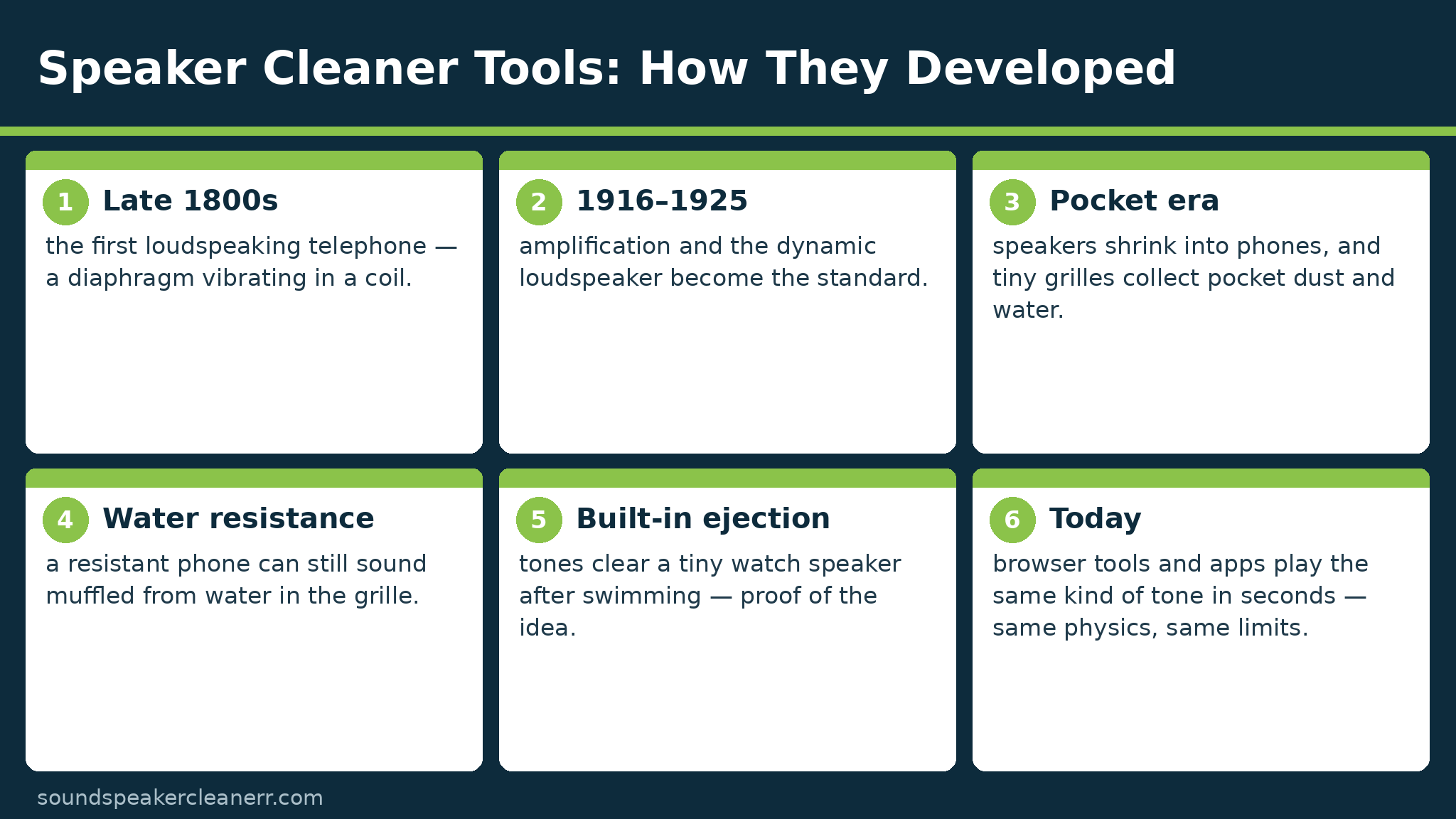
Speaker cleaner tools did not appear out of nowhere. They are the latest step in a long story from the first loudspeakers, through amplification and water-resistant phones, to a tone played through a browser. The idea at the centre never changed: move the diaphragm, move the air, and anything loose in the sound path may move with it.
Understanding that story helps in two ways. First, it explains why the tools work at all: they use the speaker's own mechanism, not a new invention. Second, it explains their limits: a tool built on a 1920s loudspeaker principle cannot do things that principle never promised, such as drying the inside of a phone or repairing damage. History, in this case, is a practical guide, not just background.
Stage 1: The first loudspeakers could barely be heard
The story starts with the telephone in the late 1800s. Early loudspeaking telephones used a thin diaphragm attached to a magnet and suspended in a coil of wire. When current passed through the coil, the magnetic field made the diaphragm vibrate and produce sound waves. It was a working speaker, but it was not loud: without amplification, it could only produce a modest sound, suitable for a person listening closely, not for a room.
Inventors through the late 1800s and early 1900s improved the design in steps. Werner von Siemens patented a moving-coil design in 1877. Oliver Lodge worked on a cone-shaped speaker in 1898, attaching a cone to convert electrical energy into sound waves more effectively. Horns were used to direct and increase the sound, because the electrical signal itself was still weak. The pieces of the modern speaker were arriving, but the system to drive them loudly did not yet exist.
For speaker cleaning, this stage matters because it establishes the mechanism. From the very first loudspeaking telephone, sound was made by a diaphragm vibrating in response to current in a coil. Every later cleaning tool, still relies on that same vibration. No cleaning tool has invented a new way to make sound; each one has simply found a new use for the old one.
Stage 2: Amplification made speakers truly loud
The turning point was electronic amplification. Bell Labs introduced the first electronic vacuum-tube amplifier in 1916, and the first commercial electric loudspeaker followed in 1924. With amplification, a speaker could be driven hard enough to fill a room, a hall, or a cinema — and, crucially for later history, a speaker could be driven with enough force to move air in a controlled, powerful way.
In 1925, Edward W. Kellogg and Chester W. Rice invented the dynamic loudspeaker that became the standard. It used a voice coil in a magnetic field to drive a cone, with a suspension to keep the movement clean — the same basic architecture described in the companion article on how phone speakers work. Through the rest of the 20th century, that design was refined for radios, phonographs, public address, cinemas, and home audio, with better materials, better magnets, and better manufacturing, but without changing the core principle.
Amplification also changed what "playing a tone" could mean. Before amplification, a tone was a faint signal. After amplification, a tone could be a deliberate, powerful vibration — loud enough to be heard across a room, and, in principle, strong enough to move air and loose material in front of the diaphragm. The cleaning idea was not yet a product, but the physical capability it would later use was now in place.
Stage 3: Speakers shrank into pockets
The next great change was miniaturisation. Radios shrank, then portable audio players, then mobile phones, and the speaker had to shrink with them. A phone speaker is the same dynamic design as a room speaker, compressed into a module a few millimetres thick, with a tiny chamber and a grille full of small holes instead of an open cone.
Miniaturisation created both the need and the opportunity for speaker cleaners. The need came from the environment: a phone lives in pockets, bags, rain, dust, and sweat, and its tiny grille and mesh collect lint and water far more readily than a large home speaker behind a cloth cover. The opportunity came from the phone itself: it already contained the amplifier, the speaker, and a processor that could generate any tone on demand. A phone did not need an external cleaning device; it could, in principle, clean its own speaker by playing the right sound.
Phones also gained earpiece and microphone openings, each with its own small grille, multiplying the places where blockage could occur.
Stage 4: Water resistance changed the question
As phones became water-resistant — rated under the IP system explained in the companion article — the question changed. It was no longer only "how do we keep dust out?" but also "what happens when water gets into the sound path, and how does it get out?"
Water resistance, as that article explains, means the enclosure resisted water in laboratory tests; it does not mean water cannot enter the grille or mesh. In practice, a water-resistant phone that has been splashed or submerged often sounds muffled afterwards, even though its electronics are dry. The water is sitting in the grille, blocking air movement. That is a different problem from internal water damage, and it calls for a different response: remove or evaporate the surface water, rather than repair the phone.
This distinction is the moment speaker cleaning became a distinct idea rather than just general dusting. Dust cleaning is about removing solid buildup from a surface. Water cleaning is about moving liquid out of tiny openings, and the speaker's own diaphragm — already designed to move air — turned out to be a natural tool for that job. If the diaphragm could push air out through the grille, it could push droplets out too, at least those sitting near the opening.
Stage 5: Built-in water ejection showed the idea worked
The clearest early proof that sound could eject water from a small speaker came not from a phone, but from a watch. Apple Watch Series 2 and later models include a Water Lock feature for swimming: when Water Lock is turned off after swimming, the watch plays a series of tones to clear its speaker. Slow-motion footage has shown droplets leaving the speaker holes as the tones play, and the feature is widely cited as the demonstration that sound-driven ejection works in a tiny, sealed device.
Built-in ejection mattered for two reasons. First, it came from a device maker, not from a third-party tool, which gave the idea credibility: a manufacturer was willing to build it into a product and describe it as a normal part of using the device in water. Second, it set the pattern that later tools would follow — a series of tones, played at a level strong enough to move water, through the device's own speaker, with no tools, no disassembly, and no liquid or object inserted into the opening.
Phones did not all gain the same built-in feature, and that gap is what third-party tools filled. Some phone makers include water-ejection or speaker-cleaning options in their software, and some do not, and the availability varies by maker and model. Where no built-in option exists, users looked for another way to play the same kind of tone — and the web and the app stores provided it.
Stage 6: Browser tools and apps made the tone available to anyone
The most recent stage is the one readers meet today: speaker cleaner tools that run in a browser or as a phone app, with no installation or with a simple install, offering water-eject tones, dust-cleaning sweeps, and speaker tests.
Browser tools have a particular advantage: they need no download, no permissions beyond playing sound, and no trust in an unknown developer's data practices. A user visits a page, taps a button, and the phone's own browser plays the tone through the speaker. The site's own homepage tool follows this pattern, and it is the reason this site can offer water ejection, dust cleaning, ear-speaker cleaning, and speaker testing without asking users to install anything.
Apps offer a different trade-off. An installed app can remember settings, offer vibration modes or saved tones, and work without a browser open, but it requires installation, permissions, and trust in the developer, and its quality varies widely. App-store listings for water-eject and speaker-cleaner apps show a fast-changing field: new apps appear, some disappear or are removed, and descriptions and features change frequently. That churn is itself a lesson: no single app's claims should be taken as settled, and a browser tool that does one job transparently is often the simpler choice.
Common tool frequencies illustrate how the field converged without a formal standard. Many tools use a low tone around 165 Hz for water ejection, because a low tone moves the diaphragm farther than a high tone, while still being loud enough for a small phone speaker to reproduce. Other tools sweep across a range — for example, roughly 120 Hz to 400 Hz for dust modes — to reach particles of different sizes. As the ClearSpeakers source notes, 165 Hz is a common choice, not a published standard, and no manufacturer has named one ideal frequency. Any tool that claims one exact frequency is "the" correct frequency for all phones is overstating what is known.
What has stayed the same, and what has not
Across all six stages, three things have stayed the same. The mechanism is unchanged: a coil in a magnetic field moves a diaphragm, and the diaphragm moves air. The goal is unchanged: clear the sound path so sound can pass cleanly. And the limit is unchanged: sound can move what is loose near the opening, but it cannot dry the inside of a device, remove packed residue, or repair damage.
What has changed is access and packaging. A tone that once required a laboratory amplifier and a room-sized speaker can now be generated by a phone's own processor and played through a speaker smaller than a coin, from a web page, in seconds. The interface has changed from hardware to software, from installed programs to browser pages, and from a single tone to modes for water, dust, earpiece, and testing. The physics did not change; the delivery did.
Moderate volume, short sessions, drying time, and maker guidance for wet devices appear in every careful guide, from manufacturer support pages to this site's own tool pages. The tools became easier to use, but the phone did not become invulnerable, and the advice did not become less necessary.
What the future may hold, honestly stated
It would be tempting to predict the next stage — smarter tones, automatic detection of blockage, or built-in ejection on every phone — but this article does not present predictions as facts. What can be said honestly is that the direction so far has been toward less friction: from external devices to built-in features, from installs to browser pages, from one tone to a small set of modes. If that direction continues, future tools are likely to be more integrated and more automatic, but they will still be bound by the same physics: a diaphragm moving air through a grille.
Two cautions apply to any future claim. First, a tool that promises to "repair" a speaker, "restore" water resistance, or "deep clean" the inside of a phone with sound alone is promising something sound cannot do, however modern its interface looks. Second, a tool that requires broad permissions, a download from outside an official store, or payment for a basic tone should be judged with the same scepticism applied to any software: the tone itself is simple, and simplicity does not require extensive access to your phone.
The most useful way to read any new speaker cleaner tool, then, is to ask three questions that history suggests. Does it use the speaker's own mechanism, transparently, without inserting anything into the phone? Does it state its limits — surface water and loose dust near the opening, not internal water or damage? And does it respect the phone maker's guidance for wet devices, including drying and charging safety? A tool that answers yes to all three is continuing the story in the right direction. A tool that does not is repeating an old mistake in a new package.
The short version to remember
Speaker cleaners began with the first loudspeaking telephones in the late 1800s, became truly powerful with amplification in 1916 and the dynamic loudspeaker of 1925, shrank into pockets with mobile phones, gained a new purpose when water-resistant phones still sounded muffled from water in the grille, proved themselves with built-in watch ejection, and finally became browser tools and apps anyone can use in seconds. The mechanism never changed — a diaphragm moving air — and neither did the limit: sound can move loose water and dust near the opening, but it cannot dry a phone's inside or repair damage. Remember the mechanism and the limit, and every new tool becomes easy to judge.
FAQ
When were speaker cleaner tools invented?
There is no single verified inventor or date for the first speaker cleaner tool in the sources checked, so this article does not claim one. The underlying mechanism dates to the first loudspeakers of the late 1800s and the dynamic loudspeaker of 1925, while water-ejection features and browser and app tools are much more recent developments built on that mechanism.
What was the first device to eject water with sound?
The clearest widely cited built-in example is the Apple Watch: Series 2 and later models play tones to clear the speaker when Water Lock is turned off after swimming. That feature demonstrated sound-driven ejection in a tiny sealed device, but it was not the first loudspeaker, and this article does not claim it was the first use of sound to move water in any context.
Why do many tools use a tone around 165 Hz?
A low tone moves the diaphragm farther than a high tone, which helps push air and droplets out, while still being loud enough for a small phone speaker to reproduce. Around 165 Hz is a common choice across tools, but it is not a published standard, and no manufacturer has named one ideal frequency for all phones.
Did old phones need speaker cleaners?
Old phones had speakers too, but they were less exposed to the pocket, rain, and water-resistance expectations of modern smartphones, and they lacked the built-in tone generation that makes modern tools so easy. The need grew as speakers shrank, grilles became finer, and phones began to be used near water.
Are browser speaker cleaners newer than app cleaners?
Both forms exist today and have developed in parallel. Browser tools have the advantage of needing no install or permissions beyond playing sound, while apps can offer saved settings and extra modes. The field changes quickly — apps appear and disappear — so neither form should be judged by a single example.
Can a modern tool do something an old tone could not?
In delivery, yes: modern tools offer modes, sweeps, tests, and one-tap use from a web page. In physics, no: a modern tone still only moves the diaphragm and the air in front of it. It cannot dry the inside of a phone, remove packed residue, or repair damage, whatever its interface promises.
Will speaker cleaners become unnecessary?
Only if phone design changes fundamentally — for example, if speakers no longer have open grilles that can collect dust and water. As long as phones have small openings exposed to pockets, dust, and water, there will be a use for a simple tool that moves surface water and loose dust out of the sound path.
Should I trust a tool that claims to repair my speaker?
No. A tool that claims to repair damage, restore water resistance, or deep-clean a phone's interior with sound alone is claiming something sound cannot do. Use tools for surface water and loose dust near the opening, at moderate volume, and seek inspection for persistent distortion or other faults.
Leave a Reply