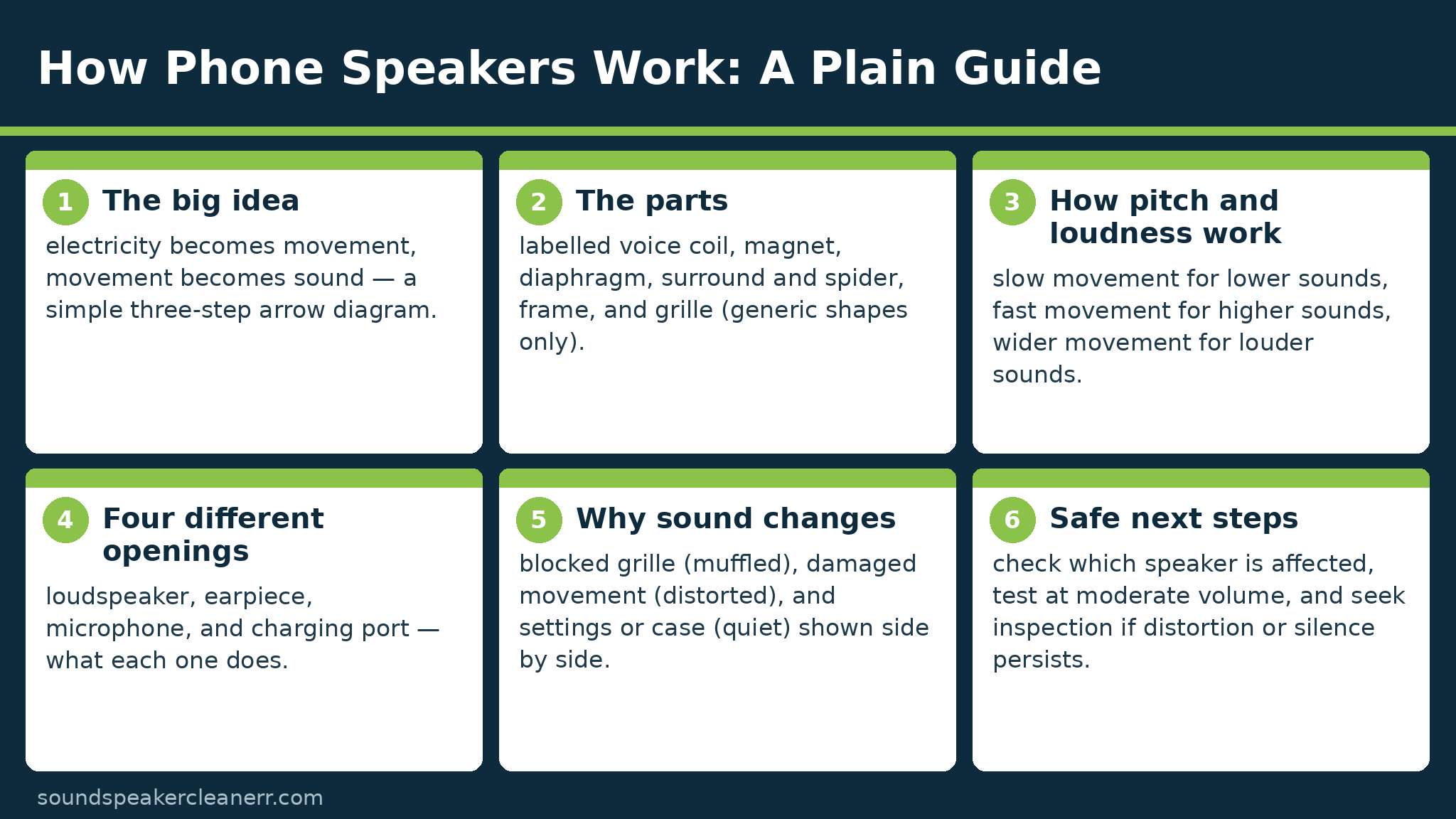
A phone speaker works by turning an electrical signal into movement, and movement into sound waves in the air. A small coil moves back and forth in a magnetic field, a thin diaphragm moves with it, and those vibrations push air toward your ears as sound.
That one sentence is the whole idea, and everything else in this guide is detail around it. Once you can picture the coil, the magnet, and the diaphragm, most phone sound problems become easier to understand: a blocked opening muffles sound because the air cannot move freely, while a damaged part distorts sound because it cannot move cleanly.
From a file to a sound you can hear
A song, a voice call, or an alarm starts as digital information stored on the phone. The phone turns that information into an electrical signal that changes rapidly over time. That signal is then strengthened by an amplifier, because the raw signal alone is too weak to move a speaker part.
The strengthened signal travels to the speaker driver, which is the part that does the converting. In most phones, the driver is a dynamic, or moving-coil, driver. It is tiny compared with a home speaker, but the principle is the same. The phone also has a small chamber behind or around the driver, and that chamber shapes how the sound leaves the phone. A larger home speaker can move much more air, which is part of why it can sound fuller; a phone speaker has far less room to work with.
It helps to separate three steps. First, electricity carries the pattern of the sound. Second, magnetism turns that pattern into movement. Third, the moving diaphragm turns movement into pressure waves in the air. If any step is interrupted — a software problem changes the signal, a part is damaged, or the opening is blocked — what you hear changes too.
The main parts, in plain language
The voice coil. This is a coil of thin wire. When electrical current flows through it, the coil acts like a temporary magnet. Change the current, and the magnetic force changes, so the coil moves in one direction, then back again, following the signal.
The permanent magnet. This is the fixed magnet that the voice coil works against. The coil sits in or near the magnet's field. Because the magnet does not move, the changing force on the coil is what creates the back-and-forth motion.
The diaphragm. This is the thin, flexible surface attached to the coil. Some descriptions call it a cone or a membrane. As the coil moves, the diaphragm moves with it. The diaphragm is the part that actually pushes the air. Its size and stiffness affect how it moves, but in a phone it is always small, which limits how much air it can move at once.
The suspension: surround and spider. These flexible parts hold the coil and diaphragm in place while letting them move. The surround connects the edge of the diaphragm to the frame, and the spider (a flexible support behind the diaphragm) keeps the coil centred so it does not rub against the magnet. Without them, the moving parts would wobble or scrape, and the sound would distort.
The frame, or basket. This holds the whole assembly together and fixes it inside the phone. In a phone, the frame is part of a very compact module, and the sound then travels through a channel to the holes or grille you can see on the outside.
The grille and mesh. The visible holes, and any fine mesh behind them, protect the driver from dust, lint, and fingers, while letting sound pass. They are not the speaker itself, but they sit in the path of the sound, so anything that blocks them changes what you hear. A separate article in this batch explains the mesh in detail.
Why the diaphragm's speed matters
Sound is vibration, and the speed of that vibration is what your ear hears as pitch. When the electrical signal changes slowly, the diaphragm moves back and forth slowly, and you hear a lower sound. When the signal changes quickly, the diaphragm moves quickly, and you hear a higher sound. Louder sound generally means the diaphragm moves farther, not just faster.
This is why a phone speaker can sound thin compared with a larger speaker. Low sounds need large movements of air, and a tiny phone diaphragm can only move a small amount of air with each stroke. Phone makers use the chamber, the tuning of the driver, and software processing to get the best result they can from a small space, but they cannot repeal the basic trade-off: a small moving surface moves less air than a large one.
It is also why you should not judge a speaker by one tone alone. Music and speech contain many frequencies at once, and the diaphragm has to follow a complex, changing pattern, not a single steady vibration. A speaker that sounds fine for a ringtone may still struggle with a busy song, and a speaker that sounds muffled may simply have a blocked path rather than a failed driver.
Earpiece, loudspeaker, microphone, and charging port are different parts
People often say "my phone speaker" when they mean any sound part, but a phone has several openings that look similar and do very different jobs.
The loudspeaker is the main speaker, usually at the bottom edge, used for music, videos, alarms, and speakerphone calls. The earpiece is the smaller speaker near the top, used when you hold the phone to your ear. It is quieter by design, because it only needs to reach one ear at close range, and it uses a smaller driver and opening.
The microphone works in the opposite direction: sound waves move its diaphragm, and that movement creates an electrical signal. That is why a cleaning tone aimed at the loudspeaker does not clean a microphone, and why a blocked microphone makes you sound quiet to the other person even though you can hear them perfectly well.
The charging port is not a sound part at all, although it sits close to the loudspeaker on many phones and can collect the same lint and dust. Water or lint in the charging port is a separate problem from water in the speaker, and charging a wet phone carries its own risks. Always follow the phone maker's guidance for a wet device, and do not charge until the device is dry.
Knowing which part you mean saves time. If calls on speakerphone sound fine but calls held to your ear sound quiet, the earpiece is the suspect, not the loudspeaker. If the other person cannot hear you, the microphone is the suspect, not either speaker.
Why a phone speaker sounds muffled, quiet, or distorted
Muffled sound usually means something is in the way of the air. Dust, lint, pocket debris, or water sitting in the grille or mesh can block the path, so less sound reaches your ear and the sound that does reach you loses clarity. This is the most common, least serious cause, and it is also the reason sound-cleaning tools play tones: the diaphragm's movement can sometimes push loose water or dust near the opening outward.
Quiet sound can have several causes. The volume setting, a case covering the opening, a software setting, or a blocked grille can all reduce what you hear without any damage. A damaged driver, on the other hand, tends to produce distortion — crackling, buzzing, or rattling — rather than simple quietness, because the moving parts are no longer moving cleanly.
Distortion at high volume is a warning sign. Pushing a small driver to its limit, especially a driver that is already blocked or damaged, can make the coil or diaphragm hit its limits or rub. Moderate volume is safer for both the speaker and your hearing, and it also gives you a cleaner test: if a speaker distorts even at moderate volume, the problem is more likely to be damage or a serious blockage than a setting.
Water deserves a special note. Water in the grille can muffle sound until it evaporates or is moved out, but water inside the phone is a different matter. Sound cannot dry the inside of a phone, and it cannot repair corrosion or damage caused by liquid. If a phone has been submerged for a long time, shows other problems besides muffled sound, or the sound does not improve after drying, it needs proper inspection rather than repeated tones at maximum volume.
Stereo sound, and why two speakers sound better than one
Many modern phones use two speakers for media: the loudspeaker at the bottom and the earpiece acting as a second speaker. Together they can create a wider, more balanced sound than a single small speaker, because the sound reaches your ears from two points and the phone can share the work between them.
This is also why a phone can sound unbalanced. If one opening is blocked and the other is clear, the sound seems to come mostly from one side. A left-right speaker test, linked below, is a simple way to check whether both sides are working. If only one side is quiet, check that side's opening and case fit before assuming the whole audio system has failed.
Stereo on a phone is still a compromise. The two speakers are very close together compared with home stereo speakers, so the sense of space is limited. What stereo does well on a phone is balance: neither side has to do all the work, and voices and music sound less thin than they would from one tiny driver alone.
What a cleaning tone can and cannot do, in light of how speakers work
Now that the mechanism is clear, the limits of cleaning tones make sense. A tone makes the diaphragm move, and that movement pushes air through the grille. If water droplets or loose dust are sitting near the opening, that air movement may push some of them out. That is a real, physical effect, and it is the same basic idea behind built-in water-ejection features on some watches and phones.
But a tone cannot do anything the diaphragm cannot do. It cannot reach dust packed behind the mesh, dry the inside of the phone, repair a torn diaphragm, re-centre a rubbing coil, or fix a software fault. It also cannot distinguish between the loudspeaker, the earpiece, and the microphone: the right tool and the right opening matter. Playing a loudspeaker tone while the earpiece is the problem will not help the earpiece, and playing tones at maximum volume for a long time is not better than a short, moderate session followed by a test.
The practical order is simple: check the obvious first (volume, case, and which speaker is affected), try a gentle physical clean and a short tone session if water or loose dust is the likely cause, test again at moderate volume, and stop and seek inspection if the sound stays distorted, stays silent, or other problems appear. Understanding the parts helps you stop at the right point instead of repeating a step that cannot fix the actual fault.
The short version to remember
A phone speaker is a small electric motor for air. Electricity becomes magnetism, magnetism becomes movement, and movement becomes sound waves. The voice coil and diaphragm do the moving, the magnet provides the fixed field, the suspension keeps the movement clean, and the grille protects the whole assembly while letting sound out. Small size limits how much air the speaker can move, which is why phone sound is thinner than home-speaker sound, and why a blocked grille or a damaged moving part changes the sound so quickly. If you remember the coil, the magnet, and the diaphragm, you have the whole picture.
FAQ
How does a phone speaker make sound?
An electrical signal flows through a voice coil inside a magnetic field. The changing current makes the coil move back and forth, the attached diaphragm moves with it, and the diaphragm pushes air in waves that your ears hear as sound.
What is the difference between the earpiece and the loudspeaker?
The loudspeaker is the main, louder speaker used for media, alarms, and speakerphone calls. The earpiece is the smaller, quieter speaker at the top used for calls held to your ear. They are separate drivers with separate openings, so one can be blocked while the other works normally.
Is a phone speaker the same as a microphone?
No. A speaker turns electricity into sound, while a microphone turns sound into electricity. They use similar parts in opposite directions, but cleaning or testing one does not fix the other.
Why do phone speakers sound worse than larger speakers?
A phone diaphragm is very small, so it moves much less air with each stroke than a large speaker. Low sounds in particular need large air movement, so small speakers sound thinner. The chamber and software tuning help, but they cannot fully make up for the size difference.
Does a blocked grille really change the sound that much?
Yes. The grille sits directly in the path of the sound. Dust, lint, or water in the grille or mesh blocks air movement and can make sound muffled, quiet, or uneven, even though the driver inside is working normally.
Can sound from a cleaning tone damage a phone speaker?
A short session at moderate volume is the safer approach. Repeated tones at maximum volume, especially on a speaker that is already distorted or damaged, add stress without adding benefit. If distortion continues at moderate volume, stop and seek inspection instead of turning the volume up further.
Why does only one side of my phone sound quiet?
Many phones use the loudspeaker and the earpiece together for stereo media. If one opening is blocked by a case, lint, or water, that side will sound quieter. Check each opening separately, and use a left-right test to confirm which side is affected.
Can a cleaning tone fix a damaged speaker?
No. A tone can sometimes move loose water or dust near the grille, but it cannot repair a torn diaphragm, a rubbing coil, corrosion, or any other physical damage. Persistent distortion, silence, or other faults after drying and gentle cleaning point to inspection or repair.
Leave a Reply