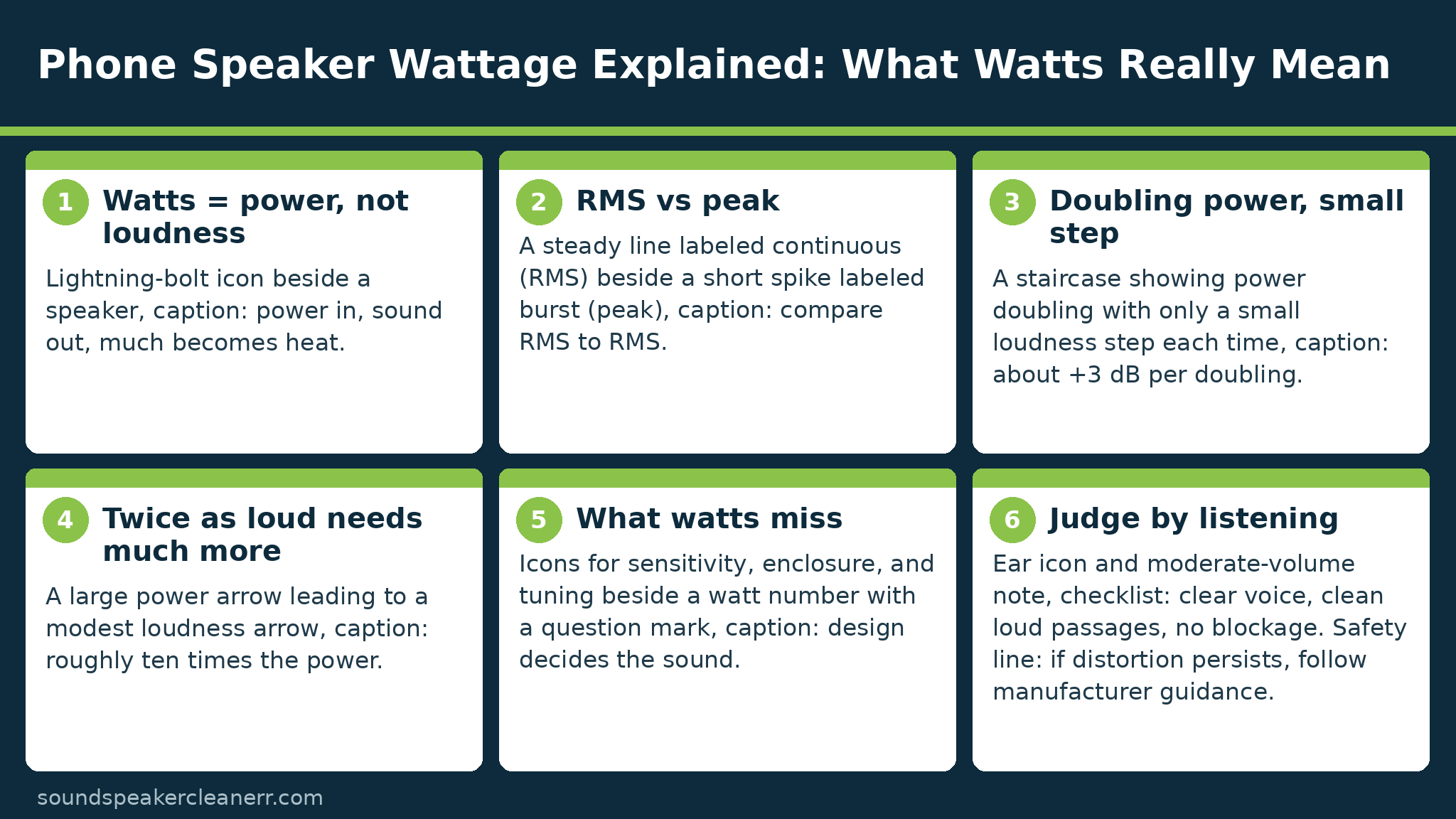
Watts measure electrical power, not loudness itself. For a speaker, a watt rating usually describes power handling — how much power the speaker can receive without distortion or damage — and for an amplifier it describes how much power it can send. More watts do not automatically mean louder sound, because loudness also depends on sensitivity, design, and how human hearing works.
That distinction is the whole point of this guide. Wattage is one of the most quoted specs in audio, and one of the most misunderstood. A bigger watt number looks like a better speaker, but on its own it tells you very little about what you will hear from a phone. Once you know the difference between continuous power and short-burst power, and why doubling power only adds a small step in loudness, watt figures become much easier to read — and much harder to be misled by.
What a watt actually is
A watt is a unit of power. In audio, power is the electrical energy an amplifier delivers to a speaker over time. The amplifier turns an audio signal into electrical power, the speaker's voice coil turns that power into movement, and the moving diaphragm turns movement into sound waves in the air. Not all of the electrical power becomes sound; much of it becomes heat in the coil and the amplifier. That is normal, and it is one reason efficient design matters more than raw power alone.
When a speaker is described with a watt figure, the figure usually means power handling: the amount of power the speaker can take before the sound starts to distort or the parts risk damage. When an amplifier is described with a watt figure, it usually means power output: the amount of power it can deliver. Those are two sides of the same pairing, and in a well-designed system they suit each other. Confusing the two — for example, assuming a speaker "produces" watts the way an amplifier does — leads to the most common misreadings.
For a phone, the amplifier and speaker are designed together, inside a small, battery-powered device with very limited space for heat to escape. The power available is therefore modest by home-audio standards, and the design must be efficient. That is not a flaw; it is a trade-off. A phone speaker is designed to be clear at the distances people actually use it — in the hand, on a desk, or on speakerphone — not to fill a large room the way a home speaker is.
RMS vs peak: the only watt distinction that matters most
If you remember one watt distinction, make it this one: RMS versus peak. RMS stands for root mean square, and in plain language it means continuous power — the power a speaker or amplifier can handle or deliver steadily over time during normal use. Peak power means the maximum power handled or delivered in a very short burst, such as a sudden drum hit or a loud sound effect. Peak figures are always higher than RMS figures for the same device, sometimes several times higher.
That gap is where marketing creeps in. A product advertised with a large peak number can look far more powerful than a product advertised honestly with its RMS number, even if the two perform similarly in everyday listening. Some listings use an even less meaningful figure called PMPO, or peak music power output, which describes an extreme short burst under favorable conditions and is widely treated as a marketing number rather than a useful comparison. The safe rule is simple: compare RMS to RMS, and treat a listing that shows only a peak or PMPO figure as incomplete information.
Why does continuous power matter more? Because music, speech, and video are continuous. A speaker does not play one burst and then stop; it plays for minutes or hours. A rating that only describes a fraction of a second does not describe that experience. RMS gives a realistic picture of what the device can sustain without distortion or strain. Peak still has a role — it describes headroom for sudden loud moments — but it should never be the only number you compare.
On a phone, you will rarely see either figure advertised as a headline spec, because the internal amplifier and speaker are not sold separately. When watt figures do appear in technical discussions of phones, they are best read as design notes about the internal pairing, not as a ranking you can use to choose between phones. The sound you hear depends on the whole system, not on one power number.
Why doubling watts does not double loudness
Human hearing does not work in a straight line. It works logarithmically, which means equal steps in perceived loudness require ever larger steps in power. The standard rule of thumb from audio guides is clear: doubling the power adds only about 3 decibels, which most listeners notice as a small increase, not a doubling. To make a sound feel roughly twice as loud, you need about ten times the power, an increase of about 10 decibels.
A worked example makes this concrete in general terms. If a system is playing at a given level and you double its power, the level rises by about 3 dB. Double again, and it rises another 3 dB. After two doublings — four times the original power — the level is about 6 dB higher, which is clearly louder but still not twice as loud in perception. Reaching roughly twice-as-loud requires about ten times the power. That is why chasing watt numbers quickly becomes impractical: each extra step in loudness costs far more power than the last.
This rule also explains why a modest, well-designed speaker can sound satisfying while a high-wattage speaker can disappoint. If the high-wattage design is inefficient, or if its enclosure and tuning waste energy, the extra power may be spent as heat or distortion rather than as clean sound. Power is an input. Loudness is an output, and the conversion between them depends on efficiency. That conversion is described by sensitivity, covered in the companion explainer.
Distance matters too. Sound spreads as it travels, so a phone held close to you sounds louder than the same phone across a room, even at the same volume setting. Room surfaces, background noise, and whether the speaker faces you or is muffled by a case or a hand also change what you hear. None of those factors appear in a watt figure, which is another reason watts alone cannot predict your experience.
What watts do tell you, and what they do not
Watts are still useful, when read correctly. A power-handling figure tells you about the limits of a design: how much continuous power it can take before distortion or damage becomes a risk. An amplifier output figure tells you about the headroom available for clean peaks. In a system with separate parts, matching those figures sensibly matters — an amplifier that constantly drives a speaker far beyond its continuous rating risks distortion and damage, while a very weak amplifier pushed to its limit can also distort.
What watts do not tell you is sound quality. Tone, clarity, bass control, voice intelligibility, and distortion at your normal listening volume are not described by a watt number. Two speakers with the same watt rating can sound very different because of driver design, enclosure, tuning, and processing. A speaker with a lower watt rating but a better design can sound clearer and more satisfying than a higher-rated speaker that distorts early or sounds harsh.
Watts also do not tell you about battery life in a simple way. A phone that can deliver more power is not automatically a phone that drains faster, because efficiency, processing, and how loudly you actually listen all matter. Listening at a moderate volume, which is also safer for your hearing and for the speaker, uses far less power than listening at maximum volume. If battery life matters to you, real-world usage matters more than a watt figure.
Wattage myths to leave behind
The first myth is "more watts always means louder." As shown above, loudness grows slowly with power, and sensitivity and design intervene. A second myth is "a high peak number means a powerful speaker." Peak numbers describe short bursts, not sustained performance, and PMPO numbers are not a reliable comparison at all. A third myth is "you need the highest wattage for good sound." For close listening — calls, videos, podcasts, and music in the hand or on a desk — clarity and clean output at a moderate volume matter far more than maximum power.
A fourth myth is specific to phones: "a phone with a bigger watt figure must have a better speaker." Phone makers do not generally compete on internal watt figures, and the figure, when it appears, describes an internal pairing you cannot change. Judging a phone speaker by an internal watt number is like judging a meal by the size of the stove it was cooked on. The stove matters, but the recipe, ingredients, and cook matter more.
Finally, beware of comparisons that mix RMS and peak figures. A listing that shows one device's peak number beside another device's RMS number is not a fair comparison, even if the numbers look similar. Always check which kind of watt figure you are looking at, and if the listing does not say, treat it as incomplete.
How to judge a phone speaker instead
Judge by listening, at the volume you actually use. Play speech first: a clear phone speaker keeps voices intelligible without harshness or muddiness. Then play music with a mix of quiet and loud passages: a good speaker stays clean on the loud parts instead of distorting or rattling. Check both the earpiece and the loudspeaker separately, because they are different parts with different jobs. The earpiece is for calls held to the ear; the loudspeaker is for speakerphone, media, and ringtones. A fault in one does not prove a fault in the other.
Check the simple causes before blaming power or specs. A case covering the speaker, a hand over the grille, dust or lint blocking the opening, or a software setting that has lowered volume can all make a speaker sound quiet or dull. Clean gently, without sharp tools, and keep the volume moderate while testing. Sound played through a speaker may help with loose surface dust in some cases, but it does not always eject water or dust, and it does not repair damage. If sound stays distorted, muffled, or absent, follow the manufacturer's guidance or seek professional repair rather than forcing maximum volume.
If you are comparing phones in a store or from reviews, listen for the same things reviewers should describe: clarity at moderate volume, distortion at higher volume, and whether voices stay natural. A trustworthy review describes what was heard, not just what the spec sheet says. Watt figures, when mentioned, should be labeled as RMS or peak, and should sit alongside listening impressions — not replace them.
FAQ
Do more watts mean a louder phone speaker?
Not automatically. Doubling power adds only about 3 dB, a small increase, and roughly ten times the power is needed for a sound to feel twice as loud. Sensitivity, design, and processing also decide loudness, so watts alone cannot predict it.
What is the difference between RMS and peak watts?
RMS is continuous power — what a speaker or amplifier can handle or deliver steadily during normal use. Peak is the maximum for very short bursts. RMS is the meaningful figure for comparison; peak alone is incomplete and often inflated for marketing.
What is PMPO, and should I trust it?
PMPO, or peak music power output, describes an extreme short burst under favorable conditions. It is widely treated as a marketing figure rather than a useful comparison. If a listing shows only PMPO, treat it as incomplete and look for an RMS figure.
Is a high-wattage speaker always better quality?
No. Wattage describes power handling or output, not tone, clarity, or distortion. A lower-rated but well-designed speaker can sound clearer than a higher-rated speaker that distorts early or sounds harsh.
Why do phone makers rarely advertise speaker watts?
Because the amplifier and speaker are built together inside the phone and are not sold or swapped separately. The watt figure describes an internal pairing, not a feature you can upgrade, so it is not a useful headline buying spec for most buyers.
Can too much power damage a speaker?
In a system with separate parts, driving a speaker far beyond its continuous rating can cause distortion or damage, and pushing a weak amplifier to its limit can also distort. On a phone, the pairing is fixed by design, so do not try to force extra power through it.
Does listening louder drain the battery faster?
Listening at maximum volume uses more power than listening at a moderate volume, but battery life also depends on efficiency and processing. Moderate volume is kinder to both battery and hearing, and to the speaker itself.
How should I compare two phone speakers if not by watts?
Listen at your normal volume. Check speech clarity, whether loud passages stay clean, and whether the earpiece and loudspeaker each work well. Check for blockages or settings first if one sounds quiet or dull.
Leave a Reply