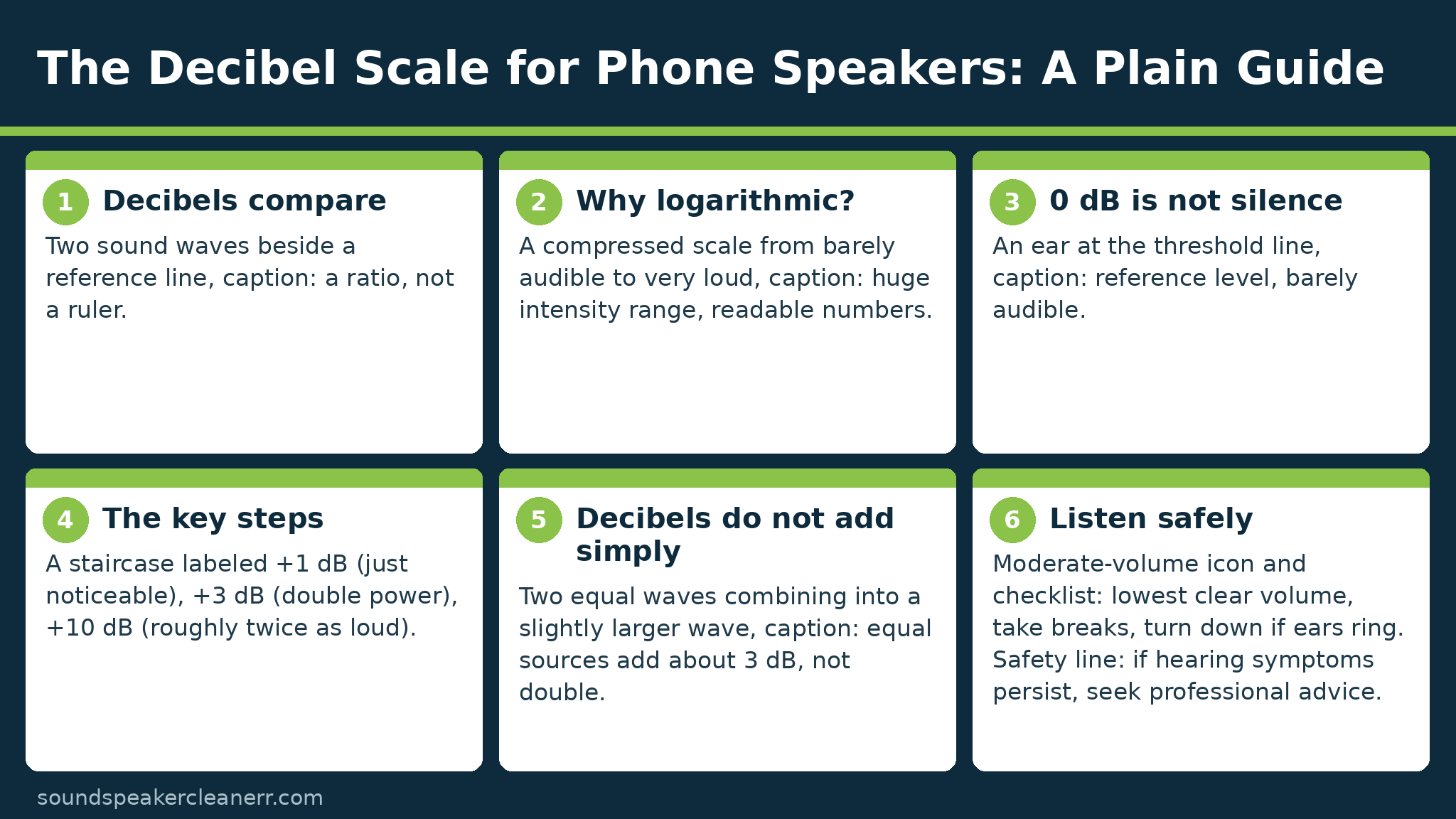
A decibel (dB) is not a direct measure of loudness like a meter measures length. It is a ratio comparing one sound with a reference sound, on a logarithmic scale. That is why small decibel changes can mean large power changes.
Once you grasp that one idea — decibels compare, they do not count like ordinary numbers — the rest of the scale falls into place. You will stop adding decibels together as if they were ordinary numbers, stop assuming that a higher dB figure always means a proportionally louder phone, and start reading speaker specs with far more confidence. You will also have a better sense of when volume is getting into the range where moderation and hearing protection matter.
Why we need a logarithmic scale at all
Human hearing covers an astonishing range. The quietest sound a healthy ear can detect and the loudest sound it can tolerate differ in intensity by an enormous factor — many orders of magnitude. If we tried to describe that range with a straight, linear scale, the numbers would be unwieldy: tiny numbers for quiet sounds, huge numbers for loud ones, and almost no useful detail in between.
The decibel solves this by compressing the range. It takes the ratio between a sound and a reference sound, takes the logarithm of that ratio, and multiplies by ten. The result is a compact scale that runs, for everyday sounds, roughly from 0 dB upward past 100 dB. A whisper, a conversation, a busy street, and a loud concert can all sit on the same readable scale, even though their actual intensities differ by factors of thousands or millions.
This compression is not just a mathematical convenience. It also matches how we hear. Our ears respond to proportional changes, not absolute ones. Adding the same amount of power to a quiet sound makes a bigger impression than adding the same amount to an already loud sound. A logarithmic scale captures that behavior: equal steps on the decibel scale feel like roughly equal steps in loudness, even though the power steps behind them grow larger and larger.
The unit itself is named for Alexander Graham Bell. The original unit, the bel, described a tenfold ratio of power. A bel proved too large for everyday use, so the decibel — one-tenth of a bel — became the standard. That history explains the "deci" in decibel and the factor of ten in the formula, but you do not need the formula to use the scale well. You need the rules of thumb that follow from it.
What 0 dB does and does not mean
One of the most common misunderstandings is that 0 dB means silence. It does not. In sound pressure level, written dB SPL, 0 dB is the reference level — roughly the quietest sound an average healthy ear can detect under ideal conditions. A sound at 0 dB SPL is barely audible, not absent. Sounds below 0 dB SPL exist in measurement terms but are generally below the threshold of hearing.
This matters because decibels always need a reference to mean anything absolute. When you see "dB SPL," the reference is a standard quiet threshold. When you see "dB" on a phone's volume display, a mixing desk, or a digital file, the reference may be different — for example, the maximum level a digital system can represent, where levels are negative and 0 dB is the ceiling, not the floor. Two figures that both say "dB" but use different references cannot be compared directly. Always check which kind of decibel you are looking at.
For phone speakers, the most useful reference is dB SPL: the actual sound pressure reaching your ears. A sensitivity figure, for example, is stated in dB SPL at a standard distance, because it describes real sound in the air. A volume slider position, by contrast, is not a dB SPL figure at all — it is a control setting. That is why two phones at "half volume" can produce very different sound levels: the slider does not measure the sound, it only sets the signal.
The rules of thumb that matter
Four rules cover most everyday uses of the decibel scale. First, about 1 dB is the smallest change most people can reliably notice under good listening conditions. A change smaller than that is real in measurement terms but may be imperceptible in practice. Second, doubling the power adds about 3 dB. This is the same rule that appears in the wattage and sensitivity explainers, because power and decibels are linked: twice the power is a small step on a logarithmic scale, not a doubling of loudness.
Third, a change of about 10 dB feels roughly twice as loud, or half as loud, to most listeners. Reaching that 10 dB step requires about ten times the power. That is why loudness is expensive in power terms: each step that feels like a doubling costs ten times the energy of the step before it. Fourth, decibels do not add like ordinary numbers. Two separate sources each producing the same level do not double the decibel number. Two independent sources at the same level together produce a level about 3 dB higher, not twice the number. If you see "60 dB + 60 dB = 120 dB," that calculation is wrong.
These rules explain many everyday puzzles. They explain why turning a phone from half volume to full volume does not sound twice as loud, or even close to it, in a simple proportional way. They explain why a speaker that is a few decibels more sensitive can be noticeably louder with far less power. And they explain why a small decibel difference in a spec sheet — 3 dB, for example — is not a trivial detail but a meaningful gap.
Distance also follows a rule worth knowing. As sound spreads from a small source, its level falls as you move away. Doubling the distance from a phone speaker reduces the level noticeably, though the exact amount depends on the environment — walls, furniture, and reflections all shape the result. The practical point is simple: moving a phone closer is often more effective, and safer, than turning it up much louder.
Reading decibel figures on phones and speakers
When you encounter a decibel figure for a phone or a speaker, ask what it describes. A sensitivity figure describes loudness at a standard distance from a standard input, and is useful for comparing efficiency when the measurement conditions match. A maximum loudness figure, if given, describes the loudest output the design can produce, usually at a close distance and often with some distortion allowed — so it is not a figure for comfortable listening. A volume or gain figure in decibels, such as on a mixer or an audio app, describes a change relative to a reference, not an absolute loudness in the room.
Be cautious with figures that lack context. A claim that a device "reaches" a certain decibel level means little without the distance, the test signal, and the distortion limit. A figure measured very close to the speaker will always look larger than the same speaker measured from a normal listening distance. A trustworthy description states those conditions; a marketing claim that omits them should be treated as incomplete.
Also remember that decibels describe level, not quality. A loud speaker is not automatically a clear speaker. Distortion, harshness, and muddiness can all increase as volume rises, especially from a small phone driver pushed to its limit. A speaker that sounds clean at a moderate volume is more useful than a speaker that can reach a high decibel figure only by distorting. Judge by listening, not by the largest number on the page.
Decibels, hearing, and safe listening
Decibels are also a hearing-safety tool, because risk depends on both level and time. Brief exposure to a moderately loud sound is very different from prolonged exposure to the same level. As a general principle, the louder the sound, the shorter the safe listening time. That is why moderation matters more than any single number: a phone at a comfortable volume for a call or a video is very different from a phone at maximum volume held close to the ear for a long period.
A few practical habits follow from the scale. First, keep the volume at the lowest level that lets you hear clearly. If you must raise it to overcome background noise, consider moving to a quieter place or using headphones at a moderate level rather than pushing the loudspeaker to its limit. Second, take breaks from loud listening, and do not fall asleep with a loudspeaker or headphones playing at high volume. Third, pay attention to warning signs: ringing in the ears, a feeling of fullness, or needing to raise your voice to be heard over the sound are all signals to turn down and rest your ears.
For children, extra caution applies. Young ears are more vulnerable, and children may not report discomfort or may keep listening at high volume without realizing the risk. Keep volumes moderate, favor the loudspeaker at a distance over headphones at high volume where possible, and use any volume-limit settings the device provides.
If you notice persistent ringing, muffled hearing after listening, or difficulty understanding speech, stop loud listening and seek professional advice. This guide is educational, not medical advice, and it cannot diagnose hearing problems. The safe rule is simple: if it sounds uncomfortably loud, it is too loud, regardless of what any number says.
A plain-language scale you can use
Without claiming precise measurements for any phone, a general sense of the scale helps. Near the bottom, around the reference level, sounds are barely audible. Quiet speech and a quiet room sit in the lower part of the scale. Normal conversation sits higher. A busy street, a vacuum cleaner, or a loud television sits higher still. Very loud music, power tools, and engines sit near the top of the everyday scale, where prolonged exposure becomes a hearing concern.
The key lesson is not the exact number for each example, but the spacing: each 10 dB step feels roughly like a doubling, each 3 dB step is a doubling of power, and each 1 dB step is just noticeable. When you see a decibel figure, translate it with those steps rather than reading it as a percentage or a score. A device that is 3 dB louder is meaningfully louder. A device that is 10 dB louder is dramatically louder. A device that is 1 dB louder is barely different.
That translation skill is the real payoff of understanding decibels. It lets you read sensitivity figures, wattage discussions, and loudness claims without being misled by big numbers or small differences. It also lets you make safer choices: you can recognize when a small increase in the volume slider represents a large increase in power, and when a sound has crossed from comfortable into the range where moderation matters.
FAQ
What is a decibel in simple terms?
A decibel (dB) is a unit that compares one sound with a reference sound on a logarithmic scale. It does not measure loudness like a ruler measures length; it expresses a ratio, so small dB changes can represent large changes in power.
Does 0 dB mean complete silence?
No. In sound pressure level (dB SPL), 0 dB is the reference level, roughly the quietest sound an average healthy ear can detect. It means barely audible, not absent. Other dB references, such as digital maximum, use 0 dB differently, so always check the reference.
Why is the decibel scale logarithmic instead of linear?
Because human hearing covers an enormous range of intensities, and our ears respond to proportional changes. A logarithmic scale compresses that range into readable numbers and matches how we perceive equal steps in loudness.
How much louder is +3 dB?
Doubling the power adds about 3 dB, which most listeners notice as a small increase, not a doubling. A 3 dB sensitivity gap is still meaningful, because it represents roughly twice or half the power for the same volume.
How much louder is +10 dB?
About twice as loud in perception, and it requires about ten times the power. That is why loudness is expensive in power terms, and why chasing large loudness gains with power alone quickly becomes impractical.
Do decibels add up like normal numbers?
No. Two independent sources at the same level together produce a level about 3 dB higher, not double the number. For example, two equal sources do not produce twice the decibel figure; they produce a modest increase.
Is my phone's volume slider measured in decibels?
No, not as sound in the room. The slider sets the signal level sent to the amplifier and processing. The actual sound level in decibels depends on the speaker, enclosure, distance, and environment, so the same slider position can sound different on different phones.
How loud is too loud for safe listening?
As a general principle, the louder the sound, the shorter the safe listening time. Keep volume at the lowest level that lets you hear clearly, take breaks from loud listening, and turn down if you notice ringing, fullness, or difficulty hearing afterward. This guide is educational, not medical advice.
Leave a Reply