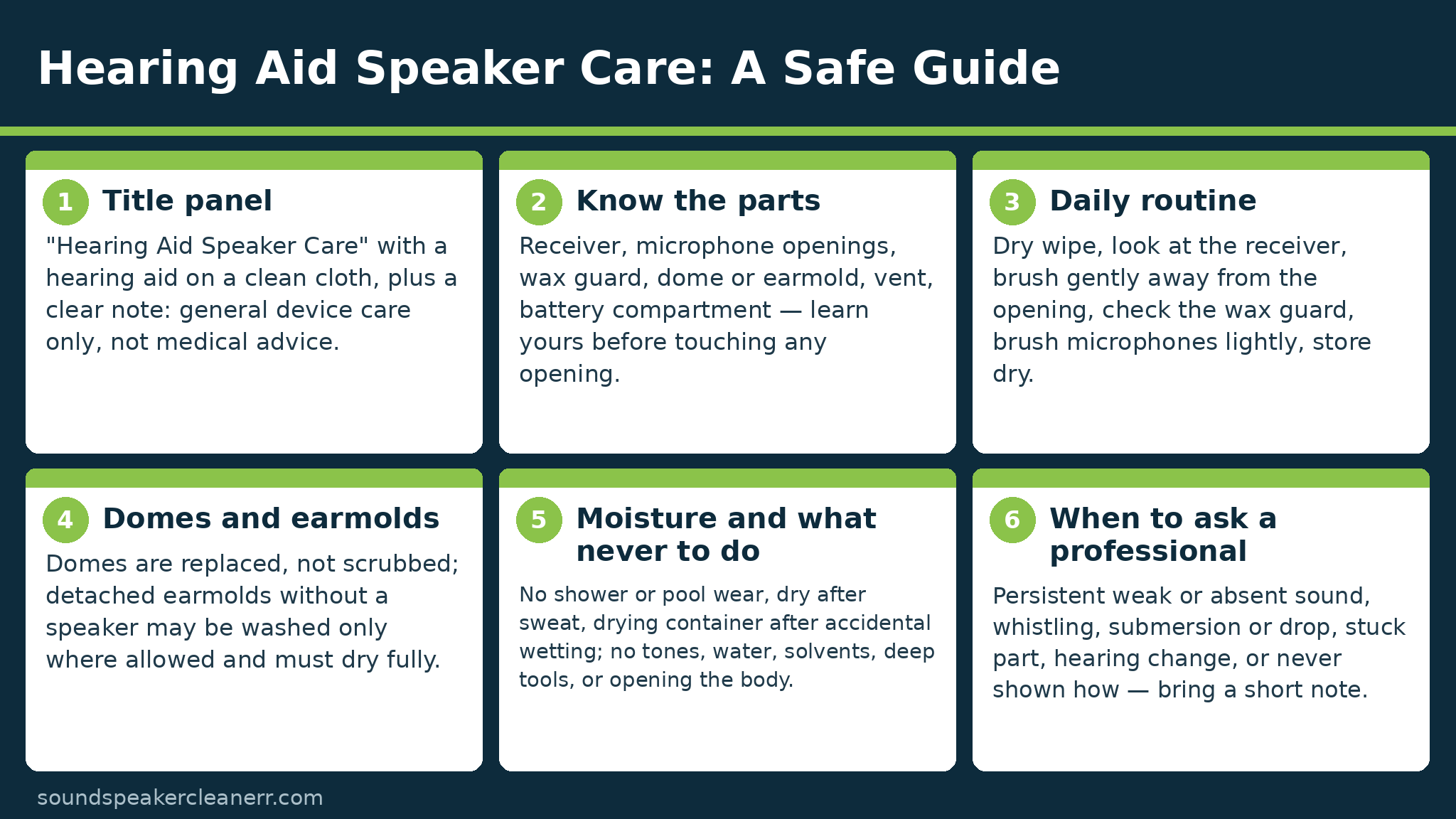
A hearing aid that sounds weak, muffled, or silent is often blocked by wax at the receiver — the small speaker delivering sound into the ear — or at a wax guard or microphone opening. General care means a daily dry wipe and brush, a check of the receiver and wax guard, and prompt drying after moisture.
That short answer is the whole general method, and its limits are part of the method. A hearing aid is a personal medical device, not an ordinary speaker. Its openings are tiny, its receiver sits in or near the ear canal, and its parts — wax guards, domes, earmolds, tubing — vary by model in ways a general guide cannot cover. This guide therefore describes what is generally safe, what is generally unsafe, and when to stop and ask a professional, rather than giving model-specific instructions. If any step here conflicts with the manufacturer's instructions for your aid or with advice from your audiologist, follow the manufacturer and the audiologist.
Know the parts before you touch them
A hearing aid has several small parts, and confusing them causes damage. Learn yours before cleaning, using the manufacturer's guide for your exact model:
- Receiver (speaker). In receiver-in-canal aids, the receiver sits at the end of a thin wire, inside the ear canal. In other aids, the speaker is inside the body of the aid, and sound travels through tubing or an earmold. The receiver opening is where sound comes out, and it is the part most often blocked by wax.
- Microphone openings. Small holes, usually on the body of the aid, where sound goes in. Some aids have more than one microphone opening. Blocked microphones make sound faint even when the receiver is clear.
- Wax guard or filter. A tiny filter in the sound outlet that helps prevent wax and debris from entering the receiver. It is a replaceable part, not a part to be cleaned deeply or forced open.
- Dome or earmold. The soft tip or custom-molded piece that sits in the ear. Domes are usually replaced rather than cleaned deeply; earmolds have their own cleaning rules, and only a detached earmold without electronics may ever be washed, as described below.
- Vent. A narrow channel that lets air pass through an earmold or aid. It can collect wax, but it is not the receiver opening, and it needs its own gentle tool if the manufacturer provides one.
- Battery compartment or charging contacts. The power part of the aid. Moisture, wax, and debris here affect power, not just sound, and the compartment should be kept dry and clean.
If you are unsure which opening is the receiver and which is a microphone, stop and check the manufacturer's guide or ask an audiologist before inserting any tool. A tool in the wrong opening, or pushed too deeply into the right one, can damage the receiver diaphragm or a microphone.
The daily routine: dry, gentle, and brief
A short daily routine, done at the end of the day when wax is still soft, prevents most blockages. Do it on a clean, dry surface, over a soft cloth or towel, so a dropped aid does not bounce or fall to a hard floor. Wash and dry your hands first, so you do not transfer moisture, lotion, or sunscreen to the aid.
Step 1: Wipe the aid. Wipe the body of the aid with a dry, soft cloth — ideally the cloth that came with the aid. Wipe the dome or earmold surface with the same dry cloth to remove surface wax and debris. Do not use water, solvents, cleaning fluids, alcohol, or household cleaners on the body of the aid, unless the manufacturer's guidance for your exact model expressly allows a specific wipe. Many general sources advise dry cleaning only, and that is the safe default.
Step 2: Look at the receiver opening. Look at the receiver opening in good light every day. If you see wax or debris, brush it away gently with the soft brush that came with the aid, brushing away from the opening so debris moves out rather than in. Use only the brush or loop tool that came with the aid, or one your audiologist has shown you how to use. Do not push any tool deeply into the receiver opening, do not use a pin, toothpick, or other household object, and do not use compressed air.
Step 3: Check the wax guard. If the wax guard looks full, blocked, or discolored, or if sound is dampened or absent and the receiver looks blocked, the guard may need replacing. Replace it only with the correct guard for your model, following the manufacturer's instructions, and only if you have been shown how. If you have not been shown how, or if you are unsure which guard fits, ask an audiologist rather than guessing. How often a guard needs changing varies by person and by device, so no universal schedule is given here — your audiologist should guide the frequency for you.
Step 4: Brush the microphone openings. Brush across the microphone openings very lightly with a dry, soft brush, away from the aid, so dust and wax move out rather than in. Do not poke anything into a microphone opening, and do not drip liquid into it. If microphones look clear but sound is still faint, the problem may be elsewhere, and further cleaning is not the next step.
Step 5: Check domes, earmolds, and tubing. If your aid has a dome, check that it is secure, undamaged, and free of wax buildup. Domes are generally replaced rather than cleaned deeply, and replacement timing should follow the manufacturer's guidance or your audiologist's advice. If your aid has an earmold, wipe it with a dry cloth while it is attached. If your aid has thin tubing, check it for blockages or stiffness, and clear it only with the brush or bulb blower provided for that purpose. Do not pull tubing, do not stretch a dome, and do not reattach anything that feels loose or cracked.
Step 6: Open the battery compartment and store dry. If your aid uses removable batteries, open the battery compartment at night to let it air out, following the manufacturer's guidance. Store the aid in its case or drying container, in a dry room, away from bathrooms, kitchens, and direct sunlight. Keep small aids, batteries, domes, and filters away from children and pets, because they are small enough to swallow.
Domes and earmolds: replace, do not force
Domes and earmolds are the parts most often damaged by well-meaning deep cleaning, because they feel like ordinary ear tips and are not.
A dome is a soft tip that covers the receiver. It is designed to be replaced, not scrubbed, soaked, or stretched. If a dome is torn, hardened, discolored, or will not stay in place, replace it with the correct size and type for your model, following the manufacturer's instructions or your audiologist's guidance. A dome that fits poorly can cause whistling (feedback), discomfort, or a dome left in the ear — all reasons to ask a professional rather than to improvise.
An earmold is a custom or semi-custom piece that sits in the ear. While it is attached to the aid, wipe it only with a dry cloth. An earmold that does not contain a speaker may be washed in warm soapy water, but only after it has been fully detached from the body of the aid, and only if the manufacturer's guidance allows washing for your earmold type. After washing, it must be completely dry before it is reattached — any moisture left inside can reach the aid's electronics. An earmold that contains a speaker must not be washed in the same way, and its opening should be cleaned only with the gentle loop tool provided, without pushing deeply. If you are unsure whether your earmold contains a speaker, treat it as if it does, and ask an audiologist.
Tubing that has become hard, stiff, yellowed, or cracked should be replaced, not cleaned harder. Stiff tubing affects sound and fit, and it is a routine maintenance item for an audiologist, not a household cleaning task.
Moisture, sweat, and what to do after getting wet
Moisture is the most common enemy of hearing aid electronics, and it comes from everyday sources: sweat, humidity, rain, and accidental splashes. A hearing aid should not be worn in the shower, bath, or pool, and it should not be stored in a bathroom, where steam and humidity collect.
After exercise or a hot day, wipe the aid with a dry cloth and let it air out in its case or drying container. If the aid is accidentally exposed to water, remove the battery if it uses one, wipe it with a dry cloth, and place it in a drying container or dehumidifier as soon as possible, following the manufacturer's guidance for your model. Do not use a hairdryer, a radiator, an oven, or any direct heat to dry it, and do not charge a wet aid. Do not use rice: it does not dry electronics reliably, and starch dust can enter small openings.
A drying container is a general maintenance tool, not a repair tool. If the aid was submerged or still sounds weak after thorough drying, contact the manufacturer or an audiologist rather than repeating drying steps.
What never to do with a hearing aid
Some habits that are safe for ordinary speakers are unsafe for hearing aids, and they are worth stating plainly:
- Do not use water, solvents, alcohol, or household cleaners on the aid body. Dry cleaning is the safe default, and any wipe or solution must be one the manufacturer expressly allows for your model.
- Do not play a speaker-cleaner tone through a hearing aid. Tone tools on this site are designed for phone speakers, not for hearing aids. A hearing aid receiver is not a phone speaker, and loud tones will not clear wax from a receiver opening. They can only risk discomfort and driver stress.
- Do not push tools deeply into any opening. A wax loop, brush, or vent cleaner should be used only as the manufacturer or audiologist has shown, and only to the depth they specify. Pushing deeper can damage the receiver diaphragm or a microphone, or push wax further in.
- Do not use compressed air, a pin, a toothpick, or a household object. These can drive wax deeper, damage small openings, or leave debris behind.
- Do not open the aid body. Internal cleaning and repair are professional tasks. If sound does not return after gentle care, that is a professional question, not a reason to open the case.
- Do not share hearing aids, domes, or filters with another person. Hearing aids are fitted to an individual, and sharing parts risks poor fit, discomfort, and hygiene problems.
When to contact an audiologist or the manufacturer
Contact an audiologist, hearing care professional, or the manufacturer — rather than cleaning further — if any of these apply:
- Sound stays weak, muffled, distorted, or absent after gentle daily care and a wax guard check.
- The aid whistles (feedback) even though the dome or earmold looks secure and the openings look clear. Feedback can mean a poor fit, a crack, wax blockage, or a loose connection, and it needs professional assessment.
- The aid was submerged, exposed to salt water or soapy water, dropped, cracked, or shows swelling, corrosion, or a loose part.
- A dome, filter, or part is stuck, lost in the ear, or cannot be removed safely. Do not try to retrieve a part from the ear canal yourself; seek professional help promptly.
- You notice any change in hearing, discomfort, pain, drainage, or irritation in the ear. This guide does not cover ear health, and those symptoms need a hearing care professional or clinician, not device cleaning.
- You have never been shown how to change a wax guard, dome, or filter for your model, or you are unsure which part fits. A short professional demonstration prevents most damage from incorrect parts.
When you contact a professional, bring a short note: the aid type, what you cleaned and how, whether the receiver, microphones, or both seem affected, whether the aid was exposed to moisture, and when the problem started. That note helps the professional distinguish a blocked opening from a fit, battery, or internal problem without repeating your steps.
A simple routine that prevents the next blockage
Hearing aid care does not need to be long or aggressive. A brief daily dry wipe and brush, a nightly check of the receiver and wax guard, a regular drying routine, and prompt professional help when something changes will prevent most blockages. Keep the aid dry, keep it in its case when not worn, and keep the manufacturer's guide where you can find it.
FAQ
How do I care for a hearing aid speaker safely?
Wipe the aid daily with a dry soft cloth, look at the receiver opening in good light, brush wax away gently with the brush that came with the aid, and check the wax guard. Do not use water, solvents, or alcohol on the aid body, and do not push any tool deeply into an opening.
What is a wax guard, and when should it be changed?
A wax guard is a tiny replaceable filter in the sound outlet that helps prevent wax and debris from entering the receiver. Change it when it looks full or blocked, or when sound is dampened or absent and the receiver looks blocked, using only the correct guard for your model and only if you have been shown how. Replacement frequency varies by person and device, so ask an audiologist to guide it for you.
How do I clean hearing aid microphone openings?
Brush across them very lightly with a dry soft brush, away from the aid, so debris moves out rather than in. Do not poke anything into a microphone opening and do not drip liquid into it. If microphones look clear but sound is still faint, contact a professional rather than cleaning further.
Should I wash a hearing aid dome or earmold?
Domes are generally replaced rather than washed or scrubbed. An earmold without a speaker may be washed in warm soapy water only after it is fully detached from the aid and only if the manufacturer's guidance allows it, and it must be completely dry before reattaching. If you are unsure whether your earmold contains a speaker, treat it as if it does and ask an audiologist.
What should I do if my hearing aid gets wet?
Remove the battery if it uses one, wipe it with a dry cloth, and place it in a drying container or dehumidifier as soon as possible, following the manufacturer's guidance. Do not use heat, rice, or compressed air, and do not charge a wet aid. If it was submerged or still sounds weak after drying, contact the manufacturer or an audiologist.
Can I use a speaker-cleaner tone on a hearing aid?
No. Tone tools on this site are designed for phone speakers, not for hearing aids. A hearing aid receiver is not a phone speaker, and loud tones will not clear wax from a receiver opening. Gentle physical care, as described here, is the correct general method.
When should I contact an audiologist instead of cleaning further?
When sound stays weak or absent after gentle care, when the aid whistles even with a secure dome and clear openings, when it was submerged, dropped, or cracked, when a part is stuck or lost, when you notice any change in hearing or ear discomfort, or when you have never been shown how to change a guard, dome, or filter. This guide is general device care only, not medical advice.
Is this guide medical advice?
No. This guide covers general device care only. It does not diagnose hearing problems or ear health issues, and it does not replace the manufacturer's instructions or an audiologist's advice. For device-specific care, hearing changes, or ear discomfort, contact the manufacturer or an audiologist or hearing care professional.
Leave a Reply