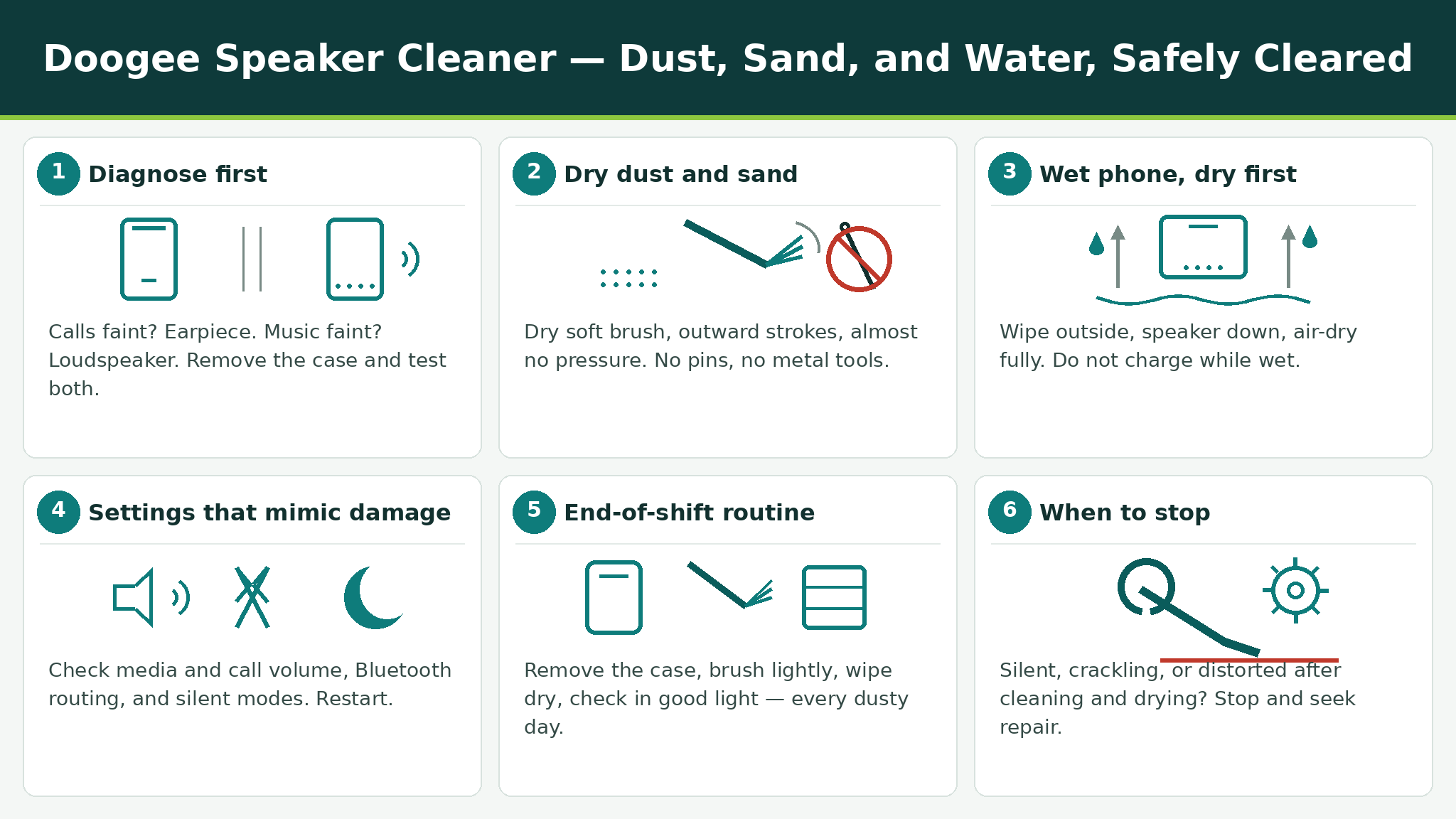
A Doogee rugged phone speaker usually sounds muffled because sand, dust, or water is blocking the grille, not because the speaker has failed. Remove the case, find whether calls or media are affected, brush the grille gently with a dry soft brush, and let a wet phone air-dry fully before charging or judging the sound.
Which Doogee phones this guide covers
This is a parent guide for Doogee rugged phones as a group. It does not claim a feature, rating, or menu layout for any single model, because Doogee's rugged range spans many years, sizes, and designs. Speaker placement varies by model: some have a bottom loudspeaker, some place the loudspeaker on the back, and every phone has a separate earpiece near the top for calls. Before cleaning, find both openings on your own phone in good light and treat them separately. A blocked earpiece makes calls sound faint while music sounds normal, and a blocked loudspeaker does the opposite. That distinction is the fastest way to avoid cleaning the wrong part.
Menu names also vary by model and Android version. On most Android phones, volume, sound, and Bluetooth controls live under Sound settings, but exact labels and order change. This guide therefore describes what to check — media volume, call volume, Bluetooth routing, and mute or do-not-disturb settings — rather than giving one exact tap sequence that may not match your phone. If a label on your phone differs, follow the label that matches the idea. If your model has its own cleaning or water-care instruction in its manual, that instruction wins over anything general written here. No Doogee-specific step is invented in this guide, because none was found in search.
Why sand and site dust are the main problem here
A rugged phone that travels in a pocket, a tool bag, a vehicle cab, or a jacket on a building site meets a steady supply of fine dust, sand, and lint. Fine dust does not always look dramatic. It builds up as a thin layer across the mesh, and sound fades gradually, so the owner often notices the problem only when calls become hard to hear in noise. Sand is different: grains can wedge into the holes and resist a light wipe, and pressing harder only wedges them further. A phone that has been in a dusty pocket for weeks may therefore need two gentle rounds of brushing and a retest, not one forceful scrub.
A rugged rating does not prevent this buildup. The rating systems described in the Oukitel guide cited above test dust-tight sealing and water immersion under controlled conditions, and they do not guarantee that sealing stays perfect after heavy impacts or long-term wear. A grille can be blocked even when the inside of the phone is well sealed, because the blockage sits on the outside of the mesh. Treat the grille as a part that needs regular inspection, not as a part that a rugged body makes maintenance-free.
First, diagnose before you clean
Play the same music track and then make or receive a short call, both at a moderate volume, and note what sounds wrong. Remove any case and test again before cleaning anything. A thick case, a case with a misaligned cutout, or dust trapped inside a case can block a grille and make a healthy speaker sound quiet. If sound improves without the case, the case was the problem. Clean the inside of the case as well, or the same dust will block the grille again as soon as the case goes back on.
Try a different audio source too. If only one app sounds muffled, that app's own volume or audio setting is more likely than a blocked speaker. Check the simple causes next. Media and call volumes are separate on Android, so turn both up for testing. Disconnect Bluetooth headphones, earbuds, and speakers, because audio routed to another device makes the phone speaker seem dead. Check that no mute or do-not-disturb setting is suppressing the sound you are testing. Restart the phone after these checks. A restart clears temporary audio routing glitches, including audio stuck on a previous Bluetooth device, and gives you a clean comparison after cleaning.
Dust and sand: the safe cleaning sequence
For a dry Doogee phone, power it off or stop all audio, then hold it with the grille angled downward so loosened material falls away from the phone rather than deeper into it. Brush lightly across the grille with a clean, dry, soft-bristled brush, such as a soft toothbrush kept only for this job, using short outward strokes and almost no pressure. Wipe with a dry microfiber cloth and inspect the grille in bright light. If surface dust remains after gentle brushing, repeat once, then retest. Do not insert pins, needles, paper clips, or any metal tool into the holes. A sharp tool can tear the mesh or push debris deeper, and that damage cannot be brushed back out.
For sand, keep the same gentle rule and add patience. Brush outward, check in good light, and stop if grains visibly move inward rather than out. A light dab with adhesive putty, pressed gently and lifted straight away without pushing it into the holes, can lift surface lint that brushing leaves behind. Do not pour or spray liquid into the speaker opening to wash sand out, and do not use chemical cleaners on the grille. A lightly damp cloth may be used on the phone's outer surface, but not pressed over the speaker opening. If sticky residue remains after dry brushing, pause and consider professional cleaning. Sticky residue, unlike dry dust, can be pushed deeper by brushing, and a repair shop can clean it without risking the mesh.
Do not use a high-pressure air gun, and do not blow hard with your mouth, which adds moisture to a grille you are trying to clear. The iFixit answer cited above warns that blasting air tends to push water further in, and the same caution applies to loose dust: strong air can drive it deeper instead of out. Gentle dry brushing is the safer first step. If you use canned air at all, hold the can upright, keep it at a distance, and use short bursts only, and stop if debris moves inward.
If the phone got wet: dry first, test second
Water changes the order completely. If your Doogee phone got wet, do not charge it, do not plug anything into the port, and do not play loud sound through it while it is still wet. Wipe the outside with a soft, dry cloth, remove the case, and hold the phone with the speaker facing down so gravity helps water drain out of the grille area. Tap it very gently against your hand if droplets are visible, then set it speaker-down on a dry cloth in a room with good airflow, away from direct heat.
Let the phone air-dry fully before you judge the speaker. A speaker that sounds muffled an hour after rain may sound normal once the grille is fully dry, because a thin film of water across the mesh blocks sound even when the rest of the phone is fine. Do not use a hair dryer, a heater, or an oven, and do not put the phone in rice. Heat can damage the speaker and other parts, and rice dust can add debris to the grille. Do not open the phone at home to dry the inside. Opening a modern sealed phone without the right tools risks breaking the body and battery area, and it is not needed for a surface grille clean.
This draft gives no fixed drying hour figure for Doogee models, because none was verified across Doogee models for this guide. Use the general rule instead: the phone must be fully dry, inside the ports as well as on the surface, before charging or judging the speaker, and if your own model's official guidance gives a specific drying instruction, follow that instruction. If the phone was exposed to salt water, soapy water, muddy water, or drinks rather than clean fresh water, seek professional advice sooner, because residue from those liquids can cause corrosion even after the phone feels dry.
Only after full air-drying should you try a sound check at a moderate volume. A browser-based speaker tool can play a low tone that vibrates the speaker, and that vibration may help move remaining droplets near the grille. Treat this honestly: it may help with loose surface water, it does not guarantee that all water is ejected, and it cannot repair internal water damage. Run a short cycle at a moderate volume, pause between cycles, and stop if you hear crackling, distortion, or silence. Those sounds after full drying point to damage, not to a need for louder sound.
Settings checks that are often mistaken for damage
Before concluding that a speaker is broken, work through the settings that mimic a speaker fault. Confirm Bluetooth is off or disconnected from other audio devices. Confirm media, ring, and call volumes separately. Check that no silent or do-not-disturb mode is active, and check the in-app volume of the app you are testing. Check audio balance if your phone offers it, since a balance slider pushed to one side can mimic a one-sided fault. Check for a software update, because an update can fix an audio routing problem that looks like a speaker fault. Also check the earpiece area for a screen protector or film covering it, since a misaligned film can muffle calls while leaving music untouched. Realigning or replacing that film is simpler than any cleaning step.
Keep notes as you go: whether the phone was wet, sandy, or dusty, which speaker was affected, what you cleaned, how long it dried, and what changed after each step. Those notes are exactly what a repair shop will ask for if you end up taking the phone in, and they help separate a simple grille blockage from a fault that needs parts.
The end-of-shift routine that prevents the next blockage
Because dust buildup on a work phone is gradual, a short routine at the end of a dusty day prevents most of the problem. Remove the case, shake out loose dust away from the phone, brush the grille lightly with a dry soft brush, wipe the body with a dry microfiber cloth, and check the grille in good light. Put the phone in a clean pocket or bag overnight, not back into a dusty tool bag with the grille pressed against fabric and grit. Check port covers are seated before the next dusty or wet shift, not after. If the phone has been in heavy dust all day, do this routine before sound fades, not after. A minute of dry care now prevents a hardened layer later, and it avoids the temptation to use a sharp tool when sound finally fades.
Also check the phone after a drop, even if the body looks fine. A drop can dent a grille, crack the body near the speaker, or loosen a seal, and any of those changes can make later water or dust exposure more harmful. Test calls and media separately after a drop, inspect the grille for a dent or torn mesh, and if the body is cracked, treat later water exposure more cautiously and seek advice sooner rather than assuming the original rating still applies in full.
When cleaning is not the answer
Stop home cleaning and seek professional or manufacturer support if the speaker is completely silent after drying and a restart; if sound is distorted or crackling at normal volume after gentle cleaning; if the phone was submerged, exposed to salt or soapy water, or shows condensation under the screen; if the phone will not power on, charges abnormally, or smells of burning; or if the grille is dented, torn, or pushed inward. Sound tools and dry brushing can move loose surface debris and surface water. Neither can fix a torn mesh, a damaged driver, corrosion, or a loose internal connection. Continuing to play loud tones into a damaged speaker can make the damage worse, so a persistent fault after careful cleaning is information, not a reason to try harder with the same method.
FAQ
Why does my Doogee phone speaker sound muffled?
Most often, dust, sand, or a thin film of water is blocking the grille mesh. Clean the grille gently with a dry soft brush for dust or sand, or air-dry the phone fully for water, then retest. If sound stays muffled after both, check settings, the case, and the earpiece-versus-loudspeaker distinction before concluding the speaker is broken.
Can I use a pin to clear my Doogee speaker holes?
No. Pins, needles, and other sharp or metal tools can permanently damage the speaker mesh and push debris deeper. Use only a dry soft brush and a dry microfiber cloth on the grille surface, and leave stubborn blockages to a professional.
My Doogee phone got wet. Should I charge it right away?
No. Do not charge a phone that may still be wet inside the port or grille. Wipe the outside, keep the speaker facing down, and let the phone air-dry fully in a room with airflow first. If your model's official guidance gives a specific drying instruction, follow that instruction.
Why are calls quiet but music sounds normal?
Calls use the earpiece and media uses the loudspeaker, so a blocked earpiece or a screen film covering it makes calls faint while music stays clear. Check the top earpiece area, the film alignment, and call volume separately from media volume.
Can a speaker cleaner tone repair my Doogee speaker?
No. A short tone at a moderate volume, after full drying, may help move remaining surface droplets near the grille, but it does not guarantee water ejection and cannot repair a damaged driver or internal water damage. Persistent distortion or silence after drying is a repair question.
Is there a Doogee-specific cleaning setting I should use?
No Doogee-specific speaker-cleaning guide or setting was found in search for this guide, so none is claimed here. Use the general safe steps in this guide, and follow your own model's manual if it gives a cleaning or water-care instruction.
Does a rugged rating mean dust cannot block the speaker?
No. A rating describes a test result under controlled conditions, and resistance can decrease with wear and drops. Dust and sand can still block the outside of the grille mesh, so regular gentle inspection and brushing are still needed.
When should I take my Doogee phone to a repair shop?
When the speaker stays silent, distorted, or crackling after gentle cleaning, full drying, a restart, and a settings check, or when the phone was submerged, exposed to salt or soapy water, shows condensation, will not charge normally, or has a dented or torn grille.
Related tools on this site
Related guides on this site
- Phone Speaker Muffled
- Clean Dust from Phone Speaker
- How to Clean Phone Speakers
- How to Clean Your Phone Without Damaging It
- Phone Fell in Water
- Water in Charging Port
- Phone Speaker After Rain: A Safe Drying Guide
- IP67 vs IP68: What Water Resistance Really Means for Your Phone
- Phone Speaker Troubleshooting
- Fix Speaker Android
- Phone Speaker Volume Low
- Does Speaker Cleaner Work?
Leave a Reply