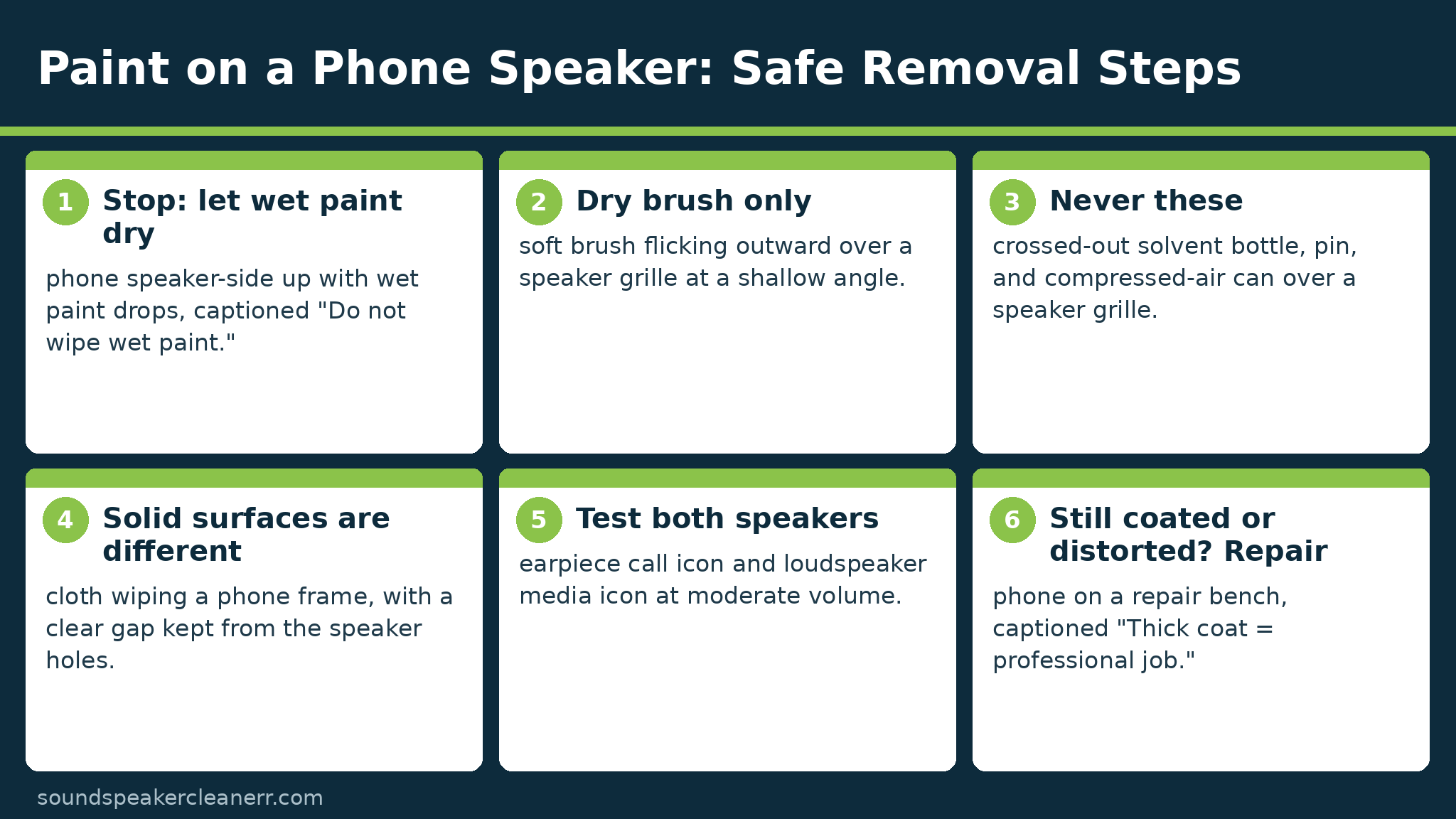
If paint is on your phone speaker, stop and let it dry fully, then remove only the loose, surface paint with gentle dry methods. Never pour solvent or liquid into the speaker mesh, and never scrape the mesh with a sharp tool, or you risk pushing paint deeper and damaging the speaker.
First, work out what kind of paint problem you have
Not all paint on a speaker is the same problem, and the right approach depends on three things: whether the paint is wet or dry, where exactly it sits, and how much of the grille it covers.
Wet paint is the most urgent case, but it is also the easiest to make worse. If you try to wipe wet paint off a speaker grille, you will smear it across more holes and push it into the mesh. The safer move is to keep the phone still, speaker-side up so the paint does not run further, and let the paint dry completely before you touch the grille at all. Wipe wet paint only from solid surfaces — the back, the frame, the screen — where it cannot be pushed into an opening.
Dried paint is the more common case, because most people notice paint on a phone after decorating, when it has already set. Dried paint on the surface of the grille is a surface blockage: it covers holes and muffles sound, but it has not necessarily reached the speaker behind the mesh. Dried paint that has soaked through the mesh is a deeper problem, and home methods are much less likely to fix it safely.
Location matters too. Paint on the frame around the speaker, or on the back of the phone, is a cosmetic problem that can be handled with more freedom. Paint directly over the speaker holes, or over the earpiece slot at the top of the phone, is a functional problem, because anything you do to the mesh affects sound. Treat those two areas differently: be conservative over holes, and more confident on solid surfaces.
Finally, consider coverage. A few small splatters over one or two holes may clear with gentle dry methods. A thick, continuous coat covering the whole grille, or paint that has visibly flowed into the holes, is a repair job, not a home cleaning job. Trying to clear a fully coated grille at home is likely to tear the mesh or drive paint into the speaker chamber.
The dry-only method for the speaker mesh
Once the paint is fully dry, work in good light so you can see the grille clearly. Power the phone off or at least stop playing sound through the speaker while you work, so you are not vibrating loose paint further in. Remove the case, since paint may be trapped under its edges as well.
Use a clean, dry, soft-bristled brush — a soft toothbrush that has never been used with toothpaste, or a clean, dry artist's paintbrush with soft bristles. Hold the brush at a shallow angle to the grille, about 45 degrees, and use short, gentle flicks outward, away from the holes, as if you are sweeping dust off a delicate surface. Do not scrub back and forth, and do not press hard. The mesh is thin and fragile, and pressing can tear it or push paint flakes through it.
Work across the grille in one direction, then rotate the phone and repeat from another angle. After each pass, tilt the phone and let loose flakes fall away, and wipe the surrounding frame with a dry, lint-free cloth. Stop frequently to check your progress and to test nothing yet — testing comes later, after cleaning is finished and the phone is reassembled. If flakes are coming off and sound holes are visibly clearing, continue gently. If nothing is coming off, or if the paint seems bonded to the mesh rather than sitting on it, stop. Forcing it will not help.
For the earpiece slot, use the same dry brush with even less pressure, because the earpiece mesh is smaller and more delicate than the loudspeaker grille. Do not use a different tool for the earpiece; the same soft brush, used more gently, is the safe choice.
What about paint on the solid parts of the phone? There, you have more options, but still keep liquids away from openings. A dry cloth, or a cloth very lightly dampened with plain water for water-based paint on a solid surface, may lift paint from the frame or back — but only if you keep the damp area well away from any hole, and only if your phone maker's guidance allows it. Never let a damp cloth drip, and never wipe toward an opening. If you are unsure whether a cleaner is safe for your phone's finish, test it on a small, hidden area of the frame first, or skip it and accept a cosmetic mark rather than risk the speaker.
What never to do to a painted speaker mesh
Never pour, spray, or drip any solvent into the speaker mesh. That includes nail polish remover, acetone, paint thinner, turpentine, and strong household cleaners. Solvents can dissolve the adhesives that hold the mesh and internal parts together, damage protective coatings, and — most importantly — they can dissolve dried paint just enough to carry it through the mesh and into the speaker chamber, where it can coat the driver and cause permanent distortion. A solvent that "works" on a table or a wall is not safe on a phone speaker.
Never use a sharp tool on the mesh. Pins, needles, toothpicks, razor blades, craft knives, and SIM tools can all puncture the mesh or scratch the speaker behind it. Some web advice suggests scraping paint off phones with a toothpick or blade, but that advice is aimed at glass screens and solid cases, not at a fine mesh with a delicate driver behind it. One slip can turn a muffled speaker into a torn, rattling one.
Never use compressed air on a painted grille. Compressed air can drive paint flakes deeper into the mesh and the speaker chamber, and the force can damage the mesh itself. The same applies to blowing hard into the openings with your mouth: it pushes debris inward rather than clearing it outward.
Never use heat to soften paint on a speaker. A hair dryer or heat gun can soften adhesives, warp the mesh, and stress the battery, and softened paint is more likely to flow into the holes than to lift cleanly off them. If paint needs softening, that is a sign the job belongs to a repairer with proper tools, not to a home heat treatment.
Finally, never soak the phone or run it under water to remove paint. Water will not reliably dissolve dried paint, and it adds water damage to a paint problem. Keep the phone dry throughout the paint-removal process.
Testing the speaker after dry cleaning
Only test the speaker after you have finished cleaning, removed all loose flakes, and wiped the surrounding frame. Disconnect Bluetooth, remove any headphones, and play a short spoken-word clip at a comfortable, moderate volume through the loudspeaker. Listen for clear speech versus muffled, quiet, distorted, or rattling sound. Compare with a clip you know well, and note whether the sound is better than before cleaning, the same, or worse.
Then test the earpiece separately with a call without speakerphone, if paint was near the top of the phone. The earpiece and the loudspeaker are different parts, and paint may affect one and not the other. If the loudspeaker improved but the earpiece did not, that tells a repairer exactly where to look.
A cleaning tone at a moderate volume may help move loose, dry flakes from the grille after brushing, but it cannot dissolve paint, remove paint bonded to the mesh, or repair a torn mesh or a coated driver. Use it only as a brief aid after dry cleaning, not as the main method, and stop if the sound does not improve. Loud, repeated playback will not clear bonded paint and can strain a speaker that is already partially blocked.
If sound is still muffled, quiet, or distorted after gentle dry cleaning, do not repeat the process with more force. You have reached the limit of safe home cleaning. Further attempts risk tearing the mesh or pushing paint deeper, and the remaining paint needs professional removal or a mesh or speaker replacement.
When to stop and seek professional repair
Seek professional repair if any of the following apply: the paint covers the whole grille in a thick coat, paint has visibly flowed into the holes, the paint is spray paint that has coated the mesh evenly, dry brushing removes nothing after a few gentle passes, the mesh looks torn, dented, or lifted at the edges, or sound is still distorted after cleaning. Also seek help if the paint is an unknown type — for example, industrial or two-part paint — since its solvents and hardness may differ from ordinary household paint.
Tell the repairer what kind of paint it is, if you know: water-based emulsion, acrylic craft paint, spray paint, or oil-based paint, and whether it was wet or dry when you found it. That detail helps them choose a safe removal method and decide whether the mesh can be cleaned or needs replacing. Ask what the inspection covers and what it costs before work starts.
Keep in mind that paint damage is not usually covered by a standard warranty, but a mesh or speaker replacement is often straightforward for a repairer, and it is far cheaper than replacing a phone damaged by a solvent or a sharp tool used at home.
Preventing paint on a phone speaker
The simplest prevention is to leave the phone out of the painting area entirely. Put it in another room, in a closed drawer, or in a sealed bag before you open a paint tin or start spraying. If you need music while painting, use a speaker you do not mind getting paint on, or a device that stays outside the room.
If the phone must be nearby, keep it in a case that covers the speaker area only if the case is designed to do so without muffling sound, and remember that most cases leave the speaker holes open — they protect against drops, not against paint spray. A zip-lock bag over the phone, with the screen visible through the plastic, is a better barrier for a painting session, as long as you do not need to make calls through it.
After painting, check the phone before you use it. Look at the speaker grille and earpiece slot in good light, and brush off any dry splatters before they are pressed further in by a pocket or a case. A quick check after each painting session is far easier than a deep clean later.
FAQ
Can dried paint on a phone speaker be removed at home?
Sometimes, if it is a few surface splatters. Gentle dry brushing with a soft brush, flicking outward, can clear loose surface paint. Thick, bonded, or fully coating paint should go to a repairer.
Should I use nail polish remover or paint thinner on a speaker grille?
No. Solvents can dissolve adhesives and coatings, and they can carry dissolved paint through the mesh into the speaker, causing permanent damage. Keep solvents away from all speaker openings.
Can I scrape paint off the speaker with a toothpick or pin?
No. Sharp tools can puncture the thin speaker mesh or scratch the driver behind it. Use only a soft, dry brush on the mesh, with gentle outward flicks.
What if the paint is still wet on the speaker?
Do not wipe it. Wiping wet paint smears it across more holes and pushes it into the mesh. Keep the phone still, speaker-side up, let the paint dry fully, and then use dry methods only.
Will a speaker cleaning tone remove paint from the mesh?
No, not as a main method. A moderate-volume tone may help move loose, dry flakes after brushing, but it cannot dissolve bonded paint or repair a torn mesh or coated driver.
Why does the speaker still sound muffled after I brushed the paint off?
Paint may have soaked through the mesh onto the driver, or residue may still coat the holes from the inside. If gentle dry cleaning does not restore clear sound, the speaker needs professional assessment.
Can I wash the phone under water to remove paint?
No. Water will not reliably dissolve dried paint, and it adds water damage to the paint problem. Keep the phone dry during paint removal.
How do I prevent paint getting on my phone speaker again?
Leave the phone out of the painting area, or seal it in a bag during painting sessions. Check the grille and earpiece slot in good light after each session, and brush off dry splatters promptly.
Leave a Reply