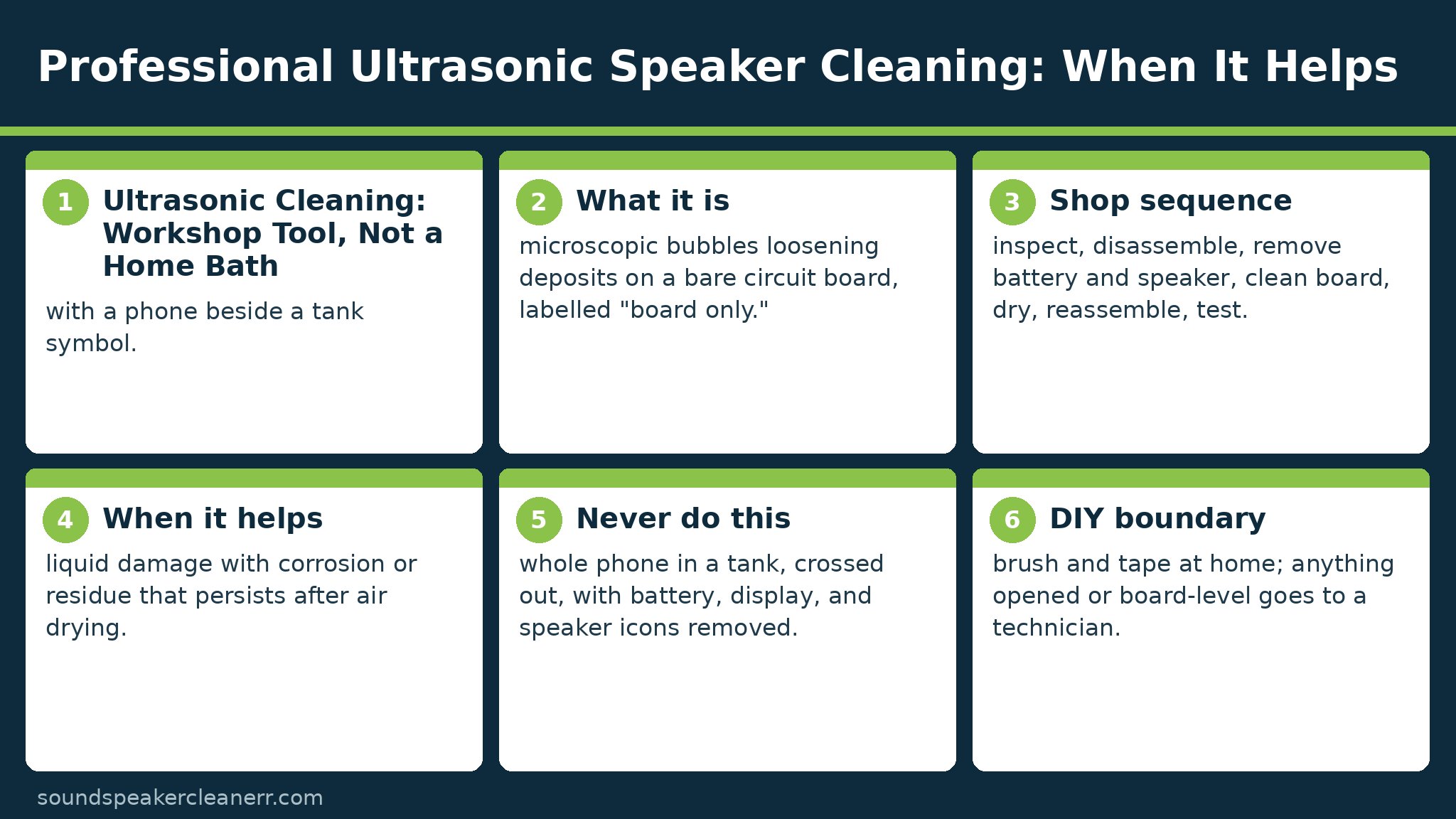
Professional ultrasonic cleaning is a workshop process for liquid-damaged circuit boards, not a home method for a dusty phone speaker. A technician disassembles the phone, removes the battery and sensitive parts, and cleans the bare board in a specialised tank. If your speaker is only dusty, gentle home methods are the right step, and an assembled phone should never go into an ultrasonic cleaner.
What Ultrasonic Cleaning Actually Means
Ultrasonic cleaning uses high-frequency sound waves in a liquid bath to create millions of microscopic bubbles. When those bubbles collapse, a process called cavitation, they loosen deposits from surfaces they touch, including tiny crevices that a brush cannot reach. In electronics repair, the liquid is a specialised electronics-safe solution, not ordinary tap water, and the process is controlled for time and temperature.
That description often leads to a misunderstanding. People hear "sound waves clean a phone" and imagine placing a whole phone in a small ultrasonic jewellery cleaner at home. That is not what professional ultrasonic cleaning is. The professional process is about a disassembled circuit board, not an assembled phone, and the distinction matters more than any other detail in this guide.
A phone contains parts that should never enter an ultrasonic tank: a battery, a display, cameras, speakers, and microphones, among others. Each of those parts can be damaged by immersion, vibration, or the cleaning solution itself. Professional cleaning works precisely because those parts are removed first.
What a Shop Actually Does
A professional ultrasonic job usually follows a careful sequence. First, the technician inspects the phone and asks what liquid it was exposed to and when. Salt water, pool water, and sugary drinks leave different residues from clean water, and time matters because corrosion progresses while the phone sits wet. The phone is powered off and, where possible, the battery is disconnected early to reduce the risk of short circuits.
Next comes disassembly. The display, battery, cameras, speakers, and other modules are removed, and the main circuit board is separated. Protective metal shields over chips may be removed so that hidden corrosion underneath can be reached. This step alone explains why ultrasonic cleaning is not a home job: it requires tools, knowledge of the specific phone model, and a safe way to handle a battery and fragile connectors.
Only then does the bare board go into the ultrasonic tank, usually in a basket that keeps it off the tank floor, for a controlled cycle. Afterwards the board is dried carefully, inspected again under magnification, and any damaged components are replaced before reassembly and testing. Drying is not a quick step. Rushing reassembly while moisture remains can undo the cleaning and cause new faults.
Notice what is absent from that sequence: the speaker itself is not ultrasonically cleaned as a unit. The speaker is removed before the board goes into the tank. If a speaker is faulty, it is inspected, tested, and replaced if needed. Ultrasonic cleaning may help the board that drives the speaker, but it is not a way to wash a speaker clean while it stays inside the phone.
When Ultrasonic Cleaning Helps
Ultrasonic cleaning is most relevant after liquid exposure that has reached the inside of the phone. Signs include a phone that was submerged or heavily splashed, sound problems that persist after the phone has dried in open air, corrosion visible on connectors, or a phone that behaves erratically after getting wet. In those cases, residue and corrosion on the circuit board may be interfering with signals, and a board-level clean can remove deposits that surface cleaning cannot touch.
It can also help when a phone has been exposed to a liquid that leaves mineral or sugary residue. Clean water may dry without leaving much behind, but salt water leaves salt deposits, and drinks leave sticky residue that can attract moisture and encourage corrosion. A technician can judge whether board-level cleaning is worthwhile based on the liquid, the time since exposure, and what the inspection shows.
Timing matters. The sooner a liquid-damaged phone reaches a technician, the better the chances that corrosion has not yet caused permanent damage. That does not mean rushing to power the phone on to test it, which is one of the worst things to do after liquid exposure. It means keeping the phone off, not charging it, and getting it assessed promptly.
When It Does Not Help
Ultrasonic cleaning is not the answer to ordinary dust in a speaker grille. Dust on the surface of a grille has not reached the circuit board, and a board-level process cannot remove it. For surface dust, a soft dry brush and low-adhesive tape are faster, cheaper, and far less invasive. Sending a dusty phone for ultrasonic cleaning would be like rebuilding an engine because the windscreen is dirty.
It also does not repair a physically damaged speaker. If a speaker diaphragm is torn, a mesh is punctured, or a speaker has failed for an unrelated hardware reason, cleaning the board will not restore it. A technician can diagnose that distinction, but the reader should not expect ultrasonic cleaning to be a general speaker repair. It is a corrosion and residue treatment for boards, not a speaker fix in itself.
There are also cases where even professional cleaning cannot save a phone. If corrosion has already destroyed traces or components, if the phone was powered on repeatedly while wet, or if damage extends beyond the board, cleaning may improve the situation without restoring full function. A reputable technician should explain that uncertainty honestly before starting work, rather than promising a guaranteed recovery.
Why You Must Never Put an Assembled Phone in a Tank
Home ultrasonic cleaners are sold for jewellery, glasses, and small metal items, and that marketing creates a dangerous temptation. An assembled phone in such a tank faces several risks at once. Liquid can be forced into seals, speakers, microphones, and ports that were never designed for immersion under vibration. Adhesives holding the display and internal parts together can weaken. The battery can be stressed by vibration and by contact with cleaning solution. Displays and cameras can be damaged by the same process that cleans a metal ring safely.
Water resistance ratings do not change this. A rating describes resistance under specific test conditions, not immunity to immersion in a vibrating cleaning bath with a chemical solution. A phone that survives rain or a brief splash has not been proven safe for an ultrasonic tank, and the tank adds forces and chemicals that the rating never covered.
The same warning applies to individual phone parts. Do not place a speaker, microphone, display, or battery in a home ultrasonic cleaner. The only parts that belong in a professional tank are bare boards and similar robust components, handled by someone who knows which parts to remove, which solution to use, and how long to run the cycle.
What to Do Before You Visit a Shop
If you suspect liquid damage, the steps before the shop visit matter as much as the shop visit itself. Power the phone off and do not charge it. Remove the case, dry the outside gently with a soft cloth, and let the phone dry in open air. Do not use heat, do not use rice as a drying method, and do not use forced air into openings. Those shortcuts can move water deeper or add new residue.
Note down what happened while it is fresh: what liquid, how deep or how long the exposure was, whether the phone was on or charging at the time, and what symptoms appeared and when. That history helps a technician judge urgency and likely damage. If sound is the main symptom, note whether it affects the loudspeaker, the earpiece, or both, and whether it is muffled, distorted, or intermittent.
When you contact a shop, ask what the inspection involves, whether disassembly and board cleaning are part of the service, and what happens if cleaning does not restore function. You do not need to name or endorse any particular shop from this guide, and you should compare the answers you receive rather than choosing based on a single claim. A shop that explains limits and uncertainty is more trustworthy than one that promises a certain outcome.
DIY Stops Here: A Clear Boundary
Home cleaning has a clear boundary, and ultrasonic cleaning sits firmly beyond it. At home, you can brush surface dust, lift it with tape, use a gentle hand blower, and test sound at moderate volume. You can also follow manufacturer guidance for a wet phone and let it dry safely. Those steps cover the problems that surface cleaning can solve.
Beyond that boundary, the phone needs to be opened, inspected, and handled by someone with the right tools and training. That includes board-level ultrasonic cleaning, mesh replacement, speaker replacement, and any work involving the battery or internal connectors. Attempting those steps at home risks turning a recoverable phone into an unrecoverable one.
Professional ultrasonic cleaning is a powerful tool in the right context: a disassembled board, a trained technician, and a liquid-damage problem that surface methods cannot reach. It is not a home shortcut, not a speaker wash, and not a cure for dust. Knowing which side of that boundary your problem falls on is what keeps a simple cleaning job simple and gives a liquid-damaged phone its best chance.
FAQ
What is professional ultrasonic speaker cleaning?
It is a workshop process in which a technician disassembles a liquid-damaged phone, removes the battery and sensitive modules, and cleans the bare circuit board in an ultrasonic tank. The speaker itself is removed, not washed inside the phone.
Can I put my whole phone in an ultrasonic cleaner at home?
No. An assembled phone must never go into an ultrasonic tank. Liquid, vibration, and cleaning solution can damage the battery, display, speakers, microphones, and adhesives.
Does ultrasonic cleaning fix a dusty speaker?
No. Surface dust in a grille has not reached the circuit board, so board-level cleaning cannot remove it. A soft brush and tape are the right methods for surface dust.
When does ultrasonic cleaning actually help?
Most often after liquid exposure that has reached inside the phone, where corrosion or mineral residue on the circuit board affects function and persists after drying in open air.
Can ultrasonic cleaning repair a damaged speaker?
No. It removes corrosion and residue from a board; it does not repair a torn diaphragm, punctured mesh, or failed speaker. Those parts need inspection and possible replacement.
Does water resistance make ultrasonic cleaning safe?
No. A water-resistance rating covers specific test conditions, not immersion in a vibrating tank with cleaning solution. It does not make home ultrasonic cleaning safe.
What should I do before taking a wet phone to a shop?
Power it off, do not charge it, dry the outside gently, let it dry in open air, and note what liquid, how long the exposure lasted, and which symptoms appeared. Avoid heat, rice, and forced air.
How do I choose a repair shop for this work?
Ask what the inspection involves, whether board cleaning is included, and what happens if cleaning does not restore function. Prefer a shop that explains limits honestly over one that promises a guaranteed result.
Leave a Reply