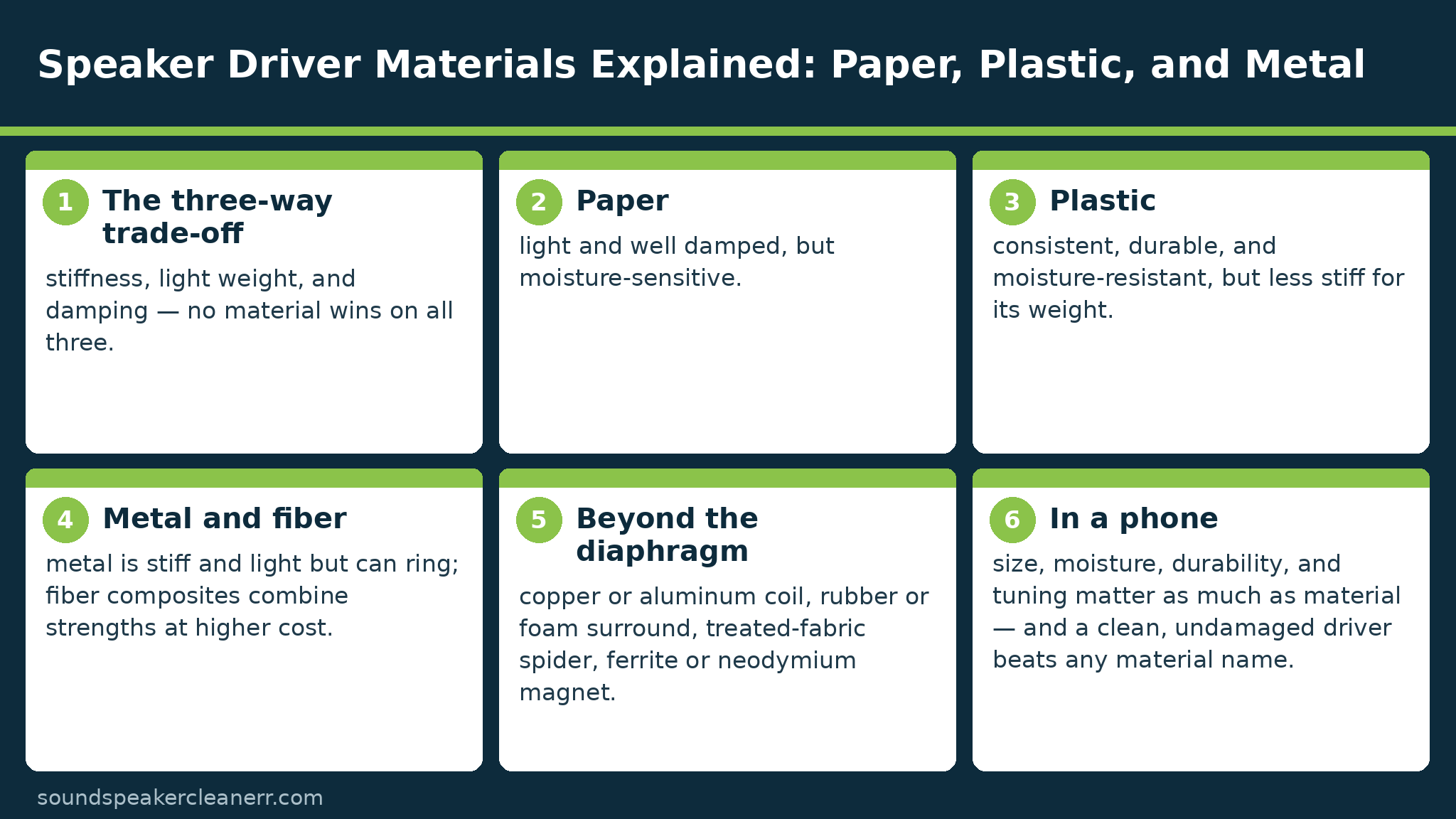
Speaker driver materials matter because the diaphragm must be stiff enough to move as one piece, light enough to respond quickly, and damped enough not to keep ringing after the signal stops. No single material is perfect on all three counts, so makers choose different materials for different drivers, sizes, and budgets.
That three-way trade-off — stiffness, low weight, and damping — is the key to the whole topic. Paper is light and well damped but can absorb moisture. Plastic is durable and consistent but can be less stiff for its weight. Metal is very stiff and light for its stiffness but can ring at certain frequencies if not damped. Fiber and composite materials try to combine strengths, Once you hold those three properties in mind, material names stop being marketing words and start being engineering choices.
The diaphragm: the part that moves the air
The diaphragm, also called the cone, is the surface that pushes air to make sound. Ideally it moves back and forth as a single rigid piston: every part of it moves together, following the signal exactly. In reality, a diaphragm can flex, bend, or break up into different moving sections, especially at higher frequencies or higher volumes. That flexing adds sounds that were not in the original signal, which listeners hear as distortion or harshness.
Three properties decide how close a diaphragm gets to that ideal. Stiffness is resistance to bending: a stiffer diaphragm holds its shape better and moves more uniformly. Low density means light weight for its size: a lighter diaphragm is easier for the voice coil to accelerate and stop, so it can follow fast changes in the signal more accurately. Internal damping is the material's ability to absorb its own unwanted vibrations: a well-damped diaphragm stops ringing quickly after the signal changes, instead of continuing to vibrate on its own.
Every material below is a different compromise among those three properties, plus practical factors such as cost, moisture resistance, and ease of manufacturing at a given size. A material that is ideal for a large home woofer may be a poor choice for a tiny phone driver, and vice versa, because size changes which property matters most.
Paper and paper-based diaphragms
Paper was one of the earliest diaphragm materials, and it is still widely used. A paper diaphragm is usually not plain paper: it is a pulp blend, often mixed with fibers such as wool, silk, or carbon fiber, and treated or coated to improve its behaviour. The result is light, with naturally good damping, which is why paper cones are often described as sounding natural and balanced, with good detail for voices and instruments.
Paper's strengths are its light weight and its damping. Its weaknesses are moisture sensitivity and consistency. Untreated paper absorbs water, swells, and softens, which changes how it moves. That is a real concern for phone speakers, which live in pockets, bathrooms, and rain, and it is one reason phone makers often prefer sealed or treated designs and moisture-resistant materials for small drivers. Paper also varies more from batch to batch than a moulded plastic, unless manufacturing is tightly controlled.
For a phone, a light, well-damped diaphragm helps clarity, but moisture and durability push small, exposed drivers toward materials that handle damp conditions better.
Plastic diaphragms, especially polypropylene
Plastic diaphragms, most commonly polypropylene, are moulded rather than pressed from pulp. Moulding gives consistent shape and thickness from unit to unit, which helps makers produce large numbers of identical small drivers — an important advantage for phones, where millions of units must sound alike.
Polypropylene is durable, resistant to moisture, and relatively inexpensive. Sources describe it as providing good overall sound with improved bass response and durability compared with untreated paper. Its trade-off is stiffness for weight: polypropylene is not as stiff as metal or carbon fiber for the same weight, so a plastic diaphragm may flex more at high frequencies or high volumes unless its shape — ribs, curves, or a dome profile — adds stiffness structurally.
In a tiny phone driver, moulded plastic has practical advantages beyond sound: it can be made very thin, it holds its shape in humidity, and it can be combined with a moulded surround or frame in a compact module. That is why plastic-family materials are a natural fit for small drivers, even though a larger home speaker might choose a different material for a woofer or tweeter where size allows other trade-offs.
Metal diaphragms: aluminum, titanium, and alloys
Metal diaphragms, commonly aluminum or titanium alloys, offer very high stiffness for their weight. A stiff, light diaphragm can move as a piston to higher frequencies before flexing, which is why metal is often associated with extended, detailed high-frequency response and precise transient response — the ability to start and stop quickly on sharp sounds.
Metal's trade-off is damping and resonance. A very stiff, lightly damped metal diaphragm can ring at its own resonant frequencies, producing a metallic character or harshness if that ringing is not controlled by design — for example, by coatings, shaping, or crossover and tuning choices in larger systems. In a phone, where there is little room for elaborate damping or crossover design, that ringing must be managed within the tiny module itself, which limits how far metal's stiffness advantage can be pushed.
Metal is also durable and moisture-resistant, which suits a phone environment, but it can be more expensive to form into very small, precise shapes than moulded plastic. As with every material here, the question is never "is metal better?" but "is metal's stiffness worth its ringing and cost in this size, at this price, for this use?"
Fiber and composite diaphragms
Fiber materials — including carbon fiber, glass fiber, and aramid fibers (the family that includes Kevlar-type fibers) — and composites that combine fibers with a resin or with paper or plastic, aim to get the best of several worlds. Carbon fiber is noted for an excellent balance of rigidity, light weight, and damping. Aramid fibers are noted for rigidity and resistance to distortion. Glass fiber composites offer a balance of strength and sound quality at a more moderate cost than carbon fiber.
Composites work by combining a stiff fiber skeleton with a matrix that holds it together and damps vibration. The fiber provides stiffness and lightness; the matrix provides damping and shape. By changing the fiber type, the fiber direction, and the matrix, a maker can tune the diaphragm's behaviour more precisely than with a single material.
The trade-offs are cost and complexity. Fiber and composite diaphragms are generally more expensive to make, especially in very small sizes where handling and consistency are harder. They are therefore more common in larger or higher-priced drivers than in basic phone modules, although the principles — stiffness plus damping at low weight — apply. For phone buyers, a fiber or composite name on a specification sheet is not by itself proof of better sound; the whole driver, chamber, and tuning matter more than any one material label.
The voice coil: copper and aluminum wire
The voice coil is the wire winding that carries the signal and moves in the magnetic field. It is most commonly copper or aluminum wire, wound on a thin former and attached to the diaphragm.
Copper is the more common choice in general: it conducts well and is durable, but it is relatively heavy. Aluminum wire is lighter, which helps the moving assembly respond quickly, but it conducts less well for the same thickness and can be more fragile to handle. Some designs use copper-clad aluminum or other combinations to balance weight, conductivity, and durability.
For a phone driver, coil weight matters more than it does in a large speaker, because the whole moving assembly is tiny and every fraction of weight affects how quickly it can start and stop. But the coil cannot be judged alone: a lighter coil with a heavier diaphragm may be no better than a heavier coil with a lighter diaphragm. What matters is the total moving mass, the strength of the magnetic field, and the suspension — the system, not the single part.
It is also worth correcting a common misunderstanding. The voice coil is simply wire. It does not need a special "break-in" treatment to rearrange itself, and no material change in the wire explains large sound changes over time. Any small settling that occurs with use is mainly in the flexible suspension parts, not in the coil wire itself. That distinction is covered in more detail in the site's existing break-in post, linked in section (E) as an update recommendation rather than duplicated here.
The surround, spider, and magnet
The diaphragm does not work alone. The surround is the flexible ring connecting the diaphragm's edge to the frame. Common surround materials are rubber and foam. Rubber is durable and holds its properties over time, which suits a phone that must last years in varying temperatures. Foam is more flexible, which can help low-frequency movement, but it may degrade over time with exposure to ultraviolet light, heat, and ozone. In a phone, durability usually wins, because the surround must survive pocket heat, sunlight, and years of vibration without hardening or crumbling.
The spider is the flexible support behind the diaphragm that keeps the voice coil centred in the magnetic gap. It is often a treated fabric — for example, cotton or synthetic fibers impregnated with a resin — formed into concentric rings that flex up and down but resist sideways movement. The spider's stiffness affects how freely the diaphragm moves, and it is the part most likely to soften slightly with initial use, as the resin-treated fabric flexes for the first time. That softening is small and gradual, and it is not a reason to run a new speaker at maximum volume.
The magnet provides the fixed magnetic field. Common magnet materials are ferrite (a ceramic-type magnet) and neodymium (a rare-earth magnet). Ferrite magnets are larger and heavier for a given strength but inexpensive. Neodymium magnets are much stronger for their size, which is a decisive advantage in a phone: a small neodymium magnet can provide a strong field in a module only a few millimetres thick, where a ferrite magnet of the same strength would not fit. Neodymium costs more, but in a phone the size saving is usually worth it.
Together, these parts explain why phone drivers look so different from home speakers yet follow the same physics. The magnet must be small and strong, the coil must be light, the diaphragm must be thin and stiff, and the suspension must be durable — all in a space smaller than a coin.
What this means for a phone in your pocket
In a phone, material choice is constrained by size, moisture, durability, and cost far more than by any single sound ideal. A phone driver must survive humidity, pocket lint, temperature swings, and drops, while fitting into a module with a tiny chamber and a grille that also has to keep debris out. Makers therefore favour materials that are consistent to manufacture, resistant to moisture, and durable over years — which is why moulded plastics, treated fabrics, rubber surrounds, and small neodymium magnets are such a natural fit, even though larger speakers might choose differently.
That also means you cannot judge a phone's sound from a material name alone. Two phones with the same diaphragm material can sound very different because their chambers, grilles, tuning, and software processing differ. And a phone with a modest material, well tuned and kept clean, will usually sound better than a phone with an exotic material whose grille is blocked with lint or whose driver has been damaged by poking or water.
Keep the grille clean and dry, because residue and moisture change how any diaphragm moves, regardless of what it is made of. Use moderate volume, because pushing any small driver to its limits stresses the suspension and can make the diaphragm flex or the coil rub. And do not try to "improve" a driver by opening the phone or replacing parts yourself: the materials, clearances, and adhesives are designed as a system, and a mismatched replacement will almost always sound worse than the original, even if its material sounds more impressive on paper.
The short version to remember
A good diaphragm is stiff, light, and well damped, and no material wins on all three. Paper is light and well damped but moisture-sensitive. Plastic is consistent, durable, and moisture-resistant but less stiff for its weight. Metal is very stiff and light but can ring if not damped. Fiber composites combine strengths at higher cost. The voice coil is copper or aluminum wire, the surround is usually rubber or foam, the spider is treated fabric, and the magnet in a phone is usually small, strong neodymium or larger, cheaper ferrite. In a phone, size, moisture, durability, and tuning matter at least as much as the diaphragm material itself — and a clean, undamaged driver will always beat a blocked or damaged one, whatever it is made of.
FAQ
What are phone speaker diaphragms made of?
Makers do not publish one universal phone material, and it varies by model. Across loudspeakers generally, common diaphragm materials are paper pulp blends, plastics such as polypropylene, metals such as aluminum and titanium alloys, and fiber composites such as carbon fiber, glass fiber, and aramid fibers. This article does not claim a specific material for any named phone model.
Is paper, plastic, or metal best for a speaker?
There is no single best material. Paper is light and well damped but moisture-sensitive. Plastic is durable and consistent but less stiff for its weight. Metal is stiff and light but can ring at certain frequencies. The best choice depends on driver size, use, cost, and the whole design, including the chamber and tuning.
What is a voice coil made of?
Usually copper or aluminum wire, wound on a thin former and attached to the diaphragm. Copper conducts well and is durable; aluminum is lighter, which helps quick movement, but conducts less well for the same thickness. The total moving mass matters more than the coil material alone.
What is the difference between ferrite and neodymium magnets?
Ferrite magnets are larger and heavier for a given strength but inexpensive. Neodymium magnets are much stronger for their size, so they fit the tiny modules phones require. That size advantage is why small, strong magnets matter so much in phones.
Do speaker materials affect durability in a phone?
Yes. Moisture resistance, temperature tolerance, and long-term flexibility all matter in a pocket environment. Rubber surrounds tend to last longer than foam, moulded plastics resist humidity well, and untreated paper is more vulnerable to moisture — all reasons makers weigh durability alongside sound.
Does break-in change the driver material?
No. The voice-coil wire does not rearrange or improve with use. Any small settling with initial use is mainly in the flexible suspension (surround and spider), not in the diaphragm or coil material. The site's existing break-in post covers that topic in full and should be updated rather than duplicated.
Can I tell a phone's speaker material by looking at it?
No. The diaphragm sits behind the grille and mesh, and you cannot identify its material reliably from outside the phone. Do not open the phone or poke into the openings to check. If a specification lists a material, treat it as one part of the design, not as a guarantee of sound quality.
Does a better material fix a muffled speaker?
No. A blocked grille, water in the openings, or a damaged driver will muffle or distort sound regardless of material. Clean the openings gently, test at moderate volume, and seek inspection for persistent distortion — material quality cannot overcome blockage or damage.
Leave a Reply