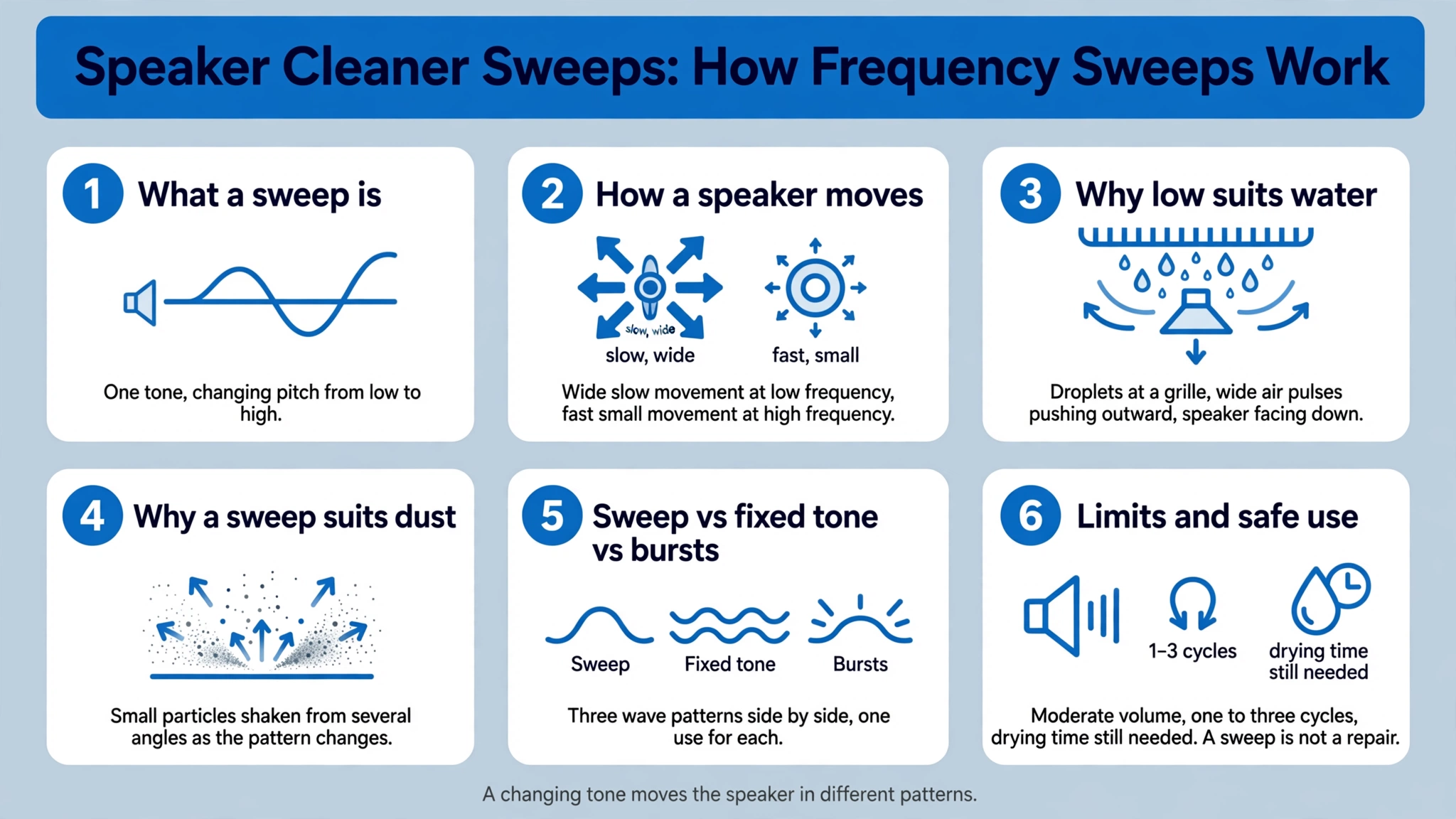
A frequency sweep is a tone that gradually changes pitch instead of staying on one note. In a speaker cleaner, that moving tone makes the phone’s speaker diaphragm vibrate in changing patterns, which can help push water droplets out of the grille or shake loose dust near it. A sweep is a cleaning aid, not a repair.
That one-sentence version hides the interesting part: why change the pitch at all? If one frequency worked perfectly, every tool would use it. The reason tools sweep is that no single frequency is ideal for every phone, every droplet, and every particle — so the sweep covers a range, hoping to pass through the frequencies where a given speaker moves most and where a given blockage loosens. Understanding that trade-off helps you use a sweep sensibly and recognize when it has done all it can.
What a speaker actually does when a tone plays
A phone speaker produces sound by vibrating a thin diaphragm — a small membrane that moves back and forth. Each movement pushes air, and that moving air is what you hear as sound. The frequency of the tone is how many times per second the diaphragm moves back and forth: 165 Hz means 165 cycles per second.
Two properties of that movement matter for cleaning:
- How far the diaphragm moves. Low frequencies generally move the diaphragm farther with each cycle than high frequencies do, because each cycle lasts longer. A farther movement pushes more air per cycle.
- How fast it moves. High frequencies move the diaphragm faster but over a smaller distance. That faster, finer vibration shakes the surface differently.
Neither property is "better" in isolation. Water and dust respond to different kinds of movement, which is why tools offer different patterns for them.
What a sweep is, in plain language
A sweep starts at one frequency and moves steadily to another — for example, from a low tone up to a higher one, or from a high tone down to a low one — over a set time, such as 30 seconds. You hear the pitch rise or fall smoothly, rather than jumping between notes.
Think of it like running a hand across a surface instead of pressing one spot. A fixed tone presses one spot, rhythmically, at one rate. A sweep passes through many rates in sequence, so it reaches the speaker’s behavior at each frequency along the way. That is the whole idea, and it explains both the appeal and the limits of a sweep: it covers more ground, but it spends only a short time at any one frequency.
A sweep is different from two related patterns that are often confused with it:
- Fixed tone: one frequency held steady, for example 165 Hz for the whole run. Simple, predictable, and easy to repeat.
- Burst or pulsed pattern: short bursts of sound with brief pauses between them. The pause lets loosened water shift position so the next burst can move it further, rather than pushing the same droplet back and forth.
- Sweep: a tone that moves continuously through a range, spending a short time at each frequency.
Many tools combine these: a sweep with bursts, or a fixed tone followed by a sweep. The combination is a design choice by the toolmaker, not a standard.
Why low frequencies are used for water
Water in a speaker grille is held in place partly by surface tension — the same effect that lets a droplet cling to a surface instead of falling off. To move it, the speaker needs to push air against the droplet with enough force to break that grip, and gravity helps when the speaker faces down.
Low frequencies are used for water because they move the diaphragm farthest, producing the strongest pumping action per cycle. That is why so many tools cluster around the low-mid range for water eject: roughly 120–400 Hz in various tools, with 165 Hz as the most commonly used single frequency. The 165 Hz figure is a common tool choice, popularized by its association with the Apple Watch water-eject tone — it is not a published standard, and no phone manufacturer has named one ideal cleaning frequency. Treat any tool that presents one frequency as "the scientific optimum" with skepticism.
There is also a practical ceiling: a phone speaker is small, so it struggles with very deep bass. A tone that is too low barely plays at all, because the small driver cannot move enough air at that rate. The useful water range is therefore a compromise — low enough to move the diaphragm far, but high enough that the small speaker can still play it loudly. That compromise is why tools settle in the low hundreds of hertz rather than at extremely low frequencies.
Why sweeps and higher frequencies are used for dust
Dust, lint, and sand behave differently from water. Water is a liquid that clings as droplets; dust is many independent solid particles wedged into the tiny openings of the speaker mesh. A single frequency shakes those particles back and forth in one pattern, which may loosen some but leave others wedged at angles that pattern does not reach.
A sweep changes the vibration pattern continuously, so particles are shaken from many angles in sequence. Higher frequencies add faster, finer vibration, which suits small, dry particles better than the slow, wide push used for water. That is why dust modes on various tools use wider or higher ranges than water modes — for example, sweeps reaching into the low thousands of hertz, or pulsed patterns rather than one continuous push.
Even so, sound has a clear limit with dust. Loose surface dust may shake free, but packed lint or sticky debris often needs gentle physical cleaning as well, such as a soft brush used carefully on the outside of the grille. Sound alone will not clear everything, and forcing louder or longer sweeps will not change that. Never insert anything into the speaker opening, and never use compressed air, which phone makers advise against for iPhone and which can push debris deeper.
Sweep vs. fixed tone: which should you use?
There is no proven winner, and honest guides say so. Here is how to choose based on the problem, not on marketing:
| Situation | Sensible first choice | Why |
|---|---|---|
| Water just splashed on the speaker, sound is muffled | Low-frequency sweep or fixed low tone, speaker facing down, moderate volume | Wide diaphragm movement pushes air against droplets, and gravity helps |
| Dry dust or pocket lint, sound slightly muffled | Sweep or pulsed pattern covering a wider range | Changing vibration patterns reach particles wedged at different angles |
| You want to test the speaker, not clean it | Steady tone, then a slow sweep at moderate volume | A test needs a controlled, repeatable sound; cleaning patterns are not test patterns |
| Sound is still muffled after two or three runs | Stop and reassess: drying, grille check, settings check, or repair advice | Repeating the same sweep louder will not fix blockage or damage it cannot reach |
If a tool offers both a standard and an extended sweep, start with the standard one. One toolmaker states openly that it found no published measurement showing its extended setting beats its standard setting, and that honesty is worth copying: wider is not automatically better, and a longer or louder run is not automatically more effective.
How to run a sweep safely
A sweep is ordinary audio playback, but the same safety rules as any loud test apply.
- Disconnect Bluetooth first. Otherwise the sweep may play through headphones or earbuds instead of the phone speaker, which tells you nothing and can be uncomfortably loud in the ear.
- Point the speaker grille down. Gravity helps water leave the grille, and it keeps the sound away from your face.
- Start at a moderate volume. You can raise it if the sound is clean and comfortable, but do not start at maximum. Distortion is a signal to lower the volume, not to push through it.
- Keep the phone away from your ear. Never hold the phone to your ear during a sweep. High-frequency portions of a sweep can be sharp and unpleasant at close range.
- Run one cycle, then test. Play normal audio or a voice recording and listen. If the sound is clearer, one cycle was enough. If it is unchanged after two or three cycles, further cycles are unlikely to help.
- Let a wet phone dry as well. A sweep does not dry the inside of a phone. Follow the maker’s drying guidance: wipe with a soft, lint-free cloth, leave the phone in a dry area with airflow, and do not charge until completely dry. A sweep is an aid alongside drying, not a replacement for it.
For the earpiece, use a gentler, shorter run at lower volume, or the dedicated ear-speaker tool. The earpiece is smaller than the loudspeaker, and a loudspeaker sweep is not automatically right for it.
What a sweep cannot do
This is the part that matters most, because sweep descriptions online often overpromise.
- A sweep cannot repair a damaged speaker. A torn diaphragm, corroded connection, or water damage inside the phone will not be fixed by any sound pattern, however long it plays.
- A sweep cannot dry the inside of a phone. It can help move droplets near the grille, but moisture deeper inside needs drying time and, in some cases, professional inspection.
- A sweep cannot prove the speaker is healthy. Clear sound after a sweep means the speaker sounds clear at that moment. It does not rule out intermittent faults, microphone problems, or damage that only shows at certain volumes.
- A sweep cannot clean the microphone or the charging port. Those are different openings with different parts behind them. Sound from the loudspeaker does not clean them, and inserting objects into them risks damage.
- A sweep cannot reproduce very high frequencies accurately on a phone speaker. Phone speakers are small and are not designed to reproduce frequencies such as 30,000, 50,000, or 100,000 Hz accurately. A dust sweep that reaches into the high audible range is still within ordinary hearing; anything presented as "ultrasonic cleaning" for a phone speaker should be treated as marketing, not physics.
If the sound stays muffled, distorted, or silent after drying, a grille check, a settings check, and two or three careful sweep cycles, the sensible next step is a professional inspection — not a louder, longer sweep.
A short summary to remember
A fixed tone pushes at one rate. A sweep passes through many rates, so it covers more of the speaker’s behavior and more particle angles in one run. Low frequencies move the diaphragm farthest and suit water near the grille; wider, faster sweeps suit loose dust better. No single frequency is a published standard, no sweep repairs damage, and no sweep replaces drying time. Used at moderate volume, speaker down, for one or two cycles, a sweep is a reasonable first aid for a muffled speaker — and knowing when to stop is what makes it safe.
FAQ
What is a frequency sweep in a speaker cleaner?
A frequency sweep is a tone that moves gradually from one frequency to another over a set time, so the speaker diaphragm vibrates in changing patterns instead of at one fixed rate. It is used to cover a range of frequencies in a single run.
Why do speaker cleaners use 165 Hz?
165 Hz is a common tool choice because it is a low-mid frequency that a small phone speaker can still play loudly while moving its diaphragm relatively far, which helps push air against water droplets near the grille. It is not a published standard, and no phone manufacturer has named one ideal cleaning frequency.
Is a sweep better than a fixed tone?
Neither is proven better in general. A sweep covers more frequencies and vibration patterns in one run, which suits dust and varied speakers. A fixed tone is simpler and more repeatable, which suits a quick water-eject attempt. For most users, the difference matters less than using moderate volume, pointing the speaker down, and stopping after two or three cycles if nothing changes.
How long should a sweep run?
Follow the tool’s own cycle length — many tools use runs of around 30 seconds — and then test with normal audio. One to three cycles is a sensible limit. Longer or repeated loud runs do not add cleaning power and only add wear and hearing exposure.
Can a sweep damage my phone speaker?
A sweep at moderate volume is ordinary audio playback. Risk rises with maximum volume, long duration, and repeated runs, especially if the speaker is already distorting. Stop if you hear harsh distortion, rattling, or buzzing, and lower the volume before trying again.
Does a sweep work for the earpiece too?
The earpiece is smaller than the loudspeaker and needs gentler handling. Use a dedicated ear-speaker mode or a shorter, lower-volume run, and never hold the phone to your ear during a sweep. If call audio stays muffled after a gentle attempt, check the earpiece grille and consider professional advice.
Why does my speaker sound different at different points in a sweep?
That is expected. A phone speaker does not reproduce every frequency equally loudly — it is naturally weaker at very low and very high frequencies, and its response varies across the range. A sudden dropout or harsh band is worth noting, but a gradual change in loudness across a sweep is normal for a small speaker.
My speaker is still muffled after several sweeps. What now?
Stop sweeping loudly. Check that the phone is fully dry, check the grille and case for blockage, check audio settings and Bluetooth routing, and test the speaker with a steady tone. If the problem persists, get a professional inspection — sound cannot repair damage or clear blockage it cannot reach.
Leave a Reply