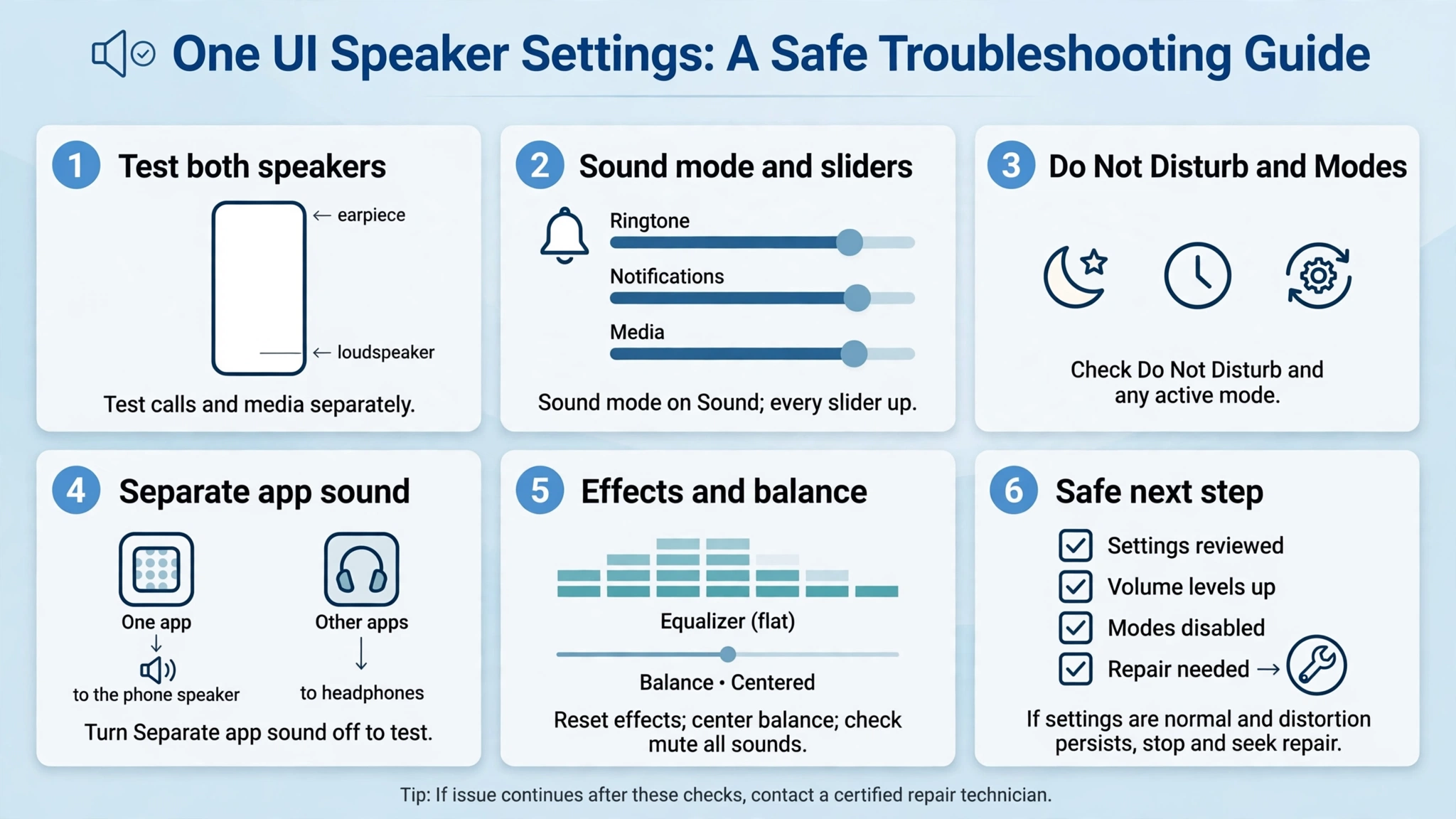
If your Samsung Galaxy phone running One UI suddenly goes quiet, plays only through another device, or starts sounding distorted, the cause is often a setting rather than a broken speaker. A separate volume slider, a sound mode, a per-app output choice, a routine, or a sound effect can each change what you hear, while the speaker itself still works.
That is good news, because settings checks are quick and reversible. Work through them in order, test after each change, and note the original position of anything you change. Labels and menu positions vary by One UI version, model, region, and carrier, so if a label in this guide does not match your phone, use the search box inside Settings and type the setting name rather than assuming the setting does not exist.
Test the two speakers separately first
Before changing anything, find out whether the speaker can make sound at all. Play a short video or a song you know well, then make a test call and listen on the earpiece, then on speakerphone. Media normally uses the loudspeaker, while calls normally use the small earpiece at the top. A problem only during calls points to the earpiece, call volume, or call routing. A problem only with media points to media volume, media output, or a sound effect. A problem with callers hearing you points to the microphone, which is a different part from either speaker.
Also remove the case for the test. A thick case or a cover that overlaps a grille can muffle sound and look exactly like a settings fault. If sound returns without the case, the case was the problem, and no settings change is needed.
Check sound mode and the separate volume sliders
One UI keeps sound mode and volume separate, and both can silence a phone. Open Settings, then the Sounds and vibration area. First confirm the sound mode is set to Sound, not Vibrate or Mute. A phone on Mute will not ring or play notification sounds, even though media may still play, and a phone on Vibrate will buzz instead of ringing.
Next, open the volume area and check each slider in turn: ringtone, notifications, media, calls, and system sounds. Pressing a volume button during playback normally adjusts only the stream that is active at that moment, so a media slider that looks fine while a video is paused tells you nothing about the ringtone slider. Raise each slider gradually, not straight to maximum, and listen at a moderate, comfortable level. If a slider is at zero or very low, that alone explains silence for that kind of sound. Do not use maximum volume as a diagnostic tool. Loud sound does not clean a speaker, does not repair damage, and can make distortion worse.
While you are here, check that a real ringtone and notification sound are selected, not silence. A ringtone set to none produces exactly the same symptom as a broken speaker for incoming calls, and it is fixed in seconds once found.
Check Do Not Disturb, Modes, and Routines
Do Not Disturb on One UI lives in the notifications area, not only in quick settings, and it is easy to leave on by accident or on a schedule. Open the Do Not Disturb area, check whether it is on now, and check whether a schedule is set to turn it on again. A schedule explains a problem that appears every evening and disappears every morning. If Do Not Disturb is the cause, turn it off for testing, or keep it and add exceptions for the people and apps that should still ring. Do not assume a contact is excepted; open the exceptions list and confirm it.
One UI also has Modes and Routines, such as Sleep or Driving, that can mute sound automatically. A routine can re-silence a phone even after you have turned Do Not Disturb off by hand, which is why a problem that keeps returning deserves a check here. Open the Modes and Routines area and turn off any active mode for testing. If sound returns, the mode was the cause, and you can then decide whether to keep the mode with a sound exception or delete the routine.
Check Separate app sound: the One UI routing trap
Separate app sound is the One UI feature most likely to confuse troubleshooting, because it is designed to split audio on purpose. When it is on, a chosen app can play through the phone speaker while everything else uses a Bluetooth device, or a chosen app can play through Bluetooth while everything else uses the speaker. That means sound can work in most apps and fail in exactly one, or work through headphones and fail through the speaker, without any hardware fault at all.
Samsung's own troubleshooting guidance lists disabling Separate app sound if it is not needed as one of the first settings checks. Open the Sounds and vibration area, find Separate app sound, and turn it off for testing. If the silent app suddenly plays through the phone speaker, routing was the cause. Restore the feature afterward only if you actually want per-app routing, and note that it cannot assign different apps to different Bluetooth devices — the choice is the phone speaker or the single connected Bluetooth device.
If only one app is silent and Separate app sound is already off, check that app's own volume, mute, and notification settings before blaming the whole phone. A video app can be muted inside the app while system volume is fine, and a messaging app can have its notification sound turned off while calls still ring.
Check sound quality and effects before blaming the speaker
One UI's Sound quality and effects area, where present, holds several controls that can change how the built-in speaker sounds. Dolby Atmos processing, an equalizer, and Adapt Sound — a personalized hearing profile — can each make audio quieter, harsher, or muffled if they are miscalibrated or if a preset does not suit the phone's small speakers. Availability and labels vary by model and version.
If distortion, tinny sound, or quiet call audio appeared after an update or after an effect was changed, reset this area for testing: turn Dolby Atmos off, return the equalizer to its Normal or default preset, and turn Adapt Sound off. Test at a moderate volume with a song and a call you know well. If clear sound returns, the effect was the cause. You can then re-enable one effect at a time, testing after each change, rather than turning everything back on at once and losing track of the culprit. If distortion persists at moderate volume with all effects off, the problem is probably not a setting.
Check hearing enhancements: balance and mute all sounds
One UI places hearing options in the accessibility area, under hearing enhancements on many versions. Samsung's own guidance names two checks here: left and right sound balance, and mute all sounds. A balance control shifted to one side makes a phone sound quiet or one-sided. A mute-all-sounds toggle, where present, turns off all sounds including calls and alerts. Both can look like a speaker fault, and both are fixed in seconds once found.
If sound is one-sided, center the balance control and test again. If all sound is gone, check for a mute-all-sounds toggle and turn it off for testing. Note the original position of any accessibility setting before you change it, and restore anything you do not intend to change permanently. Accessibility settings should be adjusted to your needs, not reset blindly, because they may have been set deliberately for hearing assistance.
Check Bluetooth and other outputs last in the settings layer
A phone with a working speaker can still sound silent if it is sending audio elsewhere. Bluetooth headphones, a car system, a smart speaker, or a wired accessory can all take over output. Turn Bluetooth off temporarily, unplug any wired audio accessory, and test again. If sound returns, the speaker was never broken; the output was routed elsewhere. Also check the media output control in quick settings or the volume panel, where your phone may list the phone speaker alongside connected devices. Choose the phone speaker for the test, and only switch back to another device when you intend to use it.
Keep the distinction between parts in mind throughout. The loudspeaker, the earpiece, the microphone, and the charging port are different parts with different checks. Cleaning the wrong opening, or treating a microphone problem as a speaker problem, wastes time and can cause damage.
When settings are not the cause
If sound mode is Sound, every slider is up, Do Not Disturb and every mode are off, Separate app sound is off, effects are default, balance is centered, mute all sounds is off, and no Bluetooth device is connected, yet sound is still absent or distorted, the problem is probably not settings. Check gently for dust or lint blocking a grille, and check whether the phone got wet. For a wet phone, follow the manufacturer's guidance first: Samsung's guidance includes turning the device off if wet and drying the speaker, microphone, and USB port areas with a soft, clean cloth, and letting the phone dry completely. Do not charge it while a liquid warning is present. Sound does not always eject water or dust, and it cannot repair damage, so do not keep raising the volume in the hope that repetition will fix it.
Stop and seek repair if you hear persistent crackling or distortion at moderate volume, if sound stays quiet after drying, if a grille or case is visibly damaged, or if the phone was submerged. Do not open the phone yourself unless you are qualified, do not insert sharp objects into a grille, and do not use high-pressure air or liquid cleaners.
A safe order to remember
The safest One UI troubleshooting order is: test the loudspeaker and earpiece separately, then sound mode and volume sliders, then ringtone selection, then Do Not Disturb and Modes and Routines, then Separate app sound, then sound quality and effects, then hearing enhancements, then Bluetooth and media output, then physical checks, then repair. Most One UI speaker silences turn out to be a mode, a slider, a routine, or a routed output. Checking those first saves a cleaning attempt on a clean speaker and a repair visit for a muted phone.
FAQ
1. Why is my One UI phone silent even though the volume is up?
Because One UI has separate sliders for ringtone, notifications, media, calls, and system sounds, and a separate sound mode. Check that sound mode is Sound, not Vibrate or Mute, and check each slider, not just the one shown by the volume buttons.
2. What is Separate app sound, and why does it silence one app?
It routes a chosen app to a different output from the rest of the phone — for example, one app through the phone speaker while the rest use Bluetooth. Turn it off for testing if only one app is silent or plays elsewhere. Restore it only if you want that behavior.
3. Can Modes and Routines silence my Galaxy phone?
Yes. A Sleep, Driving, or custom routine can mute sound automatically and can re-silence the phone after you turn Do Not Disturb off by hand. Check the Modes and Routines area and turn off any active mode for testing.
4. Can Dolby Atmos or Adapt Sound make my Galaxy speaker sound distorted?
Yes. A sound effect, a heavy equalizer preset, or a miscalibrated Adapt Sound profile can make audio harsh, tinny, or quiet. Return effects to default and Adapt Sound to off for testing, at a moderate volume, before concluding the speaker is damaged.
5. Why does my One UI phone sound one-sided?
Check the left and right sound balance control in the accessibility area under hearing enhancements, where present. If it is shifted to one side, center it and test again. A blocked grille or a damaged speaker can also cause one-sided sound, so check the grille gently if balance does not explain it.
6. Why does my phone play videos but never ring?
That pattern points to a setting, not the speaker. Check sound mode, the ringtone and notification sliders, a ringtone set to none, Do Not Disturb, and any active mode or routine. Media uses different sliders and is often unaffected by Do Not Disturb.
7. My One UI speaker is still muffled after checking settings. What next?
Check gently for dust or lint, and check whether the phone got wet. Follow the manufacturer's drying guidance for a wet device, and do not keep raising the volume. If distortion persists at moderate volume after drying, seek repair rather than repeating tones.
Leave a Reply