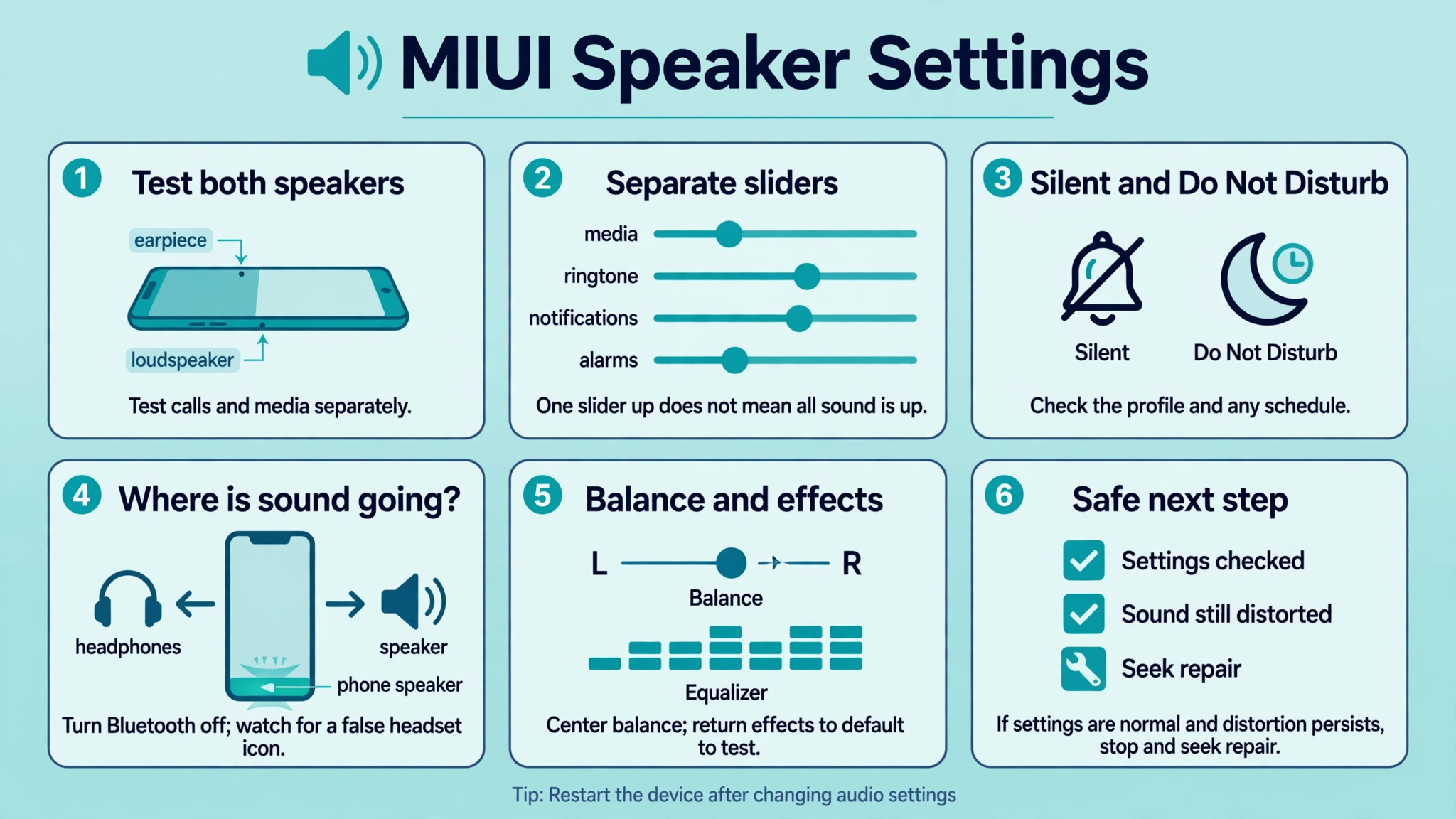
If your Xiaomi, Redmi, or POCO phone running MIUI suddenly goes quiet, the cause is often a setting rather than a broken speaker. A separate volume slider, a silence mode, a Bluetooth output, or a hearing option can each send sound somewhere you do not expect, while the speaker itself still works.
That is good news, because settings checks are quick and reversible. Work through them in order, test after each change, and note the original position of anything you change. Labels and menu positions vary by MIUI version, model, region, and carrier, so if a label in this guide does not match your phone, use the search box inside Settings and type the setting name rather than assuming the setting does not exist.
Test the two speakers separately first
Before changing anything, find out whether the speaker can make sound at all. Play a short video or a song you know well, then make a test call and listen on the earpiece, then on speakerphone. Media normally uses the loudspeaker at the bottom of the phone, while calls normally use the small earpiece at the top. A problem only during calls points to the earpiece, call volume, or call routing. A problem only with media points to media volume or media output. A problem with callers hearing you points to the microphone, which is a different part from either speaker.
Also remove the case for the test. A thick case or a cover that overlaps a grille can muffle sound and look exactly like a settings fault. If sound returns without the case, the case was the problem, and no settings change is needed.
Check the separate volume sliders in Sound and vibration
MIUI does not have one volume control. It has several, and they work independently. Your ringtone can be loud while media is silent, or media can be loud while call volume is low. Open Settings, then the Sound and vibration area, and check each slider in turn: media, ringtone, notifications, and alarms. During a call, press the volume buttons to check call volume separately, because call volume is only adjustable while a call is active on many phones.
Raise each slider gradually, not straight to maximum. Listen at a moderate, comfortable level first. If a slider is at zero or very low, that alone explains silence for that kind of sound. If a slider moves but no sound follows, note which kind of sound is affected, because that narrows the next step. Do not use maximum volume as a diagnostic tool. Loud sound does not clean a speaker, does not repair damage, and can make distortion worse.
While you are in the Sound and vibration area, check the sound profile. MIUI phones can sit in a silent or vibrate profile that is easy to leave on by accident, and the quick settings panel may show the current profile. If the phone is silent, ringtones and notifications will not play through the speaker even though media may still play. Set the profile back to sound for testing, and only restore a silent profile deliberately afterward.
Check Do Not Disturb, including schedules
Do Not Disturb is a separate control from the silent profile, and it is one of the most common causes of a phone that never rings. In the Sound and vibration area, or in the notifications area depending on your MIUI version, look for Do Not Disturb, check whether it is on, and check whether it is scheduled to turn on at certain times. A schedule explains a problem that appears every evening and disappears every morning.
If Do Not Disturb is the cause, you have two safe choices: turn it off, or keep it and add exceptions for the people and apps that should still ring. Do not assume a contact is excepted. Open the exceptions list and confirm it, because an exception that was never added will not help.
Check where the sound is going
A phone with a working speaker can still sound silent if it is sending audio elsewhere. Bluetooth headphones, a car system, a smart speaker, or wired earphones can all take over output, sometimes without an obvious indicator. Xiaomi's own support guidance lists a connected Bluetooth headset as one of the first things to check, and it also warns about a phone that mistakenly detects a wired headset when none is connected. If the status bar shows a headset icon while nothing is plugged in, that false detection is a likely cause, and gently cleaning the port area and reconnecting and disconnecting a wired accessory once may clear it. Do not insert sharp objects into any port or grille.
Turn Bluetooth off temporarily, unplug any wired audio accessory, and test again. If sound returns, the speaker was never broken; the output was routed elsewhere. Some apps also hold an audio channel without playing anything, so close background apps and reopen only the app you want to test if sound seems stuck after disconnecting Bluetooth. If only one app is silent, check that app's own volume, mute, and notification settings before blaming the whole phone.
Check hearing and accessibility options
MIUI places hearing-related options in the accessibility area, on many versions under Additional Settings. Two of them can look like a speaker fault. Mono audio combines stereo channels into one channel, which can help when one side is weaker but does not fix a blocked grille or a damaged speaker. A left and right balance control, where present, can shift sound to one side, which makes a phone sound quiet or one-sided. If sound is one-sided, center the balance control and test again.
Note the original position of any accessibility setting before you change it, and restore anything you do not intend to change permanently. Accessibility settings should be adjusted to your needs, not reset blindly, because they may have been set deliberately for hearing assistance.
Check sound effects and enhancements with care
Some MIUI phones include a sound enhancement or equalizer area inside Sound and vibration. Where present, it may offer presets or an equalizer for music and media. An extreme preset can make small phone speakers sound harsh or distorted at higher volumes, especially if bass is pushed hard. If distortion appeared after an enhancement was changed, return the enhancement to its default or off position and test at a moderate volume before concluding the speaker is damaged.
Not every MIUI phone has the same sound effects, and the same label can behave differently on different models. Treat any enhancement as a preference, not a repair. If turning an enhancement off restores clear sound, leave it off or use a gentler preset. If distortion persists at moderate volume with enhancements off, the problem is probably not a setting.
Use the built-in hardware test where your phone offers it
Xiaomi's support pages describe a built-in hardware test, sometimes called CIT, that can play test audio through the speaker and earpiece independently. The code and menu layout vary by model and version, and not every phone presents it the same way, so do not rely on a code copied from an unrelated guide. If your phone offers a hardware test through its support or diagnostics area, use it only to answer one question: does the speaker make sound at all? A test that plays clearly points back to settings or routing. A test that stays silent or distorted points toward cleaning or repair.
Keep the distinction between parts in mind throughout. The loudspeaker, the earpiece, the microphone, and the charging port are different parts with different checks. Cleaning the wrong opening, or treating a microphone problem as a speaker problem, wastes time and can cause damage.
When settings are not the cause
If every slider is up, no silence profile or Do Not Disturb schedule is on, no Bluetooth device is connected, no false headset detection is showing, accessibility options are normal, and sound is still absent or distorted, the problem is probably not settings. Check gently for dust or lint blocking a grille, and check whether the phone got wet. For a wet phone, follow the manufacturer's guidance first, let the phone dry completely, and do not charge it while a liquid warning is present. Sound does not always eject water or dust, and it cannot repair damage, so do not keep raising the volume in the hope that repetition will fix it.
Stop and seek repair if you hear persistent crackling or distortion at moderate volume, if sound stays quiet after drying, if a grille or case is visibly damaged, or if the phone was submerged. Do not open the phone yourself unless you are qualified, do not insert sharp objects into a grille, and do not use high-pressure air or liquid cleaners.
A safe order to remember
The safest MIUI troubleshooting order is: test the loudspeaker and earpiece separately, then volume sliders, then sound profile, then Do Not Disturb and its schedule, then Bluetooth and headset detection, then accessibility balance, then sound effects, then the hardware test where available, then physical checks, then repair. Most MIUI speaker silences turn out to be a slider, a profile, or a routed output. Checking those first saves a cleaning attempt on a clean speaker and a repair visit for a muted phone.
FAQ
1. Why is my MIUI phone silent even though the volume is up?
Because MIUI has separate sliders for media, ringtone, notifications, alarms, and calls. Check each slider, not just the one shown by the volume buttons. Also check the sound profile, Do Not Disturb, and whether sound is routed to Bluetooth or a headset.
2. How do I check call volume on MIUI?
Call volume is separate from media volume and is normally adjusted during an active call. Make a test call, press the volume buttons during the call, and listen on the earpiece first, then on speakerphone, to separate an earpiece problem from a loudspeaker problem.
3. Can Do Not Disturb silence my MIUI phone on a schedule?
Yes. Do Not Disturb can be scheduled, so a phone can miss calls every evening and ring normally every morning. Check both whether Do Not Disturb is on now and whether a schedule is set to turn it on again.
4. Why does my MIUI phone show a headset icon when nothing is plugged in?
The phone may be mistakenly detecting a wired headset, which routes sound away from the built-in speaker. Disconnect any accessory, gently check the port area, and test again. Do not insert sharp objects into the port.
5. What is the MIUI clean speaker option, and should I use it?
Some MIUI models offer a speaker-cleaning option that plays sound through the speaker. Availability and location vary by model and version, so it may not exist on your phone. It is not a guaranteed fix: sound does not always eject water or dust, and it cannot repair damage.
6. Why does my MIUI phone sound one-sided?
Check the left and right balance control in the accessibility area, where present. If it is shifted to one side, center it and test again. A blocked grille or a damaged speaker can also cause one-sided sound, so check the grille gently if balance does not explain it.
7. My MIUI speaker is still muffled after checking settings. What next?
Check gently for dust or lint, and check whether the phone got wet. Follow the manufacturer's drying guidance for a wet device, and do not keep raising the volume. If distortion persists at moderate volume after drying, seek repair rather than repeating tones.
Leave a Reply