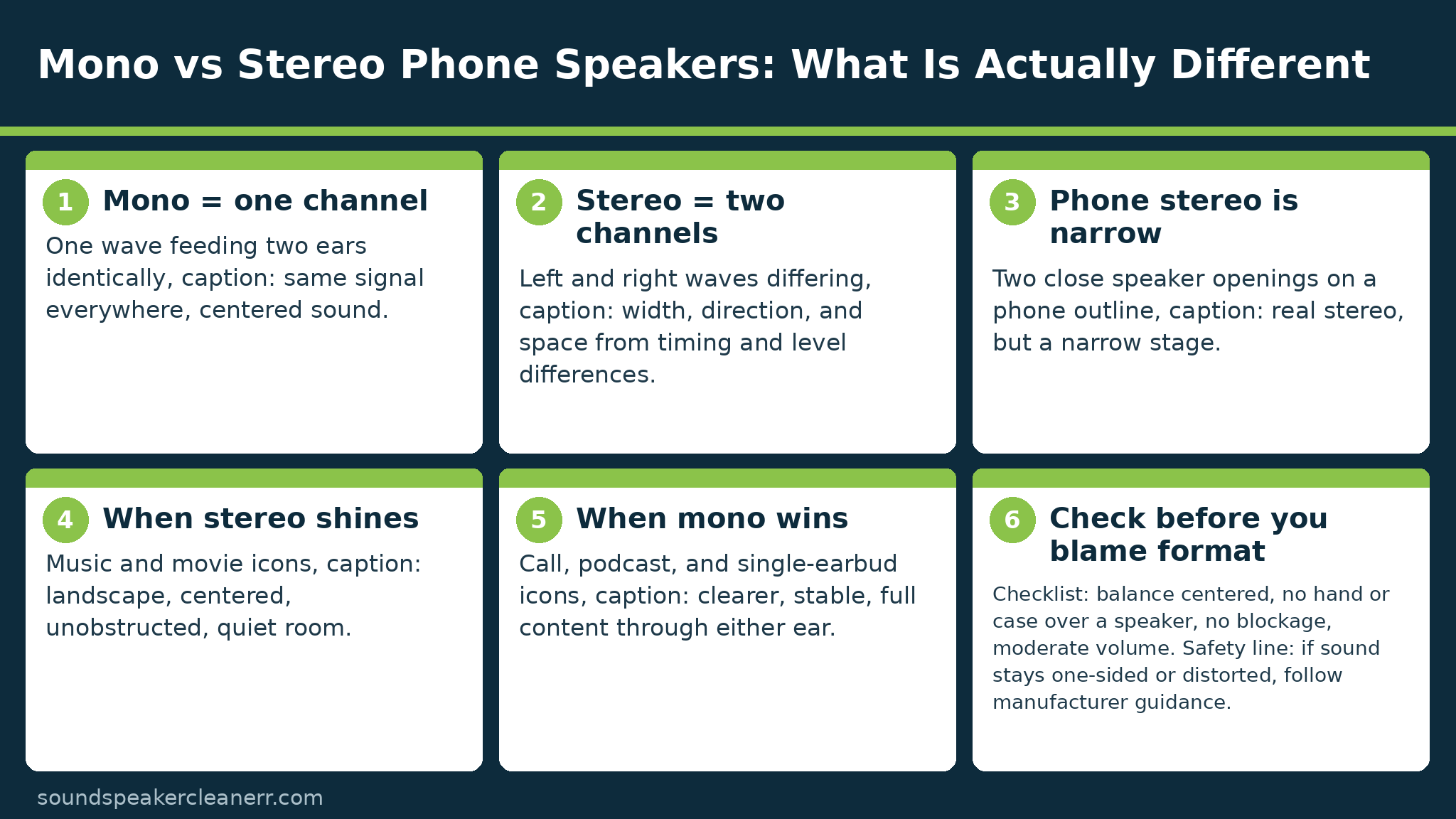
Mono sound uses one audio channel, so the same signal reaches every speaker and every ear. Stereo sound uses two channels, left and right, which can carry different information and create width, direction, and space. On a phone, stereo can sound wider for music, while mono is often clearer for calls.
Neither format is better in every situation. The right choice depends on the content, the listening position, and the listener. A phone that plays stereo is not automatically better than a phone that plays mono, and a stereo recording does not automatically sound stereo when played through a phone held in one hand. Understanding what each format actually does — and what limits phone stereo in practice — helps you judge what you hear without being misled by a "stereo speaker" label.
What mono really means
Mono, short for monophonic, means a single audio channel. Every speaker playing a mono signal plays the same waveform. If you listen through headphones, both ears hear identical content. If you listen through several speakers, every speaker plays the same thing. The sound appears to come from a single central point, rather than from a spread-out stage.
That simplicity is a strength, not a flaw. Because there is only one channel, there is nothing to lose if you hear only one side. A listener with hearing loss in one ear hears the full content through the other ear, because both ears would have received the same signal anyway. A listener using a single earbud, or holding a phone to one ear, hears everything. A listener in a noisy room, where fine left-right detail would be masked anyway, hears a stable, centered sound that does not depend on sitting in exactly the right spot.
Mono is also the foundation of most recordings. A single voice, a single microphone on an instrument, or a direct vocal capture starts as mono. Stereo mixes are built from mono sources placed across a left-right field. So mono is not an outdated fallback; it is the basic building block of audio, and it remains the right choice for content where clarity and reliability matter more than spatial effect — spoken word, podcasts, audiobooks, announcements, and phone calls.
On a phone, mono playback happens in several everyday situations, even on a device capable of stereo. A call through the earpiece is effectively a single-channel experience, because you are listening through one small speaker held to one ear. A voice message, a notification sound, or a ringtone is often mono by design, because its job is to be heard clearly, not to create a soundstage. That is normal, and it is not a defect.
What stereo really means
Stereo, short for stereophonic, means two audio channels: left and right. The two channels can carry different information. A guitar might be louder on the left, drums louder on the right, and vocals centered, because the mix places each element at a different point across the field. Your brain uses those timing and level differences — the same cues it uses to locate sounds in real life, with two ears spaced apart — to perceive width, depth, and placement.
That perception is called the soundstage: the imagined space where the music or movie seems to happen. A good stereo recording through well-placed speakers or headphones can make a band feel spread across a stage, a movie scene feel like it has space around it, and a game feel like sounds are coming from different directions. Stereo does not add new notes or new words; it adds spatial information about where the existing sounds seem to be.
Stereo recordings are usually made with two microphones capturing the same source from slightly different positions, or built in a mix by placing mono sources at different points across the field. Effects such as reverb and delay can also create stereo width from a mono source, by introducing small differences between the channels. Those differences are what the ear reads as space — but they only work if the two channels actually reach your two ears separately and distinctly.
That last condition is the key limit for phones, and it leads to the next section.
Why phone stereo is real, but limited
A phone described as having stereo speakers usually has two speaker openings that play the left and right channels separately — often the loudspeaker at the bottom and the earpiece at the top acting as a second speaker for media playback. That is genuinely stereo in signal terms: two channels are being played. But the physical separation between those two speakers is very small, often only the length of the phone. Your two ears, by contrast, are separated by the width of your head, and stereo perception relies on the difference in what each ear receives.
When the two speakers are close together and you hold the phone close to you, the left and right signals mix in the air before they reach your ears. The result is still wider and fuller than a single speaker, especially for music and video, but it is not the same wide soundstage you get from speakers placed apart or from headphones, where each ear receives only its own channel. Hold the phone in landscape orientation, with the speakers pointing left and right, and the effect is usually clearer than holding it in portrait orientation, where both speakers are roughly in line with your body and the separation is even less effective.
Your listening position matters too. Stereo works best when you are centered in front of the two speakers, at a reasonable distance, with both speakers unobstructed. If you hold the phone to one side, cover one speaker with your hand, or listen from an angle, one channel dominates and the stereo image collapses toward mono. That does not mean the phone is broken; it means the conditions for stereo perception are not met. A case that covers one opening, a hand over the earpiece speaker during media playback, or dust blocking one grille can all reduce stereo width in the same way.
In short, phone stereo is best understood as "stereo-capable with a narrow stage." It adds fullness, separation, and a sense of space compared with a single speaker, especially for music and movies, but it cannot reproduce the wide stage of separated speakers or headphones. Judging a phone's stereo by headphone standards will always disappoint; judging it by single-speaker standards will show a real, if modest, improvement.
When stereo matters, and when mono is better
Stereo matters most for content mixed for width: music with instruments placed across the field, movies with sound effects that move across the screen, and games where direction helps you locate events. For those, a stereo-capable phone in landscape orientation, held centered and unobstructed, will sound more immersive than a single speaker, even with the narrow stage. Headphones will sound wider still, because each ear receives only its own channel.
Mono is better, or at least no worse, for content where spatial effect adds nothing: phone calls, voice messages, podcasts, audiobooks, news, and announcements. For those, a centered, stable, single-channel sound is clearer and more robust, because it does not depend on your position or on both channels reaching you equally. Mono is also the better choice for accessibility. If you have hearing loss in one ear, a mono setting ensures you hear the full content through your better ear, instead of missing whatever was mixed to the weaker side. Most phones offer a mono-audio accessibility setting for exactly this reason, and using it is not a downgrade — it is a sensible adaptation to how you hear.
Mono is also more reliable in noisy or single-ear situations. If you are listening with one earbud while keeping the other ear free, or holding a phone to one ear on a call, mono guarantees you hear everything. Stereo in that situation guarantees you miss half the mix. The same applies in a car, a workplace, or a public place where you cannot sit centered in front of two speakers: mono's centered stability beats stereo's fragile width.
A practical rule follows: let the content and the situation decide. For music and movies in a quiet room, with the phone centered and unobstructed, enjoy stereo. For calls, speech, single-ear listening, or noisy environments, mono is the clearer and more reliable choice, and you lose nothing that matters for that content.
Mono, stereo, and the earpiece-loudspeaker distinction
A common confusion on phones comes from mixing up the earpiece, the loudspeaker, and stereo playback. The earpiece is the small speaker you hold to your ear for calls. The loudspeaker is the larger speaker used for speakerphone, media, and ringtones. On a stereo-capable phone, the earpiece may also act as a second loudspeaker during media playback, so that media plays through two openings at once. That does not turn the earpiece into a second loudspeaker for calls: during a call, you still listen through the earpiece alone, and the other speaker's role is different.
That distinction matters for troubleshooting. If media sounds wide and full but calls sound quiet or one-sided, the issue is not that "stereo is broken." Calls are a different use, through a different part, with different expectations. If media sounds one-sided — louder from one end of the phone than the other — check for a hand or case covering one opening, dust blocking one grille, or a balance setting that has been moved off-center. A balance slider dragged to one side will shunt sound toward that side and can easily be mistaken for a speaker fault.
Also note that a phone with a single loudspeaker opening is not necessarily a poor phone. A well-designed single speaker can sound clear, balanced, and satisfying for speech and general media, and it avoids the one-sided problems that come from a blocked or unbalanced second speaker. Stereo is an advantage for music and movies, not a requirement for good sound. Judge a single-speaker phone by clarity and distortion at a moderate volume, not by the absence of a stereo label.
How to test mono and stereo on your phone
Test with content you know, in conditions you control. For stereo, play a piece of music with clear left-right placement — for example, a track where an instrument is obviously on one side — first through headphones, where the separation is clearest, then through the phone's loudspeakers in landscape orientation, held centered and unobstructed. You should hear a wider, fuller sound than from a single speaker, but a narrower stage than through headphones. That difference is expected, not a fault.
For mono, try the accessibility mono-audio setting, if your phone offers one. With mono audio on, both headphone channels play identical content, and any left-right placement disappears. Speech should become more centered and stable, and you should hear the full content through either ear alone. If you have hearing loss in one ear, or you often listen with one earbud, mono audio is worth trying for everyday use, not just as a test.
If sound is one-sided, muffled, or distorted, check the ordinary causes before concluding the format is at fault: a balance setting moved off-center, a case or hand covering one opening, dust in a grille, or a software setting routing sound to the wrong part. Clean gently, without sharp tools, and test at a moderate volume. Sound played through a speaker may help with loose surface dust in some cases, but it does not always eject water or dust, and it does not repair damage. If the problem persists, follow the manufacturer's guidance or seek professional repair.
Do not chase a "stereo fix" for a problem that is really a blockage, a setting, or damage. Format is about channels; faults are about parts. Keeping those ideas separate makes troubleshooting faster and avoids the common mistake of treating every one-sided sound as a mono-versus-stereo issue.
FAQ
What is the difference between mono and stereo in simple terms?
Mono uses one audio channel, so every speaker and every ear hears the same signal. Stereo uses two channels, left and right, which can carry different information and create width, direction, and space.
Is stereo always better than mono?
No. Stereo is better for music, movies, and games where width and placement add to the experience. Mono is better for calls, speech, single-ear listening, and noisy places, where a centered, stable sound is clearer and more reliable.
Why does phone stereo sound narrower than headphone stereo?
Because the phone's two speakers are very close together, so their signals mix in the air before reaching your ears. Headphones send each channel to only one ear, so the separation is complete. Phone stereo is real, but its stage is narrow by physics.
Does holding my phone in landscape improve stereo?
Usually, yes. In landscape, the two speakers point left and right, which helps separation. In portrait, they are roughly in line with your body, so the stereo effect is weaker. Holding the phone centered and unobstructed also helps.
What is the mono-audio setting on my phone for?
It is an accessibility setting that mixes stereo into a single channel, so both ears hear identical content. It helps listeners with hearing loss in one ear, and anyone listening with one earbud, hear the full content instead of only one side.
Why does my phone sound one-sided during media but normal on calls?
Media may play through two speakers, so a blocked opening, a hand over one speaker, or a balance setting moved off-center can make it sound one-sided. Calls use the earpiece alone, so they are not affected the same way. Check for blockages and balance settings first.
Is a phone with a single speaker worse than a stereo phone?
Not necessarily. A well-designed single speaker can sound clear and balanced for speech and general media. Stereo is an advantage for music and movies, not a requirement for good sound. Judge by clarity and distortion at a moderate volume.
Can a mono recording sound stereo on my phone?
No, not truly. A mono recording has only one channel, so playing it through two speakers still plays the same signal from both. Effects can add artificial width, but they do not restore left-right information that was never recorded.
Leave a Reply