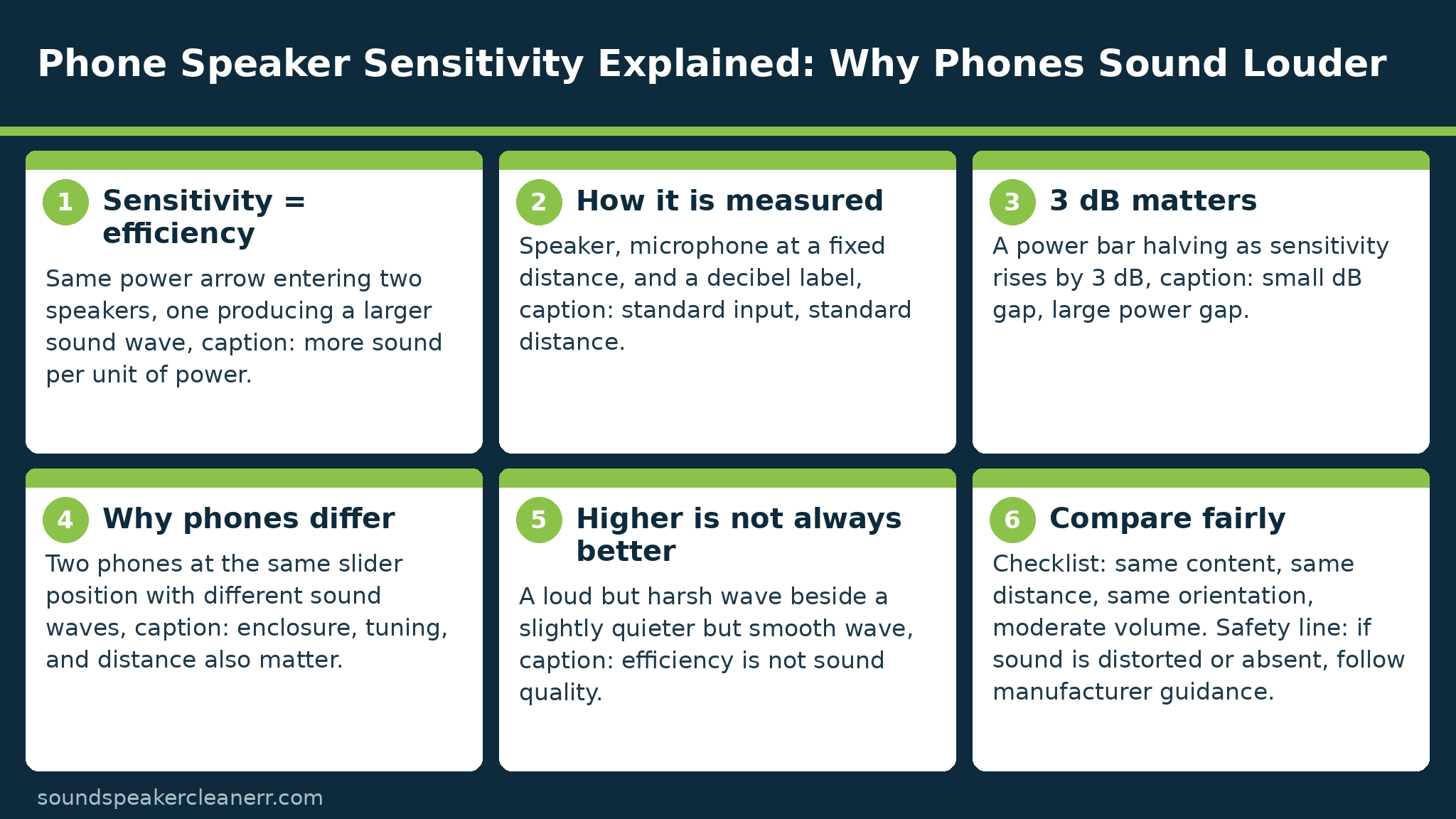
Speaker sensitivity describes how efficiently a speaker turns power into sound, measured in decibels from a standard input at a standard distance. A more sensitive speaker sounds louder with the same power, which is why two phones at the same setting can sound quite different.
If you have ever wondered why a friend's phone sounds louder than yours even though both are "turned up," sensitivity is the most likely general explanation — alongside enclosure design, tuning, and how close you are holding the device. Understanding it takes only one idea: a small difference in decibels represents a large difference in power. Once that clicks, spec sheets become far less mysterious, and the temptation to rank speakers by watts alone fades.
What sensitivity means in plain language
Imagine two speakers receiving exactly the same power. One turns that power into sound efficiently, wasting little as heat. The other wastes more and produces less sound from the same input. The first speaker has higher sensitivity. Sensitivity is therefore a measure of efficiency: how much audible sound you get for each unit of power you put in.
In general audio specifications, sensitivity is usually stated as a decibel figure measured under standard conditions — commonly one watt of power measured from one meter away, written as dB SPL at 1 watt and 1 meter. Some specifications use an equivalent voltage standard instead, which can shift the number slightly for speakers of different impedance, so two figures are only directly comparable when they were measured the same way. The key idea, however, stays the same: the figure tells you how loud the speaker plays for a given input, at a fixed distance.
A worked comparison shows why the number matters. If one general speaker design is rated a few decibels more sensitive than another, it needs noticeably less power to reach the same volume. The standard rule is that every 3 dB of extra sensitivity roughly halves the power needed for the same loudness. Turn that around: a speaker that is 3 dB less sensitive needs roughly twice the power to sound equally loud. A 6 dB gap means roughly four times the power, and a 10 dB gap means roughly ten times the power. Small decibel gaps therefore hide large power gaps.
That rule also explains the link to wattage. A sensitive speaker paired with a modest amplifier can sound louder and cleaner than an insensitive speaker paired with a much more powerful amplifier, because the sensitive design converts its smaller power input into sound more efficiently. Wattage describes the input; sensitivity describes how well that input is used. You need both ideas to understand loudness, and neither alone is enough.
Why phones sound different at the same volume setting
On a phone, the volume slider is not a loudness meter. It is a control that sets the signal level sent to the phone's internal amplifier and processing. Two different phone designs can interpret the same slider position very differently, because their speakers, enclosures, amplifiers, and tuning are different. Sensitivity, in the general sense, is one of the reasons for that difference — but on a phone it is bundled with everything else, not published as a single number you can compare across models.
Distance also changes what you hear far more than most people expect. The standard sensitivity measurement is taken from one meter away, but you usually hold a phone much closer than that — in your hand, near your ear, or on a desk in front of you. Sound gets louder as you get closer, so a phone that sounds loud in the hand may sound far quieter across a room. That is normal physics, not a fault, and it is why a fair comparison means holding both devices the same way, at the same distance, playing the same content, at a moderate volume.
Enclosure and tuning matter just as much. A phone speaker is a tiny driver in a tiny enclosure, and the enclosure shapes the sound as surely as the driver itself. The size and shape of the internal cavity, the grille opening, the case you use, and even whether your hand covers part of the speaker all change the output. Digital processing also shapes the sound before it reaches the speaker, boosting some frequencies and limiting others to protect the small driver from distortion. Two phones with similar drivers can therefore sound quite different, because the whole system — not one component — produces the sound.
Background noise plays a role too. In a quiet room, a modest volume sounds clear and full. On a busy street or in a noisy kitchen, the same volume can sound faint, because your ears must pick the phone's sound out of competing noise. That is not a change in sensitivity; it is a change in listening conditions. If a phone sounds quiet only in noisy places, the environment is likely the explanation, not a failing speaker.
Is higher sensitivity always better?
No, and this is an important correction. Higher sensitivity means more volume per unit of power, which is useful — especially in a battery-powered device where every unit of power counts. But it does not automatically mean better sound quality. A highly sensitive speaker can still sound harsh, thin, or distorted if its driver, enclosure, or tuning are poor. A less sensitive speaker with excellent design and tuning can sound more natural, clearer, and more pleasant, even if it needs more power to reach the same volume.
There are also trade-offs in design. A speaker optimized purely for maximum sensitivity might sacrifice bass control, smoothness, or durability. A speaker optimized for balanced sound might accept lower sensitivity in exchange for cleaner tone. Good design balances these goals for the device's actual use. For a phone, that use is close listening — calls, videos, voice messages, and music in the hand — so clarity at a moderate volume matters more than maximum loudness at full volume.
Another caution: sensitivity figures are only comparable when measured the same way. A figure measured at one watt and one meter cannot be directly compared with a figure measured at a different voltage, a different distance, or with different test tones, without converting between standards. That is one more reason not to rank phones by a sensitivity number you happen to find in a technical document. If the measurement conditions are not stated, the number is incomplete information.
Sensitivity, wattage, and impedance together
Sensitivity, wattage, and impedance are three parts of one story, and each answers a different question. Wattage asks: how much power can this design handle or deliver? Impedance asks: what electrical load does the speaker present to its amplifier? Sensitivity asks: how much sound does that power produce? No single answer describes loudness or quality on its own.
Consider two general examples. A sensitive speaker with a modest power rating can play loudly and cleanly, because it uses its power well. An insensitive speaker with a large power rating can also play loudly, but only by consuming far more power and generating more heat to reach the same level. If both are well designed, both can sound good — they simply arrive at loudness by different routes. If either is poorly designed, no combination of numbers will save it.
For a phone buyer, the practical conclusion is the same as for wattage and impedance: you do not shop by one number. You listen. The three specs are useful for understanding why devices differ, and for spotting misleading claims, but they are not a buying ranking. A seller who claims that a single sensitivity figure guarantees better sound is overstating what the figure can show.
What to check when one phone sounds quieter
Before concluding that a phone has a "weak" speaker, work through the ordinary causes. First, compare fairly: same content, same distance, same orientation, same volume setting, and no case covering the speaker. Second, check settings: a volume limit, a balance setting moved to one side, a mono-audio setting, or a "do not disturb" style mode can all change what you hear. Third, check the speaker itself: dust or lint in the grille, a case that muffles the opening, or moisture after exposure to water can all reduce loudness and clarity.
Also check which speaker you are testing. The earpiece and the loudspeaker are different parts. The earpiece is designed for calls held to the ear and will always sound quieter at arm's length than the loudspeaker, because that is its job. The loudspeaker is designed for speakerphone, media, and ringtones. Testing the earpiece as if it were the loudspeaker, or vice versa, will give a misleading result. Test each part in its normal use, at a moderate volume.
If one phone genuinely sounds quieter than another in a fair comparison, that does not necessarily mean it is faulty. It may simply be a less sensitive design, or a design tuned for clarity rather than maximum loudness. That trade-off may suit you or not, depending on how you use the phone. If the sound is distorted, muffled, rattling, or absent, rather than merely quieter, that points to a blockage, a setting, or damage — not to sensitivity — and the right step is gentle cleaning, a restart, and, if the problem persists, the manufacturer's guidance or professional repair.
Sound played through a speaker may help with loose surface dust in some cases, but it does not always eject water or dust, and it does not repair damage. Do not keep raising the volume to force a quiet speaker louder, and do not use sharp tools inside a speaker opening. Moderate volume protects both your hearing and the speaker.
How to use sensitivity without being misled
Use sensitivity as an explanation, not as a score. When a device sounds louder than expected for its size or power, efficiency is a likely part of the explanation. When a device sounds quieter than expected, lower efficiency is a possible part of the explanation — but so are enclosure, tuning, distance, and environment. A trustworthy description will mention sensitivity alongside those other factors, and will state how it was measured.
Be wary of any claim that treats a small sensitivity gap as unimportant, or a large one as a guarantee. A 3 dB gap is not trivial: it represents roughly a doubling or halving of power. At the same time, a sensitivity advantage does not guarantee pleasant sound. The best test remains listening at your normal volume, in your normal conditions, to the content you actually use — speech first for clarity, then music for clean loud passages.
In short, sensitivity explains why power alone does not decide loudness. It rewards efficient design, it punishes wasteful design, and it reminds you that the ear hears ratios, not raw watts. Keep that idea, and watt figures, ohm figures, and decibel figures will all make more sense — without any one of them becoming a false ranking.
FAQ
What is speaker sensitivity in simple terms?
Sensitivity is how efficiently a speaker turns power into sound, stated as loudness in decibels from a standard input at a standard distance, commonly 1 watt at 1 meter. Higher sensitivity means louder sound from the same power.
Why does one phone sound louder than another at the same volume?
Because their speakers, enclosures, amplifiers, and tuning differ, and sensitivity is one part of that difference. Distance, case, hand position, and background noise also change what you hear, so compare fairly before concluding one speaker is faulty.
How much difference does 3 dB of sensitivity make?
A lot. Every 3 dB of extra sensitivity roughly halves the power needed for the same volume. A 3 dB less sensitive speaker needs roughly twice the power, and a 10 dB gap means roughly ten times the power for the same loudness.
Is a more sensitive speaker always better quality?
No. Sensitivity measures efficiency, not tone or clarity. A highly sensitive speaker can still sound harsh or distorted, while a less sensitive speaker with better design and tuning can sound more natural and pleasant.
Can I compare sensitivity figures between two phones directly?
Only if they were measured the same way, with the same input standard, distance, and test conditions. If those conditions are not stated, the figures are not directly comparable, and phone makers do not generally publish a headline sensitivity spec for comparison shopping.
Does sensitivity affect battery life?
Indirectly, yes. A more efficient speaker needs less power for the same volume, which can ease the load on the amplifier. But battery life also depends on processing, screen use, and how loudly you listen, so sensitivity alone does not predict it.
Why does my phone sound quieter across a room than in my hand?
Because sound spreads as it travels and gets quieter with distance. Sensitivity is measured at a fixed distance, usually one meter, but you normally hold a phone much closer, so moving it away will always reduce what you hear.
Should I buy a phone based on its sensitivity rating?
No. Use sensitivity to understand why devices differ, not as a buying score. Listen at a moderate volume, check speech clarity and clean loud passages, and test the earpiece and loudspeaker separately in their normal uses.
Leave a Reply