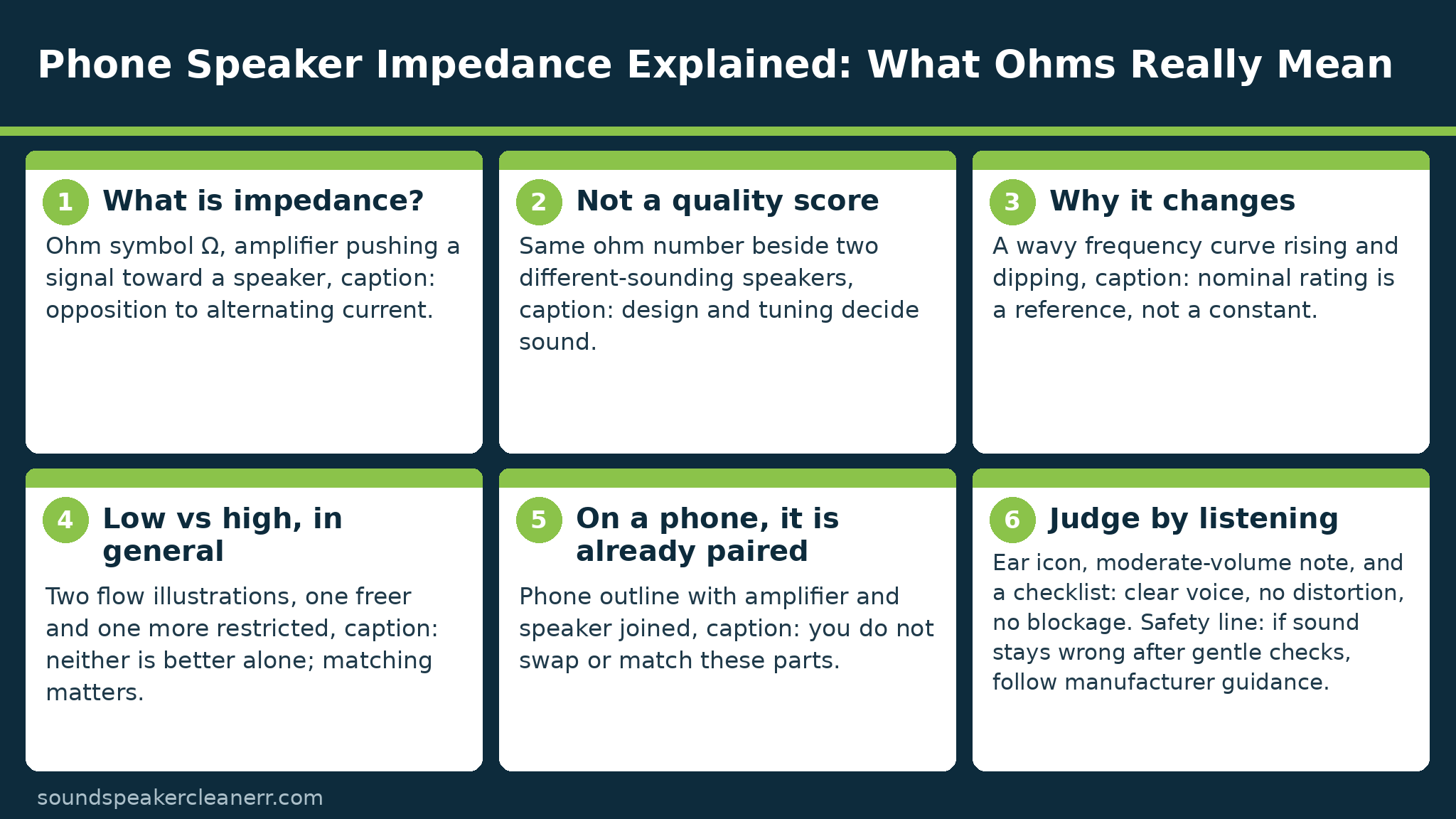
Impedance is how much electrical opposition a speaker presents to its amplifier, measured in ohms (Ω). Lower ohms mean current flows more easily; higher ohms restrict it. Impedance alone does not tell you whether a phone speaker sounds good or how loud it will play.
That short answer surprises many readers, because ohms look like a score. They are not. Impedance is an electrical description of the relationship between an amplifier and a speaker. It matters most when you are choosing separate parts that must work together, for example a home amplifier and a pair of passive speakers. On a phone, the amplifier and the speaker are designed together inside one device, so you do not match them yourself. What you can use impedance for is understanding why two devices can behave differently even when their other numbers look similar, and why a single ohm figure should never be used as a buying ranking.
What impedance actually measures
Think of an amplifier as pushing an electrical signal, and the speaker as the load that receives that push. Voltage is the push, current is the flow that results, and impedance describes how much opposition that flow meets. A helpful everyday comparison is a garden hose: higher pressure pushes more water through, a narrower hose restricts the flow, and a wider hose lets more through. In a speaker, the "hose" is mainly the voice coil, a tightly wound coil of wire that sits in a magnetic field. When current flows through the coil, the magnetic field moves the coil, and the coil moves the diaphragm that makes sound.
Impedance is not the same as simple resistance, even though both are measured in ohms. Resistance describes opposition to a steady, direct current. Audio is an alternating signal that constantly changes direction and frequency, and a coil behaves differently as that frequency changes. Part of impedance comes from the wire itself, and part comes from inductance, the coil's tendency to oppose changes in current. Together they form impedance, which is why the correct description is "opposition to alternating current," not just "resistance."
This distinction matters because it explains why an ohm rating is never a complete description. A speaker that is described with one number is being summarized. The real electrical behavior is a curve that rises and falls as the music changes pitch. The printed number is a useful shorthand, not a promise that the speaker always presents exactly that opposition.
Why impedance changes with frequency
Music is not a single tone. A phone speaker plays low notes, midrange voices, and high detail at the same time, and the coil responds differently to each. At some frequencies the coil's mechanical resonance makes impedance rise sharply. At others it may dip lower than the headline figure. Enclosures, ports, and any crossover parts in larger speakers also shape that curve, though a small phone speaker has a simpler internal path than a multi-driver home speaker.
The practical point is simple: do not treat a nominal rating as a fixed fact. When audio guides say "nominal impedance," they mean a standardized reference value that lets engineers compare designs and check that an amplifier can handle the load. It is the number used for planning, not a measurement you will see at every second of playback. If you ever read a detailed impedance curve for a general speaker design, you will see peaks and dips. That variation is normal, and it is one reason a single spec cannot capture how a speaker sounds.
For a phone owner, this also explains why volume and clarity can change between types of content. A deep bass note, a spoken voice, and a sharp notification sound place different electrical demands on the same speaker. The speaker is not changing its rating; the signal is changing, and the impedance follows the signal.
What "low" and "high" impedance mean in general
In general audio terms, a lower-impedance speaker allows more current to flow for the same voltage, so it draws more power from the amplifier. A higher-impedance speaker restricts current, so the amplifier must supply more voltage to reach the same output. Neither direction is automatically better. The right choice depends on what the amplifier was designed to drive.
That is why matching matters in systems with separate parts. If an amplifier is designed for a higher-impedance load and is connected to a much lower-impedance speaker, it may be asked to supply more current than it can comfortably deliver. The result can be heat, strain, or protective shutdown, and in extreme cases damage. If the impedance is much higher than the amplifier expects, the system may simply play more quietly, because not enough current flows. Good design avoids both problems by pairing parts that suit each other.
On a phone, that pairing has already been done by the manufacturer. You cannot plug a different internal speaker into the phone's amplifier, and you should not try to open the device to change it. So the question "should I choose a low-impedance phone or a high-impedance phone?" is not a question a buyer can act on in the way a home-audio buyer can. Phone makers do not generally advertise internal speaker impedance as a headline buying spec, and even when a figure appears in a technical document, it describes the internal design, not a part you can swap.
Why impedance is not a sound-quality score
One of the clearest points in the SERP sources is also the most useful: impedance has nothing to do with sound quality on its own. A speaker does not sound better because its ohm number is higher or lower. Sound quality comes from the whole design working together — the driver, the enclosure, the tuning, the amplifier, and the digital processing that shapes the sound before it reaches the speaker. Two speakers with the same nominal impedance can sound very different, and two speakers with different impedance can sound equally good.
This is a common trap in spec-sheet shopping. A single number feels objective, so it is tempting to rank devices by it. Impedance resists that use. It tells you about an electrical relationship, not about tone, clarity, distortion, or how natural a voice sounds. If you want to judge a phone speaker, listening at a moderate volume in a quiet room, checking speech clarity on a call, and checking whether loud passages distort will tell you far more than any ohm figure.
The same caution applies to loudness. A lower-impedance speaker can draw more power and may play louder on the same amplifier setting in a general system, but loudness also depends on sensitivity, amplifier design, enclosure size, and processing. On a phone, those factors are bundled together, so you cannot predict loudness from impedance alone. The companion explainers on wattage and sensitivity cover those two factors in plain language.
Impedance, headphones, and external speakers
Impedance becomes more practical when you connect something external, but the rules are still about matching, not about chasing a "best" number. Wired headphones and earphones have their own impedance, and a phone's headphone output or adapter is designed for a typical range. Very high-impedance headphones may sound quiet on a phone because the phone cannot supply enough voltage for that load, while very low-impedance models may be easy to drive but more sensitive to noise. Again, neither is better in isolation; the question is whether the source and the load suit each other.
With a Bluetooth speaker or Bluetooth headphones, the situation is different again. The amplifier and speaker are inside the external device, not in the phone, so the phone is only sending a digital signal. The impedance of the Bluetooth device's internal speaker is a matter for its own designer, not for the phone owner. That is one reason Bluetooth loudness and clarity vary so much between external devices: the whole design, not one number, decides the result.
If you use a wired connection and the sound is unexpectedly quiet, distorted, or uneven, check the simple causes first: volume settings, a balance setting that has been moved to one side, a dirty connector, or a damaged cable. Do not assume impedance is the cause, and do not buy an adapter or amplifier on the basis of an ohm figure alone without checking that it is designed for your device.
What to do if your phone speaker sounds wrong
Impedance is rarely the cause of a muffled, crackling, or quiet phone speaker, and it is not something you can fix by changing a setting. The common causes are far more ordinary: dust or lint blocking the grille, water or moisture in the loudspeaker opening, a case covering the speaker, a software setting that has lowered volume or routed sound to the earpiece instead of the loudspeaker, or physical damage after a drop. Start with those checks, at a moderate volume, and follow the manufacturer's guidance for a wet device rather than forcing sound through it.
It helps to be precise about which part you mean. The earpiece is the small speaker you hold to your ear on a call. The loudspeaker is the larger speaker used for speakerphone, media, and ringtones. The microphone captures your voice, and the charging port is a separate opening. A problem in one part does not automatically mean the others are affected, and cleaning or testing one part is not the same as testing the others. Keeping those parts distinct makes troubleshooting faster and avoids the common mistake of treating every sound problem as a "speaker" problem.
Sound played through a phone speaker may help dislodge loose surface dust or water in some cases, but it does not always eject water or dust, and it does not repair damage. If sound stays muffled, distorted, or absent after gentle cleaning and a restart, or if the device was exposed to liquid, stop and follow the manufacturer's guidance or seek professional repair. Do not keep raising the volume to force a result, and do not use sharp tools inside a speaker opening.
How to read an impedance spec without being misled
When you do see an ohm figure, read it as a design note, not a verdict. Ask three questions. First, is this a nominal rating, meaning a reference value rather than a constant? Second, what amplifier or system is it paired with, because impedance only has meaning in that pairing? Third, what else does the design include — sensitivity, power handling, enclosure, and tuning — that will matter more for the sound you actually hear?
If a listing gives only an ohm number and no other context, treat it as incomplete information, not as a reason to choose or reject a device. If a seller claims that a particular ohm value guarantees better bass, clearer voices, or louder sound, that claim goes beyond what impedance can show. A trustworthy description will present impedance alongside other measurements and listening impressions, and will explain the pairing it was designed for.
For most phone buyers, the honest conclusion is reassuring: you do not need to shop by impedance. Choose a phone by listening, by how clearly calls and media sound at the volume you actually use, and by whether the device suits your daily needs. Leave the impedance matching to the engineers who designed the amplifier and speaker together, and spend your attention on the things you can control — keeping the grille clean, using a moderate volume, and protecting the device from water, dust, and drops.
FAQ
What does speaker impedance mean in simple terms?
Impedance is the electrical opposition a speaker presents to its amplifier, measured in ohms (Ω). Lower impedance lets current flow more easily; higher impedance restricts it. It describes the amplifier-speaker relationship, not sound quality by itself.
Is lower impedance better than higher impedance?
Neither is better on its own. The right impedance is the one the amplifier was designed to drive. A mismatch in a system with separate parts can cause quiet sound, heat, or strain, but on a phone the amplifier and speaker are already paired by the manufacturer.
Does impedance affect how loud a phone speaker sounds?
It can influence loudness in a general system, but it does not decide loudness alone. Sensitivity, amplifier design, enclosure, and processing also matter, and on a phone they are bundled together, so impedance alone cannot predict how loud a phone will sound.
Why does impedance change instead of staying at one number?
Because audio is an alternating signal and a speaker coil's opposition changes with frequency. The printed figure is a nominal rating, a reference value for design and comparison, not a constant that holds at every pitch.
Can I change my phone's speaker impedance?
No. The internal speaker and amplifier are built together and are not user-swappable parts. Do not open the device to change them. If sound is wrong, check for blockages, settings, or damage, and follow the manufacturer's guidance.
Is impedance the same as resistance?
Not exactly. Resistance describes opposition to steady direct current. Impedance describes opposition to alternating current and includes both wire resistance and the coil's inductance, which changes with frequency. Both are measured in ohms.
Does impedance matter for Bluetooth speakers?
Not in the way it matters for a wired separate amplifier. With Bluetooth, the amplifier and speaker are inside the external device, so its internal impedance is a design matter for that device. The phone only sends a digital signal.
Should I compare phones by their ohm rating?
No. Phone makers do not generally present internal speaker impedance as a headline buying spec, and even when a figure is available it does not rank sound quality or loudness. Listen at a moderate volume and judge clarity and distortion instead.
Leave a Reply