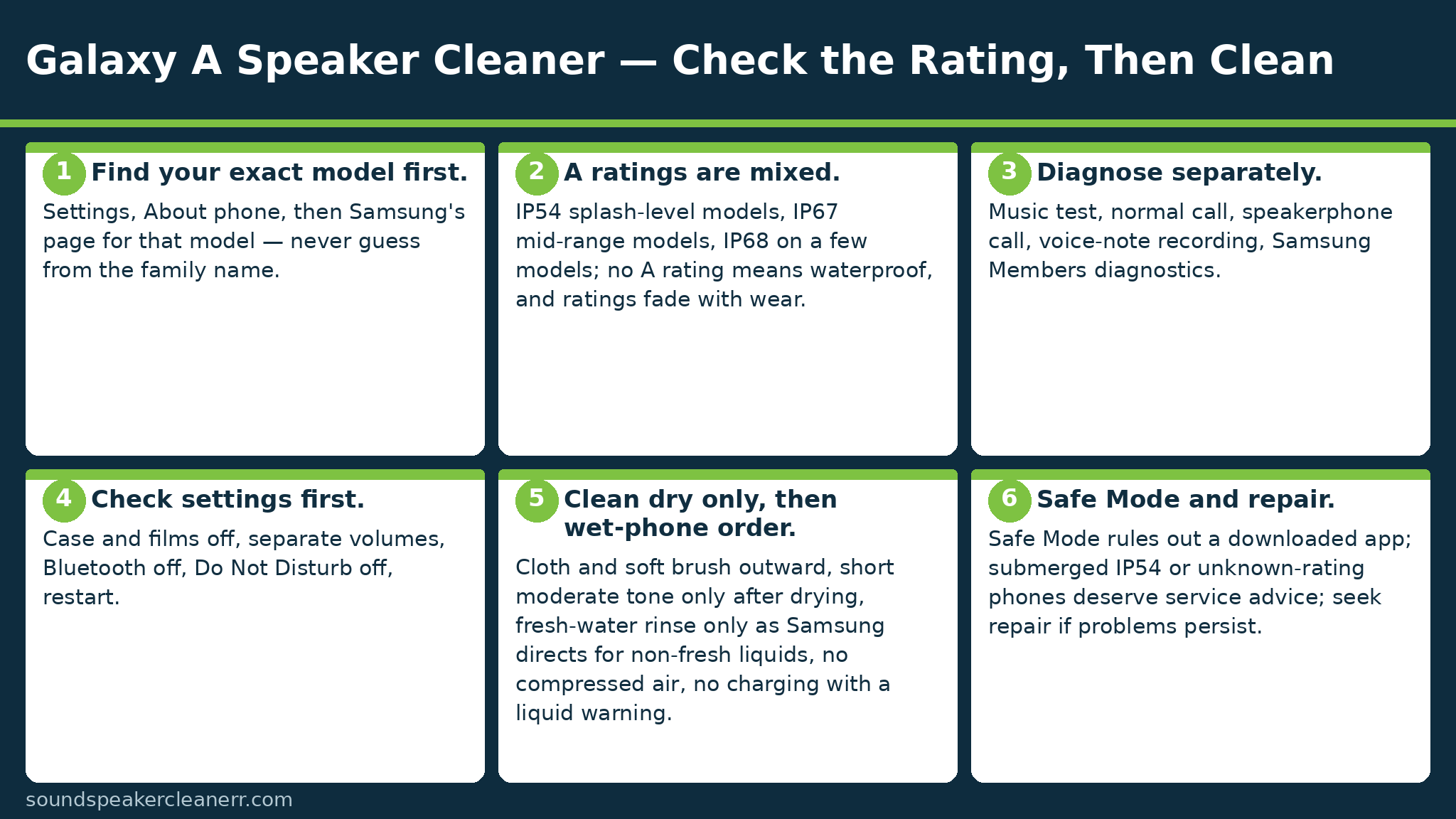
Galaxy A is Samsung's biggest, most varied family, and that variety is exactly why a Galaxy A speaker guide cannot copy a flagship guide. Some A models carry strong water resistance, some carry only splash resistance, and some older or entry-level models carry a lower rating or none you should rely on. A muffled Galaxy A speaker is usually still an ordinary problem — dust, a case, Bluetooth routing, or water that has not dried — but the safe steps after water depend on which A phone you hold. This guide starts with that check, then gives you the test, clean, and repair order for any Galaxy A.
Step one: find your exact Galaxy A model and rating
Do not guess your rating from the family name. Open Settings, then About phone, and write down the exact model name. Then check Samsung's support page for that model. The retrieved Samsung rating table splits the A series three ways: IP54 for the Galaxy A16, A16 5G, A17, and A17 5G; IP67 for models including the A26 5G, A33 5G through A36 5G, A52 5G through A56 5G, and A73 5G; and IP68 for the A5 2017, A7 2017, A8 2018, A37 5G, and A57 5G. Ratings also vary by model and region, and Samsung warns that resistance is not guaranteed beyond the tested depth or beyond 30 minutes and can diminish over time.
What the rating means in practice: an IP54 phone is protected against splashes and dust to a limited degree, not against submersion, so a phone dropped in water needs service advice, not a casual dry-and-test. An IP67 phone was tested in 1 meter of fresh water for 30 minutes without moving, in controlled conditions — that is not a swimming, shower, or beach rating. An IP68 phone was tested deeper, but still in fresh water, still for a limited time, and still not against high-pressure water, pool chemicals, or salt water. And any A phone that has been dropped, cracked, repaired, or handed down may no longer match its original rating at all. If you cannot confirm a rating for your exact model, treat the phone as unrated: dry it thoroughly, do not charge it wet, and seek service advice before assuming it is safe.
The A36 manual makes the same point in plain terms: if the phone is exposed to unclean water or liquids such as soapy water, oil, perfume, sunscreen, or alcohol-containing liquids, clean it with fresh water that does not flow, wipe it with a soft clean cloth, and dry it thoroughly before use — and do not connect a charger or accessories until the device is completely dry.
Why Galaxy A speakers go muffled
Galaxy A phones live hard daily lives. They are commuter phones, school and work phones, family phones, and second-hand phones, which means pocket lint, bag dust, kitchen steam, rain, and tight cases all get more chances to block a grille. A wrong-model case, a thick wallet case, or a protector creeping over the earpiece slot can muffle calls without anything being broken. Dust also builds slowly: sound gets a little duller each week until one day a video sounds clearly worse, and the owner assumes the speaker "wore out" when the grille is simply clogged.
Water is the second common cause, and on an A phone it is also the most misunderstood, because owners often assume every Galaxy phone shares the flagship rating. It does not. The third cause is software: Bluetooth routing to earbuds or a car, Do Not Disturb silencing calls, separate in-call and media volumes, and a single misbehaving app. All three causes — blockage, water, and settings — are cheap to rule out before you spend anything.
Diagnose first: test each part separately
Test in a quiet room, with the case removed, no Bluetooth device connected, and no headphones plugged in, so nothing else can hide the result.
Play music or a video at a moderate volume and note whether it is muffled, crackly, quiet, one-sided, or silent. Then use this site's Speaker Test tool to check for distortion or dropouts. Make a normal call without speakerphone and listen through the earpiece, then switch the same call to speakerphone and listen through the loudspeaker. Record a short voice note and play it back to test the microphone, not the speaker. If only one test fails, you have narrowed the problem to that part.
Speaker layout varies by A model, so do not assume the loudspeaker sits in the same spot as on a flagship or on a different A phone: look at the bottom edge and the top of your own phone, and check Samsung's manual diagram for your model if you are unsure. Samsung Members adds a second check: open Samsung Members, go to Support, then Phone diagnostics, and run the speaker and microphone tests offered there. A diagnostics pass does not prove the speaker is perfect, and a fail does not by itself prove hardware damage, but a clear difference between parts helps you describe the problem accurately if you need service.
Check the settings that mimic a broken Galaxy A speaker
Remove any case, screen protector, or film that covers a speaker opening, microphone hole, or air-vent groove, and test again — Samsung specifically warns that third-party cases and protectors can cover those grooves. This step matters more on A phones than on flagships, because cheap or hand-me-down cases are more common and more likely to fit poorly.
Next, check volumes separately. In-call volume can only be adjusted during a call, using the side keys, while media volume is adjusted during music or video. Open Settings, then Sounds and vibration, then Volume, and confirm media volume is up. Turn Bluetooth off temporarily, because audio may be routing to earbuds, a car system, or a Bluetooth speaker. Check Do Not Disturb, which can silence calls and notifications while music still plays, and check that "Mute all sounds" under Settings, Accessibility, Hearing enhancements is off.
Restart the phone and test again. If sound fails in only one app, check that app's mute controls and permissions before changing phone-wide settings, and test with a second app and a locally saved file so a streaming problem does not confuse the result. On an older A phone, also check storage and pending software updates: a phone that is completely full or far behind on updates can behave oddly, though neither replaces a physical check of the grille.
Clean a Galaxy A speaker safely
Dry cleaning only, and nothing inserted into any opening. This matters most for the dust-and-lint cases that dominate A-phone complaints. Wipe the outside of the grille with a dry, lint-free cloth, then use a soft, dry brush with light outward strokes so loosened dust falls away from the phone rather than deeper into it. For the earpiece slot, use the same light strokes across the slot. Do not press a brush into the slot, and never use a pin, needle, toothpick, or SIM ejector tool in a speaker or microphone hole. For a microphone hole, wipe around the opening and brush lightly outward; do not insert anything, blow hard into it, or use liquid.
If the speaker still sounds muffled after dry cleaning, try one short browser tone at a moderate volume with the speaker facing down, using this site's speaker cleaning tool or the Android Water Eject tool. Play one short cycle, then test with music. Repeat only once or twice more if the sound is clean and improving. Sound may help with light water or loose dust near a speaker opening. It is not a guarantee, and it does not repair a torn, corroded, or electrically damaged speaker. Do not use canned compressed air: Samsung's guidance warns against it, and high-pressure air at close range can push debris deeper or damage a mesh. If packed dirt does not shift with brushing, stop; that is a repair-shop job, and on a lower-cost A phone it is worth getting a repair quote before assuming replacement is cheaper.
If a Galaxy A phone got wet — follow your rating, not the family name
Water changes the order, and on an A phone the rating decides how worried to be. Do not start by playing loud tones or plugging in a charger. Remove the case, wipe the outside dry with a clean, soft cloth, and hold the phone with the speaker and port openings facing down. Samsung's guidance for a wet phone is to pat the earpiece, microphones, speaker, and USB port dry, then let the phone air-dry thoroughly before calling. Avoid heat to dry, and do not put the phone in rice.
If the phone was exposed to salt water, pool water, soapy water, oil, perfume, sunscreen, or any alcohol-containing liquid, rinse with fresh water that does not flow and dry thoroughly, as the A36 manual directs, because residue left to dry can block the openings. Do not charge while a liquid warning is shown, and do not connect any accessory until the device is completely dry. Only after drying, and only if there is no liquid warning, test the loudspeaker at moderate volume with a short tone. No specific charging-wait hour figure is given here, because guidance varies by model; follow Samsung's instructions for your exact phone.
For an IP54 model, or any model whose rating you cannot confirm, be extra cautious: splashes are one thing, submersion is another, and a submerged low-rated phone should get service advice even if it seems to dry out, because corrosion can appear later. For an IP67 or IP68 model, the same drying order still applies — a rating is a lab test in fresh water, not permission to swim with the phone.
Use Safe Mode to test for an app problem
If the speaker works in some apps but not others, or fails after a new install, test in Safe Mode. Samsung's Safe Mode steps are: swipe down to open Quick Settings, tap the power icon, touch and hold Power off until the Safe Mode prompt appears, then tap Safe Mode. In Safe Mode only pre-installed apps run. If the speaker works normally in Safe Mode but fails in normal mode, a downloaded app is the likely cause: restart normally, then uninstall the most recently installed or updated audio-related apps one at a time, testing after each removal. If the speaker still fails in Safe Mode, the cause is more likely a setting, blockage, water, or hardware.
If Safe Mode does not identify an app, Samsung's later steps include resetting all settings, which resets network and accessibility settings while keeping your data, and, as a last resort, a factory reset after backing up your data. Do not start with a factory reset. A reset will not fix a blocked grille, water damage, or a damaged speaker.
Troubleshooting
Still muffled after water: air-dry longer, speaker facing down, then try one more short tone. Do not charge while a liquid warning shows. Crackling or rattling: stop the tone. Crackling at moderate volume can mean debris, distortion, or damage. Do not raise the volume to push through it. Callers sound quiet, speakerphone sounds fine: check the earpiece, in-call volume during a call, and any case or film covering the earpiece. Callers cannot hear you: check microphone permissions, a case covering a mic hole, and Bluetooth routing, then test with a voice-note recording. Sound low but clear: check media volume and whether a case blocks the grille. Sound worse week by week: suspect slow dust and lint buildup; brush the grille dry and check the case fit. Works in Safe Mode only: uninstall recently added audio apps one at a time. Tone plays but nothing changes: that suggests packed debris, a setting, deeper water, or damage, not a higher frequency.
When to seek repair
Seek Samsung service or a qualified repair shop if sound stays distorted after gentle cleaning and drying; a speaker stays silent in Safe Mode and after resetting settings; the phone was submerged and its rating is IP54 or unknown; the phone was exposed to salt or soapy water and still sounds wrong after rinsing and drying; or you see corrosion, swelling, a cracked screen near a speaker, or a liquid warning that will not clear. Bring a clear description: your exact model and rating, when it started, whether water or dust was involved, what Samsung Members diagnostics showed, and what you already tried. On a second-hand A phone, also mention any known repair history, because a replaced screen or seal can change water resistance.
Conclusion
For a Galaxy A, the safe order is: find your exact model and rating first, remove the case and films, test loudspeaker, earpiece, and microphone separately, run Samsung Members diagnostics, check volumes, Bluetooth, and Do Not Disturb, restart, clean only the outside of the grille, try a short tone only after drying, use Safe Mode to rule out an app, and stop on distortion or no change. The rating check is what makes this a Galaxy A guide — and on a family this varied, it is the step you should never skip.
FAQ
How do I clean a Galaxy A speaker safely?
Wipe the grille with a dry, lint-free cloth and brush lightly outward with a soft, dry brush. Do not insert pins or toothpicks, do not use liquids or harsh chemicals, and do not use canned compressed air.
Are all Galaxy A phones water resistant?
No. Samsung's retrieved table splits the A series: IP54 for models like the A16 and A17, IP67 for models like the A34, A35, A36, A54, A55, and A56, and IP68 for a few models such as the A5 2017 and A7 2017. Check your exact model, because ratings vary by model and region and fade with wear or damage.
My Galaxy A got wet. What should I do first?
Remove the case, wipe the outside dry with a clean, soft cloth, hold the phone with openings facing down, and let it air-dry thoroughly before calling or charging. Do not charge while a liquid warning shows, and follow Samsung's guidance for your exact model.
Why does my Galaxy A sound muffled even though nothing spilled on it?
Slow dust and pocket-lint buildup in the grille is the most common dry cause, along with a poorly fitting case or a protector covering an opening. Brush the grille dry with light outward strokes and test again with the case removed.
Why do callers sound quiet but music sounds fine?
Music uses the loudspeaker, while a normal call uses the earpiece. Check the earpiece for a covering case or film, adjust in-call volume during a call, turn Bluetooth off, and test the earpiece separately from the loudspeaker.
Should I use compressed air on a Galaxy A speaker?
No. Samsung's guidance warns against cans of compressed air for drying and cleaning. Use a dry cloth and a soft, dry brush with light outward strokes, and stop if packed dirt does not shift.
What does Safe Mode prove on a Galaxy A?
If sound works in Safe Mode but fails normally, a downloaded app is the likely cause. If sound still fails in Safe Mode, the cause is more likely a setting, blockage, water, or hardware.
Can a cleaning tone fix a damaged Galaxy A speaker?
No. A short tone may help with light water or loose dust near a speaker opening, but it does not repair a torn, corroded, or electrically damaged speaker, and it does not clean a microphone or a charging port.
Leave a Reply