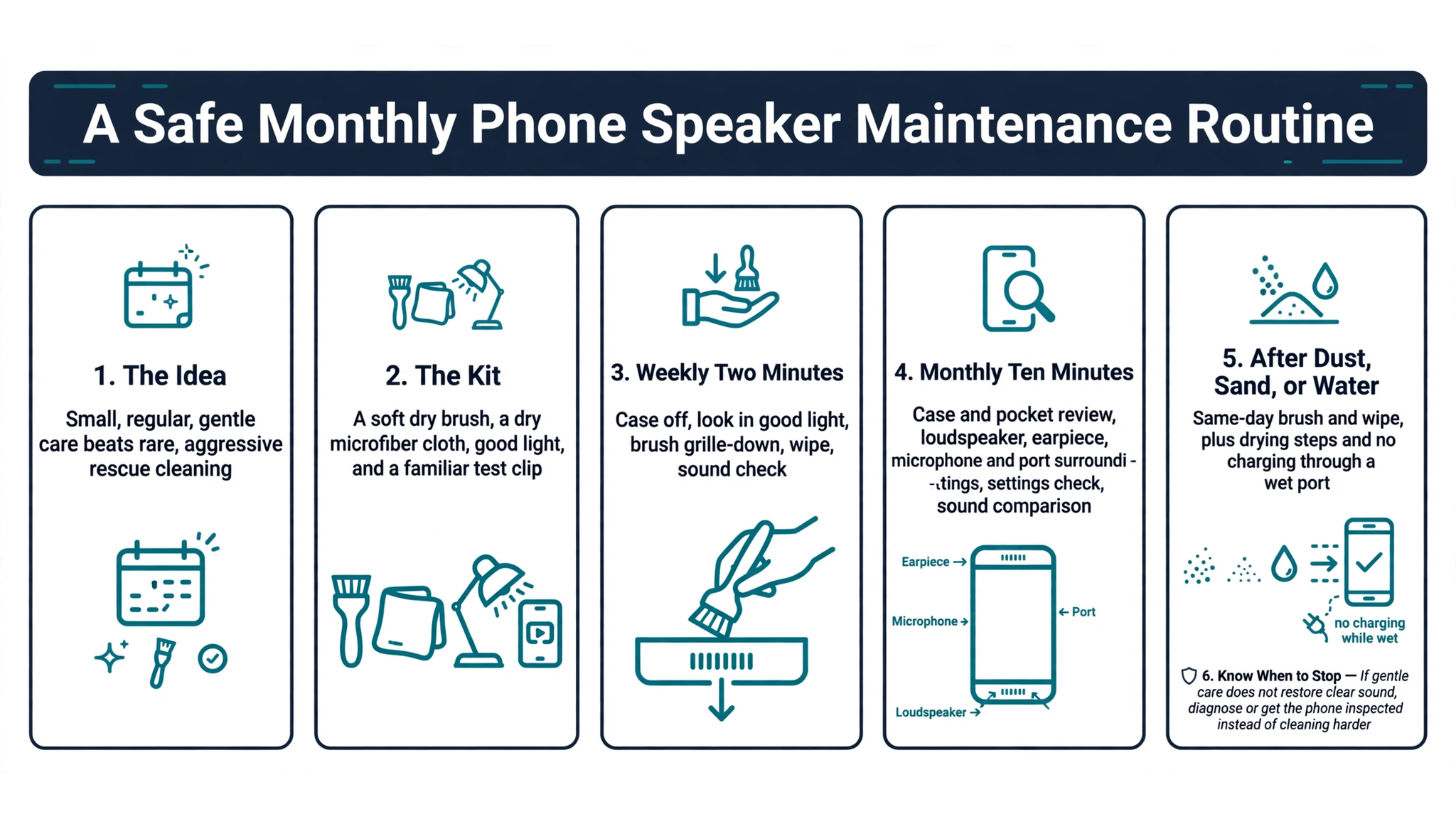
A phone speaker stays clear longest when care is small, regular, and gentle — not rare and aggressive. This routine takes about two minutes a week and about ten minutes a month: a quick weekly check for dust and case fit, a monthly deeper pass over the speaker, earpiece, microphone area, and charging port surroundings, and a short extra check after dust, sand, or water exposure. Done this way, cleaning stays a habit instead of becoming a rescue mission.
Why a routine beats rescue cleaning
Dust does not arrive all at once. It builds as a thin film, then a mat of lint, then a packed layer that resists gentle cleaning. A speaker cleaned only when it sounds badly muffled has already reached the packed stage, and the temptation then is to scrub harder, poke deeper, or blast air at close range — exactly the methods that risk the grille and the speaker underneath.
A routine catches dust at the film stage, when a light brush removes it. It also catches other problems early: a case that has drifted over the grille, a Bluetooth device still connected, a setting changed by an update, or a speaker that sounds different on one side. Early detection is quieter, cheaper, and safer than late rescue.
What you need for the routine
Keep a small kit in one place so the routine actually happens. You need only four things: a clean, dry, soft-bristled brush kept for the phone; a dry microfiber cloth; good light, such as a desk lamp or daylight; and the phone's own case-removal habit — no special tools. A short spoken-word clip or a familiar song for sound checks is helpful, because comparing the same audio each time makes changes easier to hear.
What you do not need is also worth stating: no pins, needles, toothpicks, or metal tools; no high-pressure air at close range; no liquids poured or sprayed into openings; no sticky tape pressed into the grille as a routine step; and no daily loud cleaning tones. If a step in this routine ever requires force, it is the wrong step.
The weekly two-minute check
Do this once a week, on the same day if that helps you remember it:
- Take the case off. Shake out lint from the case edge and check that the speaker cutouts still line up with the phone's grille.
- Look at the loudspeaker grille and the earpiece in good light. Note any visible lint, dust film, or grit.
- Hold the phone grille-down and brush the loudspeaker grille lightly with the dry soft brush, sweeping dust away from the openings, not into them.
- Wipe the earpiece area and the phone exterior with the dry microfiber cloth.
- Play the same short spoken-word clip at a comfortable volume through the loudspeaker, then briefly through the earpiece, and listen for muffling, uneven volume, or distortion.
If sound is clear and the grille looks clean, you are done. The weekly check is a check, not a deep clean, and most weeks it will take under two minutes. If you notice muffling, do not escalate immediately — note which speaker is affected, test briefly without the case, and check whether a Bluetooth device is still connected before deciding on a deeper pass.
The monthly ten-minute pass
Once a month, go a little deeper. The monthly pass covers everything the weekly check touches, plus the areas that collect debris more slowly:
- Case and pocket review. Clean the inside of the case around the speaker cutouts with the dry cloth. Check your usual pocket or bag compartment for accumulated lint, and clean it out. If the phone keeps clogging, the pocket or case is usually the source, not the speaker.
- Loudspeaker grille. Brush lightly with the phone grille-down, repeating with a fresh section of the brush if needed. Do not press the brush into the holes.
- Earpiece. Wipe the top edge with the dry cloth and brush very lightly. The earpiece openings are smaller and more delicate than the loudspeaker grille, so use an even gentler touch.
- Microphone and port surroundings. Wipe around the microphone holes and the charging port with the dry cloth, and look for lint at the port entrance. Do not push anything into the microphone holes or the port during routine care; port lint that affects charging is a separate job with its own safe method.
- Settings and connections check. Confirm no Bluetooth audio device is still connected, check that volume limits or accessibility audio settings have not changed after an update, and confirm the phone is not stuck in a silent or do-not-disturb mode that affects alarms and calls.
- Sound comparison. Play the same test clip as the weekly check, through both the loudspeaker and the earpiece, and compare with how it sounded last month. A slow decline that you notice month to month is more useful than a vague sense that "it used to sound better."
Write the result down if it helps: a one-line note — "November: clear, case aligned, no lint" — turns the routine into a record, and a record makes a real decline obvious instead of arguable.
After dust, sand, or water: the extra check
Some days deserve an extra check the same day, outside the weekly rhythm. After a beach trip, a dusty workday, a long drive on a dirt road, or any water splash, run a short version of the routine that evening: brush the grille lightly, wipe the phone with a dry cloth, check the case edge for grit, and listen to a test clip.
Water exposure needs its own care, not just the dust routine. If the phone got wet, follow the phone maker's wet-device guidance: remove the case, wipe the outside with a soft lint-free cloth, let the speaker area dry with good airflow, and do not charge through a wet port. A short, moderate-volume tone may help move moisture near a speaker opening after a minor splash, but it cannot dry a charging port, remove corrosion, or repair internal damage. If the phone was submerged, exposed to salt water or a sugary liquid, gets unusually hot, restarts, or shows charging problems, stop and get it inspected.
Sand deserves a special note: sand grains are hard and can scratch a grille or wedge into openings. After sand exposure, brush very lightly without pressing, and do not use tape or putty pressed into the grille to pull sand out — pressing a sticky substance into sand-filled holes can drive grains deeper.
Adjusting the routine to your life
The weekly-and-monthly rhythm is a starting point, not a rule. Adjust it to your environment. If you work in a dusty trade, spend a lot of time outdoors, or carry the phone in a lint-heavy pocket, a twice-weekly quick brush may serve you better than a weekly one. If the phone lives mostly on a clean desk and in a clean bag, the monthly pass may be the only step that ever finds anything — and that is fine. The routine should fit your life, or it will not survive the month.
What should not change is the gentleness. More frequent care should mean more frequent light brushing, never harder scrubbing, deeper poking, or longer loud tones. If a speaker needs aggressive cleaning every week, something else is wrong — a case that traps lint, a pocket that sheds fibers, a damaged grille, or a speaker problem — and finding that cause beats cleaning harder.
What to stop doing
A routine is also a list of things to stop. Stop running a cleaning tone every day: a clean, dry speaker gains nothing from repeated cycles. Stop using the phone at maximum volume as a test: a comfortable volume reveals muffling just as well, and maximum volume adds strain. Stop covering the speaker with tape between uses, stop leaving a clogged grille protector in place, and stop ignoring a speaker that sounds different on one side — one-sided sound is information, and it points to a specific grille, setting, or speaker worth checking.
Above all, stop when a step is not working. If gentle brushing, a case check, and a settings check do not restore clear sound, the next step is diagnosis or professional inspection, not a harder version of the same step. A speaker that still crackles, distorts, or stays silent after it is fully dry and clean may be damaged, and no routine will repair it.
A routine you can keep
The best maintenance routine is the one that survives contact with real life. Two minutes a week, ten minutes a month, a short check after dusty or wet days, and a habit of stopping when something does not improve — that is the whole system. It will not make a phone speaker immortal, and it will not fix damage. It will keep a healthy speaker sounding healthy for longer, catch problems while they are still small, and spare the speaker the aggressive rescue cleaning that causes most avoidable harm.
Pick a day, put the brush and cloth in one place, and start with this week's two-minute check. A month from now, the routine will feel like nothing at all — which is exactly what good maintenance should feel like.
FAQ
How often should I clean my phone speaker?
A quick check once a week and a deeper pass once a month suits most people. Adjust to your environment: dusty work or lint-heavy pockets may need a twice-weekly brush, while a clean desk-kept phone may need only the monthly pass.
Does a speaker need a cleaning tone every day?
No. A cleaning tone is a response to muffling or a minor splash, not a daily habit. A clean, dry speaker gains nothing from repeated cycles, so keep tones short, at moderate volume, and only when sound actually needs help.
What tools do I need for a speaker maintenance routine?
A clean, dry, soft-bristled brush, a dry microfiber cloth, and good light. No pins, metal tools, high-pressure air, or liquids poured into openings are needed for routine care.
Should I check the earpiece and microphone too, or just the loudspeaker?
Check all of them in the monthly pass. The earpiece collects oils and lint, and the microphone area collects dust that affects call quality. Use a gentler touch on the smaller earpiece and microphone openings.
What should I do after a beach trip or a dusty day?
Run a short extra check the same day: brush the grille lightly with the phone grille-down, wipe the phone with a dry cloth, check the case edge for grit, and listen to a test clip. Do not press tape or putty into sand-filled openings.
What if my speaker still sounds muffled after the routine?
Check the case with a brief on-and-off test, confirm no Bluetooth device is connected, and review audio settings. If gentle cleaning and those checks do not help, get the phone inspected rather than cleaning harder.
Can a routine fix a damaged speaker?
No. A routine keeps a healthy speaker clear and catches problems early, but it cannot repair a damaged driver, a torn grille, or internal water damage. Persistent crackling, distortion, or silence after cleaning and drying needs professional inspection.
How do I remember to do the routine?
Tie it to an existing habit: the weekly check with another weekly chore, and the monthly pass on the first weekend of the month. A one-line monthly note — clear or muffled, case aligned or not — makes progress easy to track.
Leave a Reply