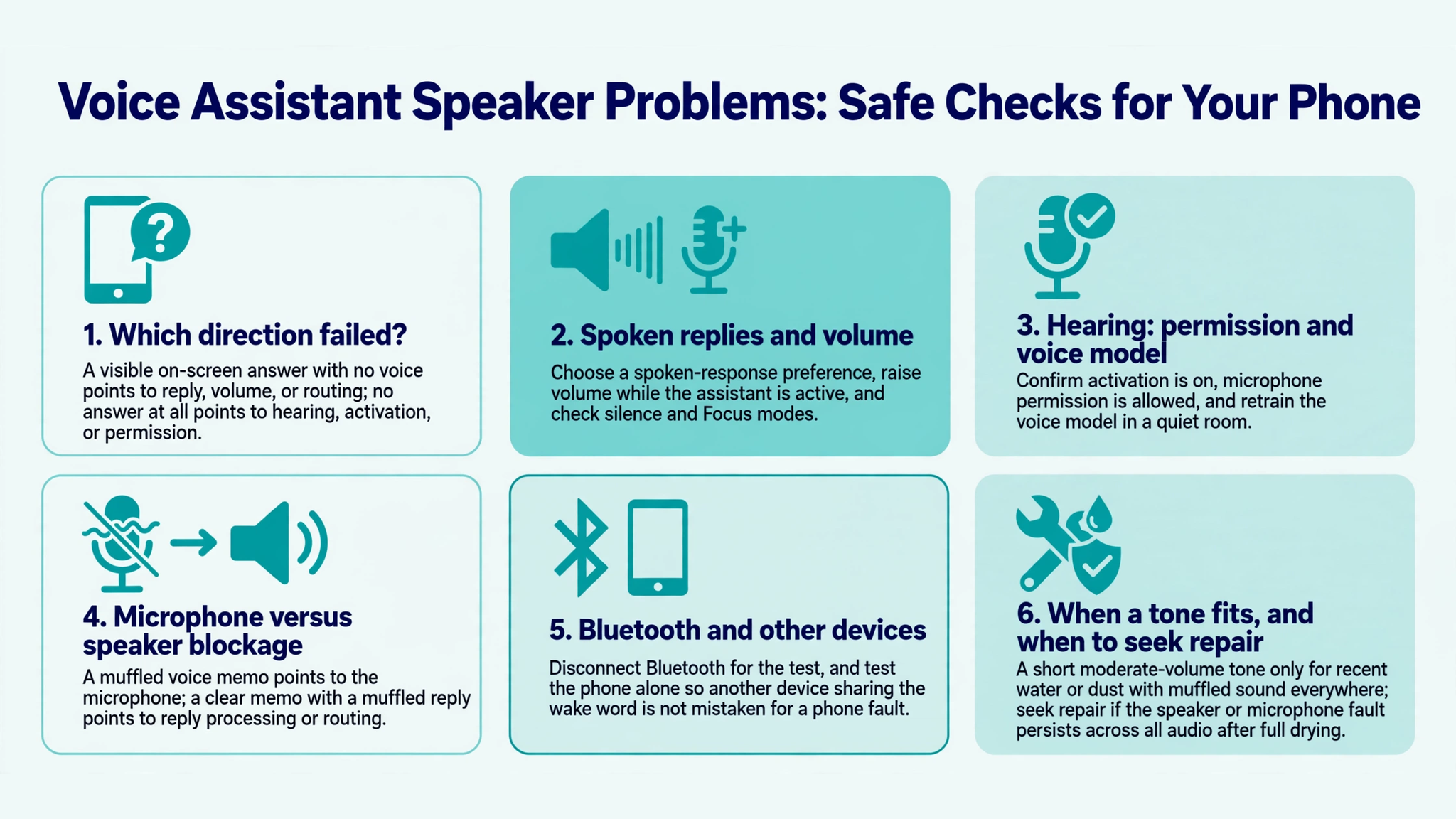
A phone voice assistant that seems broken is often not broken in one place, but broken in one direction. It may hear you perfectly and answer silently, it may fail to hear you at all, or it may answer through a speaker you cannot hear, and each of those faults needs a different fix.
The checks below keep those directions separate, starting with the fastest tests, so you can tell whether the fault is the microphone, the speaker, a response setting, a permission, or an audio route.
First test: does it hear you, and does it answer aloud?
Ask the assistant a simple question that shows a visible answer on screen, such as the time or the weather, and watch the screen while you listen. The screen tells you which direction failed, even before you change any setting.
- It shows the right answer but says nothing: the assistant heard you, and the fault is in the spoken response, the volume, or the audio route. Check spoken-response settings, volume while the assistant is active, and Bluetooth routing first.
- It shows nothing, or shows the wrong words: the assistant did not hear you clearly, or did not activate at all. Check activation, microphone permission, microphone blockage, background noise, and voice-model retraining first.
- It shows the right answer and speaks, but the voice is muffled or distorted: the loudspeaker, its grille, or an enhancement is the likely focus. Test music and a voice memo through the same loudspeaker to confirm.
- It works sometimes and fails at other times: note when it fails — in noise, in a case, on Bluetooth, with a low battery, or after an update — because an intermittent pattern points to a setting or a route, not to a permanently broken part.
Do not change five settings at once. Change one thing, repeat the same question, and note what changed. If you change volume, response setting, Bluetooth, and microphone permission together, you will not know which one helped.
Spoken responses, silent mode, and volume while active
The most common "assistant is dead" complaint is really a silent answer. Many phones let the assistant show an answer on screen without speaking it, keep it silent when the phone is in silent mode, or speak only when the screen is locked or unlocked, depending on the phone and operating-system version. Check the phone's own assistant settings for a spoken-response option, and choose the option that prefers spoken answers for the test.
Raise the volume while the assistant is active, not only from the home screen. Assistant volume can follow the media slider, the call slider, or a separate assistant volume, depending on the device, so the volume that suits music may not be the volume that controls the assistant reply. Ask the question again while raising volume gradually, and listen for the moment the reply becomes audible.
Also check silent mode, Do Not Disturb, and Focus modes. A mode that silences notifications can also silence spoken replies on some devices, while leaving on-screen answers untouched. Turn the mode off temporarily for the test, and note whether the reply returns. If it does, the mode or its exceptions, not the speaker, was the fault, and you can adjust the exception rather than leaving the mode off permanently.
Microphone permission, activation, and voice model
If the assistant does not activate or misunderstands you, the microphone side needs attention before the speaker side. First, confirm voice activation is actually turned on in the assistant settings, and that the assistant is allowed to work when the screen is locked, if that is how you normally use it. An update or an accidental toggle can turn activation off without any warning.
Next, check microphone permission for the assistant app. If permission was denied, changed, or set to allow only on some occasions, the assistant may fail to hear you even though the microphone works in other apps. Set permission to allow while using the assistant for the test, following the phone's own settings layout, which differs by device.
If activation is on and permission is allowed, but recognition is unreliable, retrain the voice model in a quiet room, speaking clearly and at a normal pace. Background noise, wind, echoes, and speaking too quickly can all cause missed wake words, even when the hardware is healthy. Retraining in a quiet room gives the model a clean sample, and testing the same phrase in the same quiet room afterwards shows whether recognition improved.
Also check for a microphone mute control, where the phone or its case provides one, and for any battery-saving setting that limits background listening. A power-saving mode can block wake-up to save battery, so test once with that mode off, and note any difference. Do not disable safety or thermal protections to chase assistant performance.
Microphone blockage versus speaker blockage
A phone has more than one small opening, and they fail differently. The microphone openings pick up your voice, the earpiece handles call audio, and the bottom loudspeaker handles most assistant replies, music, and speakerphone audio. A blocked microphone makes the assistant deaf; a blocked loudspeaker makes it silent or muffled; confusing the two leads to fixing the wrong part.
If the assistant misunderstands you, or other people say your voice sounds muffled on calls and voice memos sound muffled on playback, the microphone side is the likely focus. Look at the microphone openings under a bright light for lint or dust, and if the phone is dry and you can see surface lint, brush it gently with a clean, soft, dry brush. Do not insert pins, needles, or other objects into any opening, and do not use liquids or high-pressure air.
If the assistant understands you and shows the right answer, but its spoken reply is muffled or distorted, the loudspeaker side is the likely focus. Play a familiar song through the same loudspeaker at the same comfortable volume. If music is also muffled, check the case, grille, and enhancements as described below. If music is clear but only the assistant reply is muffled, check the spoken-response and enhancement settings before assuming the speaker is damaged.
Record a voice memo and play it back through the loudspeaker. That single test exercises both sides in sequence: the microphone records, the loudspeaker plays. If the recording is muffled, the microphone is suspect; if the recording is clear but the assistant reply is muffled, the reply processing or routing is suspect. Keep those outcomes separate.
Bluetooth, car systems, and the wrong audio route
A paired Bluetooth headset, earbuds, car system, or smart speaker can take the assistant reply away from the phone speaker. This is easy to miss, because the assistant may answer correctly on a device in another room, in a parked car, or in a headset you are not wearing, while the phone itself stays silent.
Disconnect Bluetooth temporarily for the test, and check that no wired earphones are plugged in. Ask the same question through the phone speaker alone. If the reply is clear on the phone speaker but silent or delayed on Bluetooth, the Bluetooth route or the paired device is the likely focus. If the reply is silent on both, the speaker, a setting, or the assistant itself is the likely focus.
The same check applies to any "separate app sound" or per-app audio-output setting, where the phone supports it. If the assistant's audio is sent to a different device, its reply may not come from the phone speaker even when other sounds do. Turn such routing off for the test, and repeat the same question.
Also check whether another device in the room is answering instead of the phone. If two devices share the same wake word, one may respond while the other stays silent, which can look like a phone fault. Test the phone alone, in a quiet room, with other devices muted or out of range, before concluding the phone is at fault.
Case, grille, enhancements, and network
A case that covers a microphone opening can make the assistant deaf, and a case that covers a loudspeaker grille can make its reply muffled, even when both parts are healthy. Remove the case for a test session, hold the phone so neither hand covers a microphone or speaker opening, and repeat the same question. If recognition or reply clarity improves immediately, the case or your grip, not a broken part, was the fault.
Next, check sound enhancements one at a time. Equalizers, bass boosts, surround-style effects, and manufacturer sound enhancements can distort a spoken reply even when the speaker is healthy, especially if several enhancements are active at once. Temporarily turn off enhancements and return to a flat or default setting, then repeat the same question. If the reply clears, an enhancement conflict, not a broken speaker, was the likely cause.
Finally, remember that many assistant answers depend on a network connection. A weak or interrupted connection can produce a delayed reply, a partial reply, or no reply at all, which can look like a speaker fault. Test the same question on a stable connection, and try a question that does not need the network, such as setting a timer or asking the time, where the phone supports it. If offline questions work but network questions fail, the connection, not the speaker, is the likely focus. Do not repeat the same network question many times in quick succession; wait for a stable connection and test once.
When a cleaning tone fits, and when it does not
A cleaning tone fits an assistant problem only in a narrow case: the phone recently got wet or dusty, the loudspeaker sounds muffled or distorted for assistant replies and for music at a normal volume, and you can see or suspect loose material near the grille. In that case, after drying a wet phone fully and inspecting a dry grille, a short, moderate-volume tone may help move loose material near the grille, followed by a retest with the same question and the same song.
A cleaning tone does not fit most assistant problems. It does not fix a denied microphone permission, a switched-off activation setting, a silent spoken-response setting, a Bluetooth route, a network fault, a voice-model mismatch, or a microphone fault. It does not repair a torn diaphragm or corrosion. If you have already tried a few short, moderate-volume cycles and the sound has not improved, more cycles at higher volume are not the next step. Stop, recheck settings and routing, and consider repair advice if distortion persists everywhere.
For a wet phone, follow the manufacturer's guidance first: do not charge a wet phone, and do not assume it is dry because the outside feels dry. A tone is only a grille-level check after the phone is fully dry, never a drying method on its own.
When to seek repair
Seek repair advice if: the loudspeaker is silent or distorted at a moderate volume across assistant replies, music, video, and calls; the microphone is muffled across voice memos, calls, and assistant questions after grille and permission checks; there is no sound at all after settings, Bluetooth, and grille checks; the grille or mesh is visibly torn or pushed in; the phone got wet and audio problems persist after full drying; or the phone overheats quickly, restarts, or has charging or screen problems alongside audio problems.
When you seek help, bring the pattern, not just a complaint: does the assistant hear you, does it show the right answer, does it speak, is the reply muffled or silent, does it work on Bluetooth or only on the phone speaker, and does it fail in noise or everywhere? That pattern is what separates a microphone fault from a speaker fault, and a settings fault from a hardware fault, and it helps a shop diagnose the phone without replacing a part that was never the problem.
FAQ
Why does my assistant show the answer but not speak it?
The spoken-response setting, silent mode, volume while active, or Bluetooth routing is the likely cause. Choose a spoken-response preference, raise volume while the assistant is active, and test with Bluetooth disconnected.
Why does my assistant ignore my voice completely?
Check voice activation, microphone permission, and any microphone mute control first, then retrain the voice model in a quiet room. Background noise, a blocked microphone opening, or a power-saving mode can also block wake-up.
Why does my assistant work sometimes but not other times?
Note when it fails: in noise, in a case, on Bluetooth, with a low battery, or after an update. An intermittent pattern points to a setting, a route, or a connection, not to a permanently broken part.
Is it a speaker problem or a microphone problem?
Record a voice memo and play it back. If the recording is muffled, the microphone is suspect. If the recording is clear but the assistant reply is muffled, the reply processing, enhancement, or routing is suspect.
Why does my assistant answer on another device instead of my phone?
Another device may share the same wake word, or Bluetooth may route the reply elsewhere. Test the phone alone, with Bluetooth disconnected and other devices muted or out of range, before concluding the phone is at fault.
Should I use a speaker cleaner for assistant problems?
Only in a narrow case: recent water or dust, and muffled or distorted sound from the same loudspeaker in music as well as assistant replies. A cleaning tone does not fix permission, activation, response-setting, Bluetooth, network, or microphone faults.
Why is my assistant reply quiet but music is loud?
Assistant volume can follow a different slider from music, depending on the device. Raise volume while the assistant is active, check spoken-response settings, and check whether a silence mode is suppressing replies.
When should I stop troubleshooting and seek repair?
Stop and seek repair advice if the loudspeaker is silent or distorted at a moderate volume across all audio, or the microphone is muffled across voice memos, calls, and assistant questions, after settings, Bluetooth, and grille checks, or if the phone was wet and problems persist after full drying.
Related tools on this site
Related guides on this site
- Volume Booster Safety: When Louder Hurts Your Speaker
- Phone Microphone Not Working
- Phone Speaker No Sound: A Step-by-Step Diagnosis
- Phone Speaker Muffled
- Speaker and Microphone Cleaning
- Microphone Dust Cleaning: Safe External Steps
- Bluetooth Audio Routing Problems: A Phone Speaker Guide
- Do Not Disturb and Silent Phone Speakers: Safe Checks
Leave a Reply