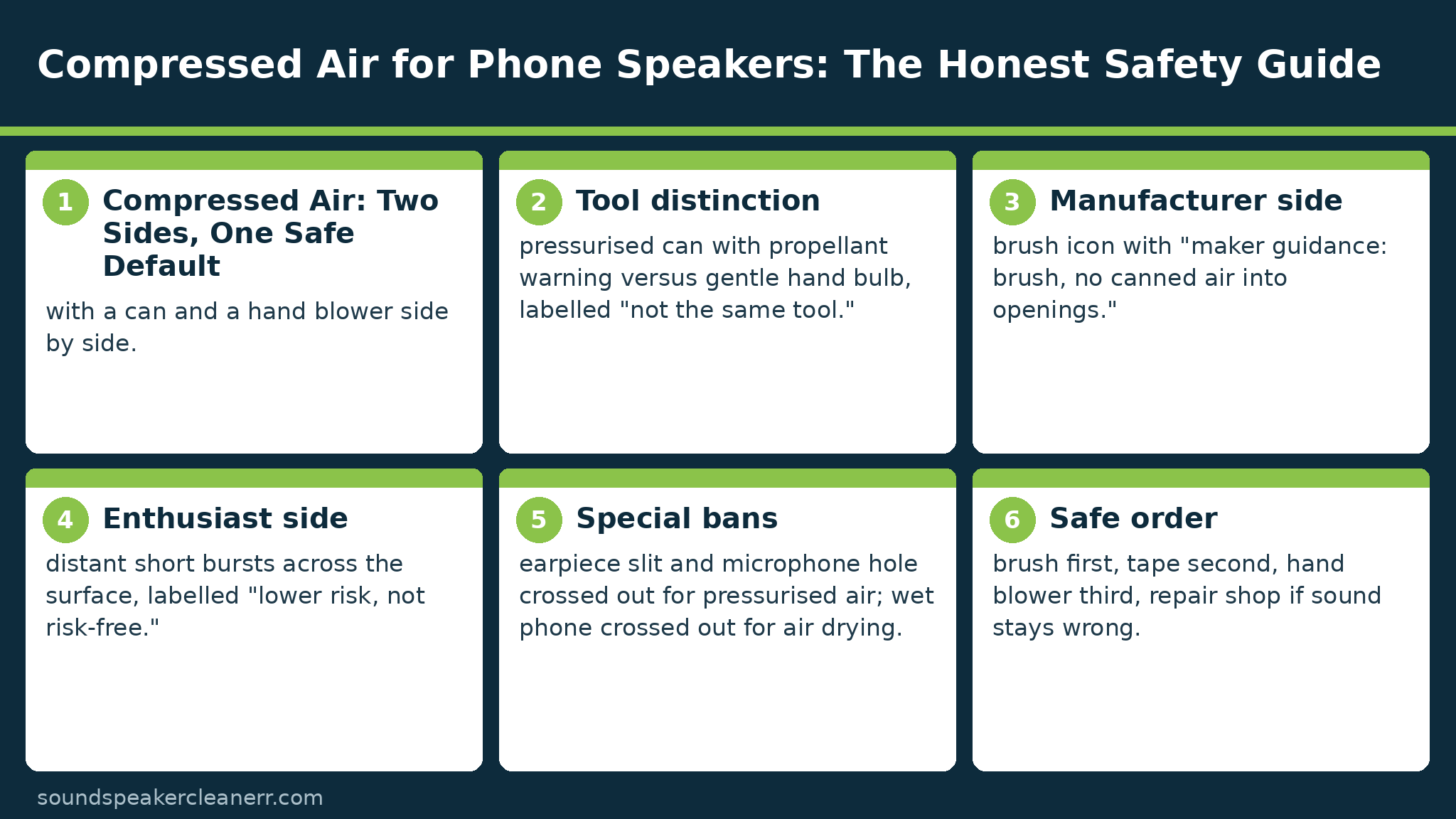
Manufacturers and enthusiast guides disagree about compressed air for phone speakers, so here is the honest position: Apple advises against it, enthusiasts argue careful distant use can work, and the safe default is to follow the manufacturer and not spray canned air into speaker openings. A soft brush, tape, and a hand-squeezed blower cover the dust that home cleaning can safely remove.
What "Compressed Air" Actually Means
The phrase "compressed air" covers more than one product, and that confusion fuels much of the disagreement. A can of compressed air, often called a spray duster, is a pressurised canister that releases a strong jet of gas. It is not simply air from a pump. Many cans contain a propellant, and if the can is tilted or shaken, liquid propellant can be discharged along with the gas.
A hand-squeezed air blower is a different tool. It is a rubber bulb you squeeze by hand, producing a much gentler puff of room air with no propellant and no high pressure. When guides say "air blowers are safe" while also saying "compressed air is not recommended," they are usually drawing exactly this distinction. Treating the two tools as the same thing is the first mistake to avoid.
There is also a difference between blowing across a surface and blowing into an opening. Air aimed across a grille can dislodge loose surface dust. Air aimed straight into a tiny hole concentrates force on the mesh and whatever sits behind it, and can drive dust and moisture deeper instead of out. Any discussion of compressed air that does not specify the tool, the distance, and the direction is incomplete.
The Manufacturer Position
Apple's cleaning guidance, as summarised consistently by third-party guides, advises against using compressed air on iPhone, along with avoiding cleaning products and moisture in openings, and recommends a small, soft-bristled brush that is clean and dry. The reasoning is straightforward: pressurised gas is forceful, it can push debris and moisture deeper into the phone, and it can damage delicate speaker and microphone parts.
That position is conservative by design. A manufacturer must give advice that is safe across millions of devices, many users, and many levels of care. A warning that assumes careful use by an expert would fail for the average user who sprays at close range, holds the can at an angle, or uses a long burst. The manufacturer warning therefore sets a simple, memorable rule: do not do it.
It is also worth noting that a manufacturer warning protects more than the speaker. The same openings that house speakers sit near microphones and, on some models, near seals that contribute to water resistance. A single rule covering all openings is easier to follow and harder to misapply than a set of exceptions for each opening type. If your phone maker gives similar guidance, that guidance should win over any general blog post, including this one, where the two conflict.
The Enthusiast Position
Enthusiast guides make a different argument, and it deserves a fair hearing rather than dismissal. Their claim is that compressed air is only dangerous when misused: sprayed from very close range, in a long continuous blast, straight into the opening, or with a tilted can that discharges liquid propellant. Used from a distance, in short bursts, aimed across the grille rather than into it, they argue, the force is low enough to dislodge loose dust without harming the speaker.
Some enthusiasts go further and report using compressed air routinely without apparent damage. That experience is real for those users, but it has limits as evidence. "No apparent damage" is not the same as "no damage." A slightly loosened mesh, a small amount of dust pushed deeper, or a microphone that degrades gradually may not be noticed immediately, and a single user's success does not establish safety for every phone model, canister type, or spraying technique.
The enthusiast position is also strongest for a narrow case: loose, dry, surface dust on a sturdy loudspeaker grille. It is weakest for the cases that matter most: fine earpiece mesh, microphone openings, wet or sticky debris, and phones that already sound distorted. In those cases, even careful compressed air adds risk without a clear benefit over a brush or blower.
Why the Two Sides Disagree
The disagreement is less about physics than about risk tolerance and audience. Manufacturers optimise for the worst case across a huge population. Enthusiasts optimise for the best case with a careful user and a specific technique. Both can be internally consistent, and both can be right about their own scenario, while giving opposite-sounding advice.
Another source of disagreement is the tool itself. A guide that says "compressed air is safe" may be thinking of a gentle hand blower, while a guide that says "never use compressed air" is thinking of a pressurised can. Readers who do not notice that distinction can follow the wrong advice for the tool they actually hold. That is why this guide names the tool every time: canned air versus hand blower are not interchangeable.
Finally, there is a survivorship effect in online advice. People whose phones survived compressed air are more likely to write about it than people whose phones were damaged and went to a repair shop instead of a comments section. The visible record therefore overstates success. Manufacturer guidance, by contrast, is informed by repair data that individual users never see.
The Safe Default This Guide Recommends
Given that disagreement, this guide follows manufacturer guidance as the safe default: do not spray canned compressed air into phone speaker openings. That rule is simple, it matches the most authoritative advice available for iPhone users, and it costs nothing, because safer alternatives cover the same dust.
The recommended home sequence starts with a soft, dry brush, used lightly across the grille with the phone held so loosened dust falls away. Next, low-adhesive tape looped sticky-side out around a finger, pressed lightly on the surface, lifts surface dust without airflow or propellant. For loose dust that remains, a hand-squeezed air blower used with short, gentle squeezes, aimed across the surface from a short distance, is the gentler air option.
If you have already used canned air and the phone sounds fine, there is no need to panic, but do not repeat it as a routine. Note it as a method to avoid in future, and if sound changes later, mention the canned-air use to a technician. If sound changed immediately after canned air, stop home cleaning and seek professional inspection rather than trying another air-based method to fix it.
Special Cases: Earpiece, Microphone, and Wet Phones
The earpiece deserves a stricter rule than the loudspeaker. Its slit is narrow, its mesh is fine, and it is close to the ear during calls. Do not aim any pressurised air at the earpiece, and do not treat a method that seems acceptable for a loudspeaker as acceptable for the earpiece. A light dry brush is the safer home method, and persistent earpiece problems need professional inspection.
Microphones are similarly sensitive. Their internal membranes respond to air pressure by design, which is exactly why a strong air jet is a risk. Never aim canned air, or any strong airflow, at a microphone opening. If a microphone sounds muffled after cleaning, that is a sign to stop and get help, not to blow harder.
Wet phones are a separate case entirely. Canned air should never be used to dry a wet speaker or to blow water out of openings. It can drive water deeper, spread it to parts that were dry, and discharge cold propellant onto wet electronics. Follow manufacturer guidance for wet devices: do not charge while wet, let the phone dry in open air, and avoid heat and forced-air shortcuts. Sound-based tools may help move loose water from a grille, but they do not repair damage or dry the inside of the phone.
How to Judge Advice You Read Online
When you encounter compressed-air advice online, check four things before following it. First, does it name the tool: canned air or hand blower? Second, does it specify distance, burst length, and direction? Third, does it distinguish the loudspeaker from the earpiece and microphone? Fourth, does it acknowledge the manufacturer position, or does it pretend the disagreement does not exist? Advice that fails those checks is not necessarily wrong, but it is incomplete, and incomplete advice is risky for a fragile part.
Be especially cautious of advice that promises a fast result, uses absolute language about safety, or treats one successful attempt as proof. Speaker cleaning is a low-stakes job when done gently and a potentially expensive one when done forcefully. The method that takes a few extra minutes with a brush is worth more than the method that saves a minute with a can.
Compressed air is not a mystery, and the disagreement about it is not a conspiracy. Manufacturers warn against it because pressurised gas can damage small, delicate parts and push debris deeper. Enthusiasts defend careful use because, in a narrow case with the right technique, it can dislodge loose dust. Both views contain truth, but only one makes a safe default for every reader. Follow the manufacturer, skip the can, and let a brush, tape, and a hand blower do the work that home cleaning can safely do.
FAQ
Does Apple advise against compressed air for iPhone speakers?
Yes, according to guidance summarised by multiple third-party sources. Apple recommends a small, soft-bristled brush that is clean and dry, and advises against compressed air, cleaning products, and moisture in openings.
Is a hand-squeezed air blower the same as compressed air?
No. A hand blower is a rubber bulb squeezed by hand, producing gentle room air with no propellant. Canned air is a pressurised canister with a much stronger jet and possible liquid propellant discharge.
Can I use canned air if I hold it far away and use short bursts?
Enthusiast guides argue that distant, short, across-the-surface bursts are lower risk, but this guide follows manufacturer guidance as the safe default: do not spray canned air into speaker openings. A brush and hand blower cover the same dust more safely.
Why do some guides say compressed air is safe?
They are usually describing careful use on loose surface dust, or they mean a hand blower rather than a can. They also reflect individual success stories, which do not capture cases where damage was gradual or unnoticed.
Can compressed air damage a microphone?
Yes. Microphone membranes are sensitive to air pressure, so strong airflow aimed at a microphone opening is a risk. Never aim canned air at a microphone hole.
Can I use compressed air to dry a wet phone speaker?
No. It can drive water deeper and discharge cold propellant onto wet electronics. Follow manufacturer guidance for wet devices and let the phone dry in open air.
What should I use instead of compressed air?
A soft dry brush first, low-adhesive tape for surface dust second, and a gentle hand-squeezed blower for loose dust. Test sound at moderate volume afterwards.
What if I already used canned air and the sound changed?
Stop home cleaning and seek professional inspection. Do not try another air-based method to fix it, and mention the canned-air use to the technician.
Leave a Reply